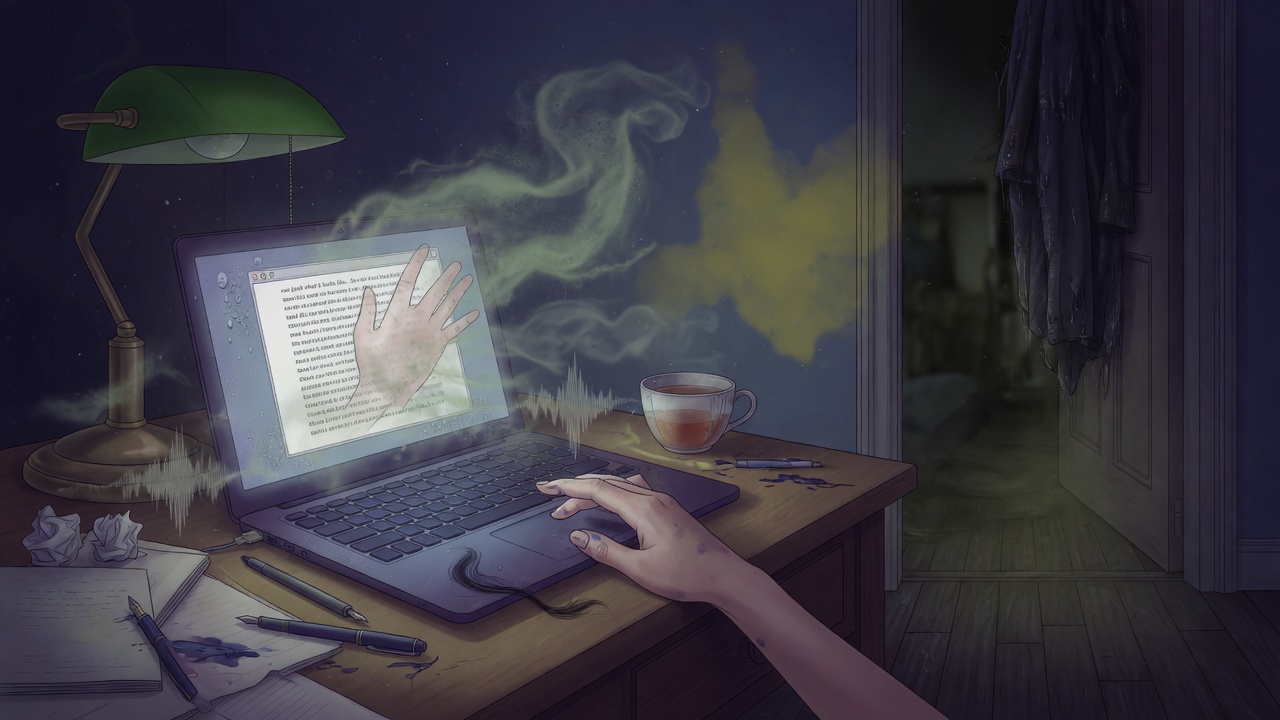
Why AI Defaults to Visual-Only Atmosphere (and Why That Kills Dread)
Ask any AI model to "write an atmospheric horror scene" and you'll get the same thing every time: grey skies, flickering lights, shadows pooling in corners, maybe a crow on a fence. It looks like atmosphere. It reads like a stage set. Nobody's pulse goes up.
The problem isn't that AI can't write sensory detail — it can. The problem is that without specific instruction, it defaults to visual description almost exclusively, because that's what decorative atmosphere looks like in the training data. Describing what a scene looks like is safe, legible, and completely inert when it comes to building genuine dread. Vision is the sense we trust most. It orients us. It reassures us we know what's there. Dread lives in the gap between what you can see and what you can't.
The other senses — smell, sound, touch, taste, proprioception — work on readers through the body before the brain catches up. A smell triggers memory before you've named it. A sound just below the threshold of identification keeps the nervous system scanning. A texture that's slightly wrong activates disgust without giving the reader anything to rationally dismiss. These are the senses that build tension, and they're the ones AI skips unless you force the issue.
If you're trying to write a book with AI in the horror or thriller space, or any genre where unease is a structural tool — dark fantasy, gothic romance, psychological suspense — you need to know how to prompt for sensory depth that works mechanically, not just aesthetically. This guide is about exactly that.
Decorative atmosphere tells readers it's scary. Physically-grounded sensory detail makes their bodies decide it's scary before their minds do.
The Sensory Hierarchy: Which Senses Signal Danger to Readers
Not all senses are equal when it comes to threat. Understanding the hierarchy helps you decide which sense to lead with in a given moment — and which ones to layer underneath.
Sound: The Early Warning System
Sound is the fastest threat-detection channel we have. Evolutionarily, you heard the predator before you saw it. A sound that can't be identified — a creak that happens once and doesn't repeat, a voice that might be a voice — keeps the threat ambiguous, which is far worse than seeing it clearly. AI is decent at writing sound, but it tends to write identifiable sounds. Your job is to prompt for sounds at the edge of categorization: not a footstep, but something that might be a footstep.
Smell: The Memory Hijacker
Smell bypasses the thalamus and hits the limbic system directly. That's not just interesting neuroscience — it's a fiction mechanic. A smell can surface a memory before a character has decided to remember anything, which means it's a perfect vehicle for trauma, recognition, and the dawning of terrible understanding. The smell of copper means blood. The smell of a specific perfume means someone who shouldn't be here. AI tends to use smell decoratively ("the air smelled of rot"). Prompt it to connect smell to something the character already knows and fears.
Touch and Proprioception: The Wrong-Body Feeling
Touch is the most intimate sense, and wrongness in touch — a surface that's warm when it should be cold, a grip that's too strong, a texture that shifts — triggers deep disgust and violation. Proprioception (the body's sense of its own position) gives you even more: vertigo, the feeling of being watched from the wrong direction, the subtle wrongness of a room that seems to have changed its dimensions while you weren't looking. These are underused in AI output almost entirely.
Taste: Rare, But Devastating
Taste is hard to work in unless your character is eating, drinking, or bleeding. But when it fits, it's visceral in a way nothing else is. The metallic taste of adrenaline. The specific taste of air before a lightning strike. Use it sparingly, and AI needs explicit prompting to include it at all.
Before you prompt for any of this, it helps to run your draft through the Sensory Detail Scanner — it'll show you exactly which senses your scene is currently leaning on and where the gaps are. If you're in revision mode, the broader Five-Pass Revision Order for AI-Assisted Novels has a dedicated pass for sensory grounding that fits neatly into this kind of work.
Prompting AI to Assign Threat to Specific Physical Sensations
The key shift in thinking here is this: stop asking AI to describe the atmosphere, and start asking it to assign threat meaning to individual physical sensations. These are completely different instructions that produce completely different output.
"Describe the atmosphere of an abandoned hospital" produces grey walls and the smell of disinfectant and you've read it a hundred times before. But "describe how a character's body registers danger in an abandoned hospital — focus on what their skin, ears, and stomach are telling them before they've consciously identified a threat" produces something that actually works.
The prompting principle is: ground the sensation in the character's body first, then connect it to the threat's specific nature. A ghost story has different sensory signatures than a home invasion thriller. The cold that doesn't track with the room's temperature means something different than the warmth that does. Tell the AI what kind of threat it's working with, and tell it to express that threat through what the character's nervous system registers — not through what the character sees.
Here's a prompt that does this well:
Write a 200-word scene where Elena enters a room in which someone has recently died violently. Do not describe any visual evidence of violence. Instead, write only what her body registers: the specific texture of the air on her skin, any sound or the wrong kind of silence, smell, and any involuntary physical response (nausea, goosebumps, the urge to back up without knowing why). She should not consciously understand what she's sensing yet. Write in close third person, past tense.Why this works: it eliminates the visual escape hatch, forces sensation-first description, and specifies that the character doesn't have cognitive access to the meaning yet — which is where dread lives, in the gap between sensation and understanding. Tweak the "recently died violently" to match your actual threat, and adjust the POV to match your manuscript.
You can also prompt AI to invert a normally safe sensation. Safety associations are deep — warmth means comfort, softness means safety, the smell of food means nurturing. Horror writers know that inverting these associations is more disturbing than simply adding unpleasant stimuli.
Rewrite the following passage so that every sensation Elena notices is one that should feel safe but doesn't. The warmth of the room should feel wrong rather than comforting. Any soft textures should suggest something she doesn't want to touch. Any familiar smell should register as an intrusion rather than a comfort. Keep the same scene structure, just shift the sensory valence. Here is the passage: [paste your passage]This is particularly useful if you're doing a revision pass. You can use it alongside how to edit a book with AI techniques to systematically target sensory layers without rewriting from scratch.
Stacking Sensory Callbacks Across a Scene for Cumulative Unease
One sensory detail, however good, is an incident. What builds dread is accumulation — the same sensation returning in slightly altered form, each repetition harder to dismiss than the last.
Think about how Shirley Jackson does this in The Haunting of Hill House. The cold spot in the hallway. It appears once, seems explicable, and Eleanor almost forgets it. Then it's there again, in a different place. Then it's everywhere she goes, and by then the reader's nervous system has built a pattern it can't unlearn. Jackson never over-explains it. The sensation does the work.
AI won't do this automatically. It writes scenes, not accumulations — unless you prompt for callbacks explicitly. The way to do this is to treat your sensory details like motifs, and instruct the AI to return to them.
I'm writing a horror scene that takes place over three distinct beats: (1) Maya enters the house, (2) Maya searches the upstairs rooms, (3) Maya finds the locked door. Across all three beats, I want the same sensory detail — the smell of turned earth, like a freshly dug grave — to appear three times. In beat one, it should be faint and almost explicable. In beat two, it should be stronger and she should try to rationalize it. In beat three, it should be unmistakable and she should stop trying to rationalize it. Write all three beats at approximately 150 words each. Do not use the phrase "smell of turned earth" more than once — find a different sensory description each time that conveys the same stimulus with increasing intensity.That last instruction — "find a different sensory description each time" — is critical. If the AI uses the exact same phrase three times, readers notice the repetition as a writing tic rather than a thematic return. You want the sensation to recur, not the sentence.
You can extend this technique to span entire chapters. If you're working on a longer project and using a story bible that AI models actually follow, consider adding a "sensory motif" section. List the specific sensations that are tied to your threat — what your monster smells like, what its presence does to the air, what physical wrongness it leaves behind — and reference that section in your prompts. The AI can then maintain consistency across scenes that are drafted days apart.
The Show Don't Tell Hints tool is also useful here: if your sensory callbacks are starting to feel over-explained, run the relevant paragraphs through it to see where the prose is tipping into telling the reader how to feel rather than letting the accumulated sensation do that work.
Prompt Templates: Four Ways to Build Dread Through the Body
These are practical starting points. Each one targets a different stage of dread — anticipation, wrongness, recognition, and aftermath. Use them as-is or adapt them to your scene's specifics. None of them will produce perfect copy on the first pass, but they'll get you material that's working at the right sensory level, which is far easier to revise than visually-dominated atmosphere that needs to be rebuilt from the ground up.
If you want to understand which AI model handles these kinds of nuanced craft prompts best before you invest time in a long project, it's worth checking out the comparison at best AI models for writing — the differences in how models handle close, embodied prose are significant.
Template 1: Anticipation (Before the Threat Appears)
Write a 250-word passage in which [character name] is waiting in [location]. The threat — [describe your specific threat, e.g., "a man who has been following her for three days"] — has not yet appeared. Write only what her body is doing: her breathing, the way her weight is distributed, what her hands are doing, whether her hearing has sharpened or narrowed. Do not name the threat. Do not have her think about the threat in abstract terms. Only her body is allowed to know something is wrong. Close third person, present tense.The present tense instruction is deliberate — it puts readers inside the waiting rather than letting them observe it from a comfortable past-tense distance. Switch back to your manuscript's native tense for the final draft, but drafting in present tense often produces more physically immediate prose that's worth the extra edit step.
Template 2: The Wrongness (Something Is Off But Inexplicable)
Write a scene where [character] enters [location] and everything appears visually normal, but something is wrong. Identify the wrongness through exactly three non-visual senses. Choose sensations that are specific and physical — not "the air felt heavy" but something the character could put their hand on if pressed. The character should try to explain each sensation to themselves and fail. Each failed explanation should make them slightly more afraid, not less. Do not resolve the wrongness in this scene. 300 words maximum.Template 3: Recognition (The Body Understands Before the Mind Does)
This template is for the moment just before a reveal — the half-second where the character's body has already understood what they're looking at, but conscious comprehension is a beat behind.
Write the moment [character] realizes [the specific thing they're about to understand — e.g., "that the person in the chair is not breathing"]. Do not write the moment of visual confirmation. Write the two or three seconds before it: what their body does, what their senses do, the specific physical sensation of dread arriving. Then cut. End the scene before the character has consciously processed what they've seen. Write in extremely close third person — stay inside the skin. 150 words maximum. No filtering phrases like "she felt" or "she noticed" — just the sensation itself.That last instruction about filtering phrases is important. "She felt her stomach drop" is a filter — it puts a layer of cognitive processing between the sensation and the reader. "Her stomach dropped" puts the reader in the body directly. The Sentence Rhythm Report can also flag whether your short, punchy fear-beats are getting lost inside longer, more measured sentence structures.
Template 4: Aftermath (What the Body Carries Out of the Scene)
Dread that ends when a scene ends isn't dread — it's a scare. Real cumulative unease follows the character into the next scene, carried in the body.
Write a 200-word passage where [character] is doing something completely mundane — making tea, driving, folding laundry — three hours after [the frightening event]. Do not have them think about the event directly. Show only what their body is still doing: is their jaw tight, are they standing differently, do they startle at sounds that wouldn't have startled them before? Find one specific sensory detail from the earlier scene that is echoing in their body now — not as a flashback or memory, but as a physical residue. Write it so the reader recognizes the callback even if the character doesn't name it.This is the technique that makes readers feel like something is accumulating across a book rather than across a scene. If you're working at novel scale and want to understand how that kind of structural tension fits into a broader craft framework, the Opening Hooks for AI Drafts: Fix the First Page Fast guide covers a related principle: grounding readers in the body from the first paragraph so that later sensory callbacks land in prepared soil.
The through-line of everything in this guide is the same: AI needs you to close the visual escape hatch before it will go looking for the senses that actually build dread. The moment you remove "describe what it looks like" from your prompt, and replace it with "describe what the body registers," the output shifts into territory that can genuinely unsettle a reader.
Your immediate next step: take the scene you're most disappointed with right now — the one that feels atmospheric on paper but flat on a second read — and run it through the Sensory Detail Scanner. Find the dominant sense. Then use Template 2 above to draft a replacement version with that sense deliberately removed, and watch what the prose has to reach for instead.