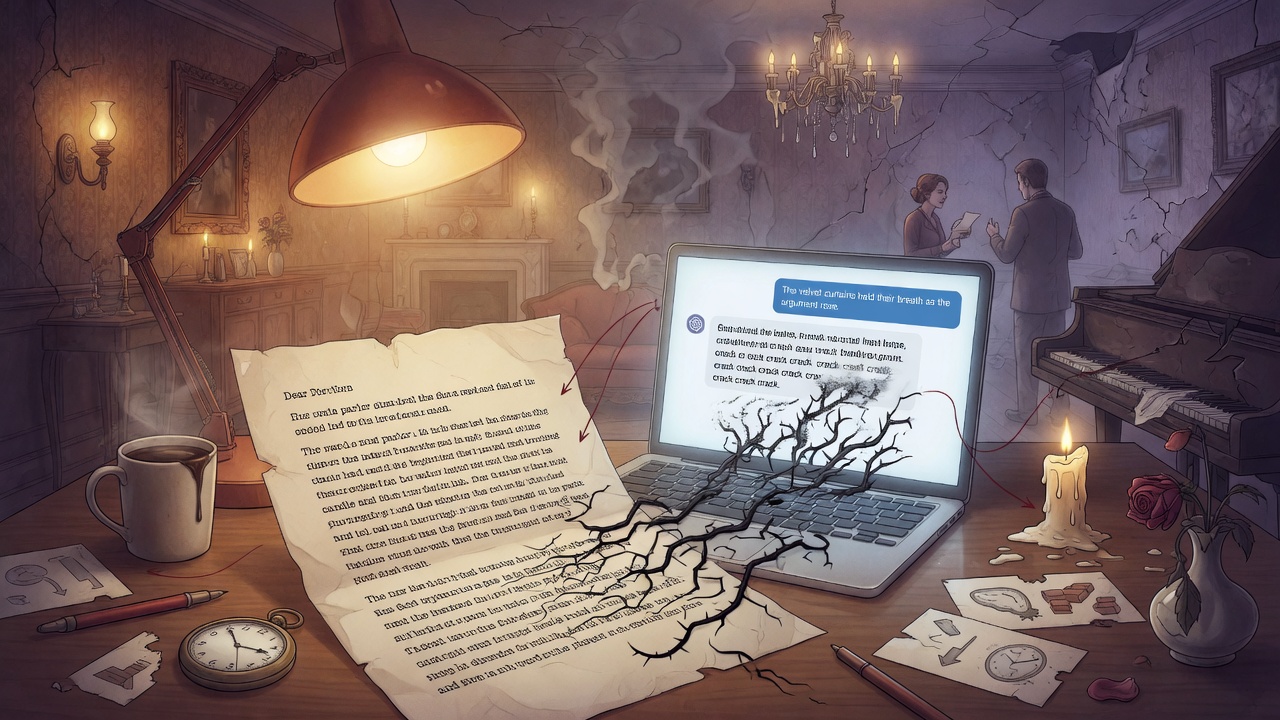
There's a specific kind of scene that separates good thrillers from great ones — the kind where you feel the walls literally closing in, where the rain gets harder as the argument escalates, where the fluorescent light starts flickering right when the protagonist realizes they've been lied to. Setting and stakes decaying in parallel. The environment becoming a second narrator.
AI can write this. But it almost never does on its own, and understanding why is the first step to fixing it.
Why AI Defaults to Static Environments (And Why That Kills Tension)
Give an AI a scene prompt and it will usually establish the setting in the first paragraph — the cracked leather booth, the smell of diesel, the overcast sky — and then more or less leave it alone. Characters move through the space. Dialogue happens. Emotions are described. But the environment? It just sits there, wallpaper.
This isn't laziness. It's how AI learned to write from the vast majority of published fiction, which itself often falls into this trap. Setting gets introduced, then forgotten. The AI is mirroring a common structural habit: describe the world, then get on with the plot.
The problem is that static environments are tension killers. Tension requires the sense that things are getting worse — that the protagonist has fewer options now than they did a page ago, that the world is actively conspiring against them. When your setting just sits there, unchanged, it's communicating stability. Safety. That nothing is fundamentally at stake.
The environment should be a clock. Every deterioration in the world around your character should register as a countdown. Readers feel this before they consciously notice it.
I've found that AI generates these static environments for another reason too: it's trying to be coherent. It tracks what it established and doesn't want to contradict itself. If it said the sky was overcast at the start, it's reluctant to suddenly describe a downpour unless you explicitly give it permission — or better yet, a system for how that change should happen and why.
That system is what the rest of this guide is about.
The Deterioration Ladder: Mapping Scene Decay Before You Prompt
Before you write a single prompt, you need to do five minutes of planning. This is non-negotiable. If you throw an AI into a deteriorating scene without a map, it'll either keep the environment static (old habit) or overcorrect and write apocalyptic prose that feels melodramatic by the third paragraph.
The Deterioration Ladder is simple: you define three or four stages of environmental and emotional decay that should happen in rough parallel throughout the scene. You're not writing the scene yet. You're just identifying what worsens, and when.
Here's what it looks like in practice. Say your scene is a confrontation between two business partners — one of whom is about to accuse the other of embezzlement — in a high-rise office at dusk.
Stage 1 (Scene opens, tension is latent): The office is lit warmly, the city visible through floor-to-ceiling windows. Emotionally, your POV character is tightly controlled, rehearsed. Physically, she's seated. Environment is almost comfortable — which makes it dangerous.
Stage 2 (First crack appears): Her partner's answers don't line up. She notices the sun is dropping faster than she expected, the room going slightly amber. She stands up. The city below starts to blur in heat haze.
Stage 3 (Active confrontation): She shows him the documents. The office lights flicker on automatically as the room darkens — but one panel stutters. The hum of air conditioning becomes noticeable. She's pacing now. Her voice is harder to control than she planned.
Stage 4 (Collapse): He's admitted enough. The full dark has come. The city lights below look cold, indifferent. She realizes she has no idea what she does now — she thought she'd feel righteous, but she just feels hollowed out. The office feels too large and too still.
Four stages. Emotional state and physical environment decaying in lockstep. Now you have something to give the AI.
Prompting AI to Synchronize Environmental and Emotional Collapse
The key technique here is what I call parallel-track prompting. Instead of asking the AI to write a scene and hoping it manages tension well, you explicitly tell it that two things must evolve simultaneously: the environment and the character's internal state. You give it both tracks, and you give it permission to let things get worse.
A few principles that make this work:
- Name the correlation explicitly. Tell the AI that as the emotional situation degrades, specific physical elements should reflect this — not symbolically in a heavy-handed way, but naturalistically. The light changes because it's actually getting dark, but you want the AI to use that darkness.
- Give it sensory details to worsen. Don't say "the environment deteriorates." Say "the fluorescent light has been flickering slightly since the scene opened — by the end, it should be distracting, an intrusion." Specificity tells the AI what to degrade.
- Specify POV filter. The environment doesn't change in objective reality — it changes in how the POV character perceives and narrates it. A flickering light means nothing to someone in a good mood; to someone unraveling, it's unbearable. Tell the AI whose perception is warping.
- Ask for restraint early, weight late. The first stage of deterioration should be subtle. If you let the AI go full throttle from paragraph one, you blow your escalation. Prompt for suggestion at the start, full presence at the end.
You'll also want to tell the AI explicitly not to use the deterioration as metaphor-hammering. The flickering light shouldn't be compared to the protagonist's flickering hope. The rain shouldn't be said to mirror her tears. These correlations should be structural — felt by the reader — not stated by the prose.
Four Prompt Examples: From Slow Leak to Full Breakdown
These are real prompts you can copy and adapt. Each one targets a different type of scene deterioration.
Prompt 1: The Slow Leak (domestic tension, long fuse)
Write a scene in close third-person POV from Miriam's perspective. She's cooking dinner for her husband Daniel, who is late — again — and hasn't texted. The scene should span about 20 minutes of story time and end when she hears his key in the lock.

Here's the deterioration I want tracked across the scene:

EMOTIONAL: Miriam starts in a state of practiced patience — she's told herself this is fine. By mid-scene she's moved to a flat, deliberate silence in her own head. By the end, she's realized she isn't angry. She's past angry. She doesn't know what she is.

ENVIRONMENTAL: The kitchen starts warm and smells of garlic and browning butter. As the scene progresses, the food slightly overcooks — not ruined yet, but past its peak. The kitchen light above the stove buzzes faintly; by the third act of the scene this sound should be registering to her. The window above the sink is dark by the end. A pot has gone cold.

Do not state the correlation between her emotional state and the environment. Do not use the word "hollow" or "numb." Let the physical details do that work. Keep the prose restrained — this is domestic realism, not gothic fiction.
Why it works: you've given the AI two explicit timelines and told it where they end up. The prohibition on "hollow" and "numb" stops the AI from reaching for its favorite emotional shorthand. The instruction to keep it domestic realism sets the register so it doesn't over-dramatize.
Prompt 2: The Pressure Chamber (confined space, escalating stakes)
Write a tense dialogue scene between two characters: Yusuf, a defense attorney, and his client Marcus, who has just told him something that changes everything about the case — something Yusuf suspects is a lie.

Setting: A small private room in the county jail. Fluorescent lighting. A metal table. One air vent that runs constantly.

Track this deterioration across the scene:

EMOTIONAL (Yusuf's POV): He begins with professional composure — he's heard bad things before. Then comes a careful, almost clinical probing as he tries to find the lie. Then the moment he's certain Marcus is lying. Then the quiet, terrible calculation of what this means for him professionally and morally.

ENVIRONMENTAL: The room starts as background — institutional, unremarkable. By the midpoint, Yusuf notices the fluorescent light is slightly too bright, slightly blue. The vent becomes audible. By the scene's final exchange, the room should feel smaller — not described as smaller, but written so the reader feels it. The metal table should be present in his awareness by the end.

Important: Marcus does not crack. Do not resolve the tension. End the scene with Yusuf still in the room, Marcus having just said something that closes a door.
The "does not crack" instruction is crucial — it stops the AI from writing toward resolution, which is its default instinct. The note about the room feeling smaller "without being described as smaller" forces the AI to use indirect technique.
Prompt 3: The Collapse Point (acute crisis, compressed time)
Write a scene in first-person present tense. The narrator, a woman named Soo-Yeon, is sitting in a hospital waiting room after being told to wait for news about her father. The scene covers approximately 40 minutes of waiting. No other named characters interact with her directly.

EMOTIONAL DETERIORATION: She starts in functional shock — moving through it, handling it. Then the waiting starts to work on her. Then she begins bargaining in her own head — bargaining with nobody, which she recognizes as strange while she's doing it. By the end, she is very still. Her thoughts have gone quiet in a way that frightens her.

ENVIRONMENTAL DETERIORATION: The waiting room is bright and too warm. Over the course of the scene, a TV in the corner cycling through news should become harder to ignore — not louder, just harder to tune out. A child at the other end of the room is drawing. A cup of coffee she got at some point goes cold without her noticing when. The light from the window changes from afternoon to something later. By the end, someone else in the room has left and she doesn't know when that happened either.

The environmental details should feel noticed by her in passing — not observed with writerly attention but with the fractured attention of someone in crisis. She isn't cataloguing; she's barely registering.
That last instruction — "barely registering" — does a lot of work. It tells the AI how to handle the POV filter, so the environmental details don't become too polished or too present. In a crisis scene, over-observed detail feels wrong. The character's noticing should be fractured.
Prompt 4: The Long Goodbye (grief, slow burn)
Write a scene from tight third-person POV following Desmond, who is spending one last afternoon in his childhood home before it's sold. He has until 5 PM, when the realtor arrives. It is currently just after 2 PM.

EMOTIONAL: Desmond starts by being efficient about it — he's said his goodbyes, he thought. But the house keeps demanding more from him. He moves from room to room. Each room costs him something different. By the end, he's sitting in the empty kitchen and he doesn't want the realtor to come because he still doesn't know how to finish this.

ENVIRONMENTAL: This is a reverse deterioration — the house is already diminished (empty, cleared out, staged for sale). What worsens is the light. Start with flat afternoon light, neutral, manageable. As the afternoon moves toward 4 PM, have the light change quality — late afternoon light has weight and gold in it, and this house full of that specific light is harder to be in than the flat midday version was. By the time he's in the kitchen, the light should be doing something to him that the empty rooms couldn't.

Do not describe the light as beautiful. Do not have him cry. Show what the light lands on in each room.
This one flips the model — the environment is already deteriorated, so you're using light quality as the escalating element. "Do not describe the light as beautiful" stops the AI from romanticizing it, which is a constant risk with late-afternoon-light prose.
Editing AI Deterioration Drafts: Cutting Overstatement, Keeping Dread
Even with careful prompts, AI drafts of deteriorating scenes tend to have two consistent problems. Learning to spot them makes editing much faster.
Problem one: the correlation gets stated. The AI will write something like: "The flickering light seemed to match her own sense of instability" or "The darkening room felt like a physical manifestation of her despair." Cut these every time. The entire point of parallel-track deterioration is that the reader makes the connection unconsciously. Once you say it out loud, the effect collapses. The reader feels managed rather than moved.
Problem two: the deterioration is front-loaded. AI often delivers all the good atmospheric detail in the first third and then runs dry. You'll get a vivid, specific opening — the buzz of the fluorescent, the cold table, the child drawing — and then a middle section where the characters are just talking in a room. When this happens, redistribute. Move the second or third environmental detail later into the scene. Hold back.
There's a third, subtler problem: the environmental details become too writerly. The AI gives you lovely, precise observations when what you want is fractured, interrupted noticing. In high-stress scenes especially, characters don't observe their environments the way a calm narrator does. They catch things sideways. A quick pass through the draft asking "would she actually notice this right now, the way it's written?" will catch the worst of these moments.
What you want to keep — and sometimes have to protect from your own editing instinct — is the structural dread. The sense that things have fewer exits than they did before. When a line earns that feeling without announcing it, leave it alone. Even if it's a little rough. Especially if it's a little rough.
Polish can kill dread. A scene that's deteriorating shouldn't feel too controlled at the sentence level. Some roughness is the point.
One practical approach: after your editing pass, read the scene's environmental beats in isolation — just pull out every physical detail and read them in sequence. They should tell a coherent story of worsening on their own. If they don't — if the sequence is random, if the final image isn't heavier than the first — that's where to focus your rewrite.
Take your last completed scene and build a Deterioration Ladder for it retroactively — write out what the environment does at each emotional stage. If the ladder is flat, you've found your revision target. Then reprompt that scene with the ladder built in, and compare the two drafts side by side. The gap between them will show you exactly what parallel-track deterioration adds, and you won't be able to write a static environment again.