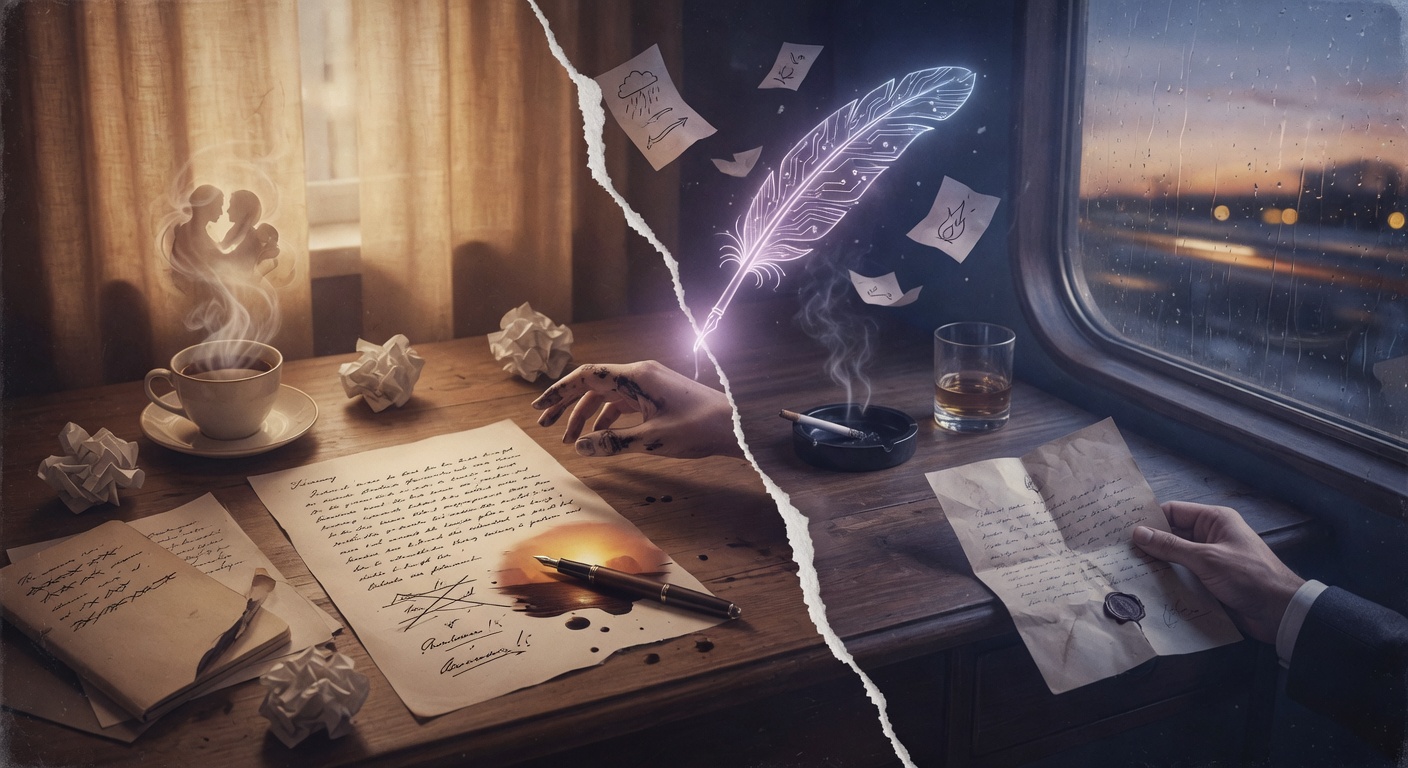
Scene transitions are where most writers sleepwalk. You've just written a devastating argument between two characters, and then you type "The next morning..." and move on. The story continues. Nobody dies. But something quiet and important just got thrown away.
The emotional residue of one scene — the tension, the grief, the dark humor — doesn't have to evaporate when you cut away. A well-crafted transition can carry that feeling forward, invert it deliberately, or use the white space between scenes as a kind of pressure chamber that builds dread or anticipation before the reader even hits the first sentence of the next chapter. AI can do this. Most writers don't ask it to.
Why Most Scene Transitions Are Missed Craft Opportunities
Here's the thing about transitions: they're structurally invisible. Readers don't consciously notice them the way they notice a great line of dialogue or a vivid piece of description. But they feel them. A clumsy transition creates a subtle emotional mismatch — the reader arrives at the new scene still vibrating at the wrong frequency. They're sad when they should be uneasy. Relieved when the story wants them wary.
Writers tend to treat transitions as connective tissue — functional, neutral, forgettable. Just get us from here to there. But the best transitions in fiction aren't neutral. Think of how Cormac McCarthy ends a scene on a single sensory detail that makes the next scene's silence feel enormous. Or how in crime fiction, a chapter might end mid-thought and resume in a completely different location, using the gap itself to create paranoia.
A transition isn't just a jump cut. It's the last thing the reader feels before the darkness, and the first thing they feel when the lights come back on.
The reason AI is actually well-suited to this task is that transitions require holding two scenes in mind simultaneously — the emotional temperature you're leaving and the emotional temperature you're entering — and threading something between them. That's a synthesis problem. It's something language models handle naturally when you give them the right inputs.
The Four Mood-Shift Mechanics AI Can Execute on Demand
Before you start prompting, it helps to know what you're asking for. There are roughly four techniques that transition writing uses to reshape mood, and once you can name them, you can ask for them explicitly.
1. The Tonal Echo
This is when the transition carries the same emotional note but shifts its context. If a scene ends in bitter laughter, the next scene opens in a situation that should be ordinary — but the bitterness bleeds through. The reader feels it without being told. The mood travels.
2. The Controlled Inversion
Deliberately switching registers. You end a scene in warmth and intimacy, and the transition actively signals to the reader: that's over now. The cut itself does the work. This is common in thrillers and tragedies. The reader knows something terrible is coming precisely because the story just gave them something soft.
3. The Pressure-Build
The transition doesn't resolve — it tightens. The ending of one scene raises a question or a threat, and instead of answering it immediately, the transition holds the reader in suspense. The white space becomes anxiety. The new scene arrives and the reader is already leaning forward.
4. The Tonal Smash-Cut
Used in darkly comedic or satirical fiction, this is the jarring juxtaposition — a scene of genuine grief cut directly to something mundane and almost absurd. The shock itself produces meaning. Used carefully, it can be devastating. Used clumsily, it just seems careless.
When you prompt AI, name the mechanic you want. "Write a transition that builds pressure" is a directive the model can execute. "Write a transition" is not.
Prompting AI to Match Transition Style to Genre Expectations
Genre isn't just plot conventions — it's an emotional contract with the reader. Literary fiction readers expect to sit with ambiguity between scenes. Thriller readers expect momentum. Romance readers expect a certain quality of longing in the white space. If your transitions fight against genre expectations, readers feel disoriented without knowing why.
This means your prompts need to include genre context, not just scene content. A horror transition that ends on a sensory detail — the smell of something wrong — works completely differently from a literary fiction transition that uses the same sensory detail to create melancholy. Same technique, different register.
A few genre-specific patterns worth knowing:
- Literary fiction: Transitions often use objects, light, or physical sensation to carry psychological weight. The scene doesn't "end" — it dissolves into the next one.
- Thriller/crime: Transitions tend to be short and clipped. The cut itself creates urgency. A chapter might end on a single sentence that doesn't resolve.
- Horror: The transition is where dread lives. The reader should feel something shift in the quiet between scenes — a wrongness they can't quite name.
- Romance: Transitions often hold the emotional moment a beat longer before moving on. The reader wants to linger. Let them, then pull them forward.
- Fantasy/epic: Scene transitions often have to carry enormous tonal range — from intimate character moments to world-scale events. The challenge is keeping the human feeling even when the scope expands.
Tell the AI which genre you're writing in, what the emotional temperature is at the end of your current scene, what the emotional temperature needs to be at the start of the next, and whether the transition should feel abrupt or gradual. That's the full spec. Everything else is craft execution.
Four Prompt Examples with Before-and-After Scene Bridges
These are prompts structured around real fiction scenarios. Take them, break them apart, and rebuild them for your own manuscript.
Prompt 1: Tonal Echo — grief that travels into the mundane
I'm writing literary fiction. My current scene ends with a woman scattering her mother's ashes at the edge of a field at dusk. The moment is quiet and dry-eyed — she's past the crying. The next scene needs to show her back at her mother's house, going through kitchen drawers looking for the car insurance documents. Write a 3-5 sentence scene transition that carries the weight of the first scene into the second without being sentimental. I don't want the character to reflect on grief — I want the grief to be present in how the ordinary world feels slightly wrong. Use a physical or sensory detail to carry the mood across.
This works because it gives the AI the full emotional context on both ends, specifies the technique (sensory/physical rather than reflective), and gives a hard constraint against sentimentality. Tweak the sensory instruction depending on your prose style — "sparse and close-observed" versus "lyrical and slightly distanced" will produce very different results.
Prompt 2: Controlled Inversion — warmth cut to threat
I'm writing a psychological thriller. Scene A ends with my protagonist and her sister laughing together over old photographs — it's the warmest moment in the book so far, and I need readers to feel that warmth completely before I cut away. Scene B opens with the protagonist arriving home to find her front door ajar. Write two versions of the transition: one where the cut is abrupt and the warmth makes the threat feel more violent, and one where a single transitional sentence does the work of shifting the reader's emotional state from safety to unease. Third person past tense, present-tense close narration style.
Asking for two versions is a strong habit. You almost always want to see the abrupt version and the bridged version side by side — it shows you the full range and helps you feel which one your story actually needs in this moment.
Prompt 3: Pressure-Build — holding the reader in suspense between scenes
I'm writing a horror novel. My chapter ends with my character finding a voicemail from a number she doesn't recognize — she hasn't listened to it yet. The next chapter begins three hours later, and she's sitting in her car outside her house, unable to go in. I want the white space between these scenes to feel like held breath. Write a chapter-ending paragraph (3-4 sentences) that closes on the unlistened voicemail in a way that maximizes dread without revealing anything. Then write the opening paragraph of the next chapter that drops the reader into the car scene with the sense that something has already happened in the gap. The reader should feel the missing three hours as an absence, not a time-skip.
The phrase "feel the missing time as an absence, not a time-skip" is the kind of specific craft direction that changes what the AI produces. Generic instruction gives you competent prose. Precise craft language gives you something that actually does what you need.
Prompt 4: Tonal Smash-Cut — dark comedy across grief
I'm writing dark comedy fiction in the style of early Evelyn Waugh — satirical, slightly cold, very precise. My scene ends with a minor character's sudden death — treated with complete seriousness and genuine pathos, which is unusual for the tone of the book. The next scene needs to return to the comedy register: the protagonist is dealing with the bureaucratic nightmare of canceling the dead man's magazine subscriptions. Write a single transitional sentence — just one — that closes the gap between these two scenes in a way that makes the tonal shift feel intentional and darkly funny rather than dismissive of the death. Then write two alternative versions so I can see the range.
Single-sentence transition prompts are underused. Sometimes the entire transition needs to happen in one line — particularly in satirical or dark comedic fiction where the form itself is part of the joke. Asking for three versions of a single sentence gives you real options without overwhelming you with material.
Building a Personal Transition Library from AI Drafts
Here's the thing most writers miss: the goal isn't just to get a transition for your current scene. It's to develop your own intuition about how transitions work by generating dozens of them, studying what the AI does well, and stealing the techniques for your own prose.
Every time AI produces a transition that genuinely works, ask yourself what it did. Was it the choice of sensory detail? The length of the sentences? The way it held back explicit emotion and let the physical world carry the weight? Write that down. Not the prose itself — the technique. You're building a personal vocabulary of what works in your specific genre, for your specific narrative voice.
A practical system for this: keep a document called something like "Transition Moves" and log three things for every AI-generated transition you find useful — what mood it was transitioning FROM, what mood it was transitioning TO, and the specific technique it used to do it. After thirty entries, you'll start seeing patterns. You'll notice that in your horror novel, pressure-builds almost always work better than tonal echoes. Or that your literary fiction voice naturally favors object-based transitions over light-based ones.
The AI isn't writing your book. It's showing you options at a speed that lets you develop taste faster than writing alone ever could.
You can also use the library to spot where you're defaulting. If every transition in your log uses a character's internal thought to shift mood, that's a habit — not a choice. Deliberately prompt for transitions that use external detail only, or that rely entirely on sentence rhythm, and see what breaks open.
One more thing worth doing: take a transition you generated with AI that you really like, delete it, and rewrite it yourself from memory. Not transcription — reconstruction from the emotional effect it had on you. That act of rebuilding is where the technique actually becomes yours. The AI draft is the model. Your reconstruction is the practice.
Start with your next scene break. Find the one where you wrote "Later that day" or "The following morning" and just moved on. Look at the emotional temperature you left behind and the emotional temperature you entered. Open a prompt, name the mood-shift mechanic you actually need, give the AI both ends of the bridge, and ask for three versions. One of them will do something you wouldn't have done yourself. Study it. Take it apart. Then write the transition that your story deserves.