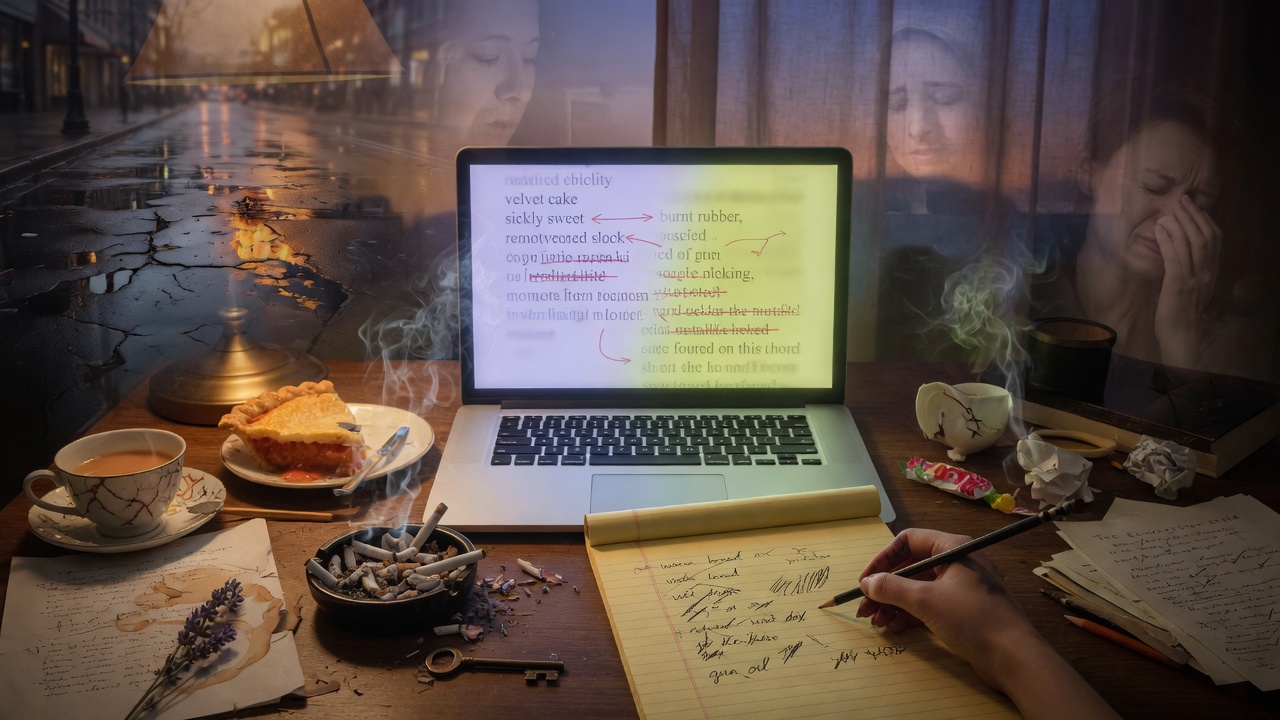
Most sensory writing in fiction fails before the scene even starts. Not because the writer lacks skill, but because the default approach — sight, sound, smell, taste, touch, check — produces something closer to an inventory than a moment. You've read it. The room smelled of lavender and old wood. Sunlight fell across the floor. Somewhere a clock ticked. It's competent. It's also completely inert.
AI, if you just ask it to "add sensory detail," will do exactly that: produce a well-organized list of pleasant or appropriately atmospheric perceptions. The scene smells right, sounds right, looks right. Everything is in agreement. And that agreement is what kills it.
Real experience doesn't work that way. A hospital waiting room smells antiseptic but the coffee from the vending machine is aggressively, stupidly normal. A memorial service is silent with grief except for the air conditioning that keeps clicking on, indifferent and loud. Your senses pull you in different directions constantly, and that tension — not plot, not dialogue — is often what makes a reader feel physically present in a scene.
This guide is about prompting AI to write that kind of scene on purpose.
Why Most AI Sensory Writing Is a List, Not an Experience
When you ask an AI to "describe the setting" or "add sensory details," it reaches for the most harmonious version of the scene. If the mood is tense, it darkens the visuals, lowers the temperature, introduces unsettling sounds. If the mood is warm, everything coheres into a cozy tableau. The senses vote unanimously.
This is actually a structural problem with how most writers prompt. They set a mood first, then ask for sensory details to match it. The AI is excellent at following that logic — so excellent that the result reads like a mood board instead of lived experience.
The problem isn't that AI writes bad sensory detail. It's that AI writes agreeable sensory detail. Every sense nods along with the last one.
Think about how disorienting real perception actually is. You're at a funeral and you're starving because you forgot to eat, and the casket is beautiful dark mahogany and the grief is enormous and you keep smelling someone's floral perfume and your feet hurt. Nothing about this is unified. The experience is an argument between your body and the moment.
That's what creates presence. Not accuracy — friction. The way one sense contradicts or refuses to cooperate with another is exactly what tells a reader's brain: this is real. The goal is to prompt AI to produce that friction deliberately, not hope it stumbles onto it.
The Competing Senses Technique: When Perception Creates Conflict
Competing senses means two or more perceptions that pull a character's (or reader's) attention in opposite emotional or physical directions simultaneously. This isn't just contrast for its own sake. The conflict between senses should do narrative work.
There are a few ways this operates in fiction:
- Emotional contradiction: The scene looks peaceful but sounds wrong. The visual tells the character they're safe; the sound tells them they're not. This is almost a horror staple, but it works in any genre where a character can't trust their own read of a situation.
- Physical against psychological: The character is in the middle of an important conversation, but their body keeps reporting something irrelevant and insistent — the cold metal chair, the too-bright light — and that physical intrusion keeps undermining the emotional weight of the scene.
- The sense that refuses the narrative: Something is beautiful when it should be awful, or disgusting when it should be comforting. A character visiting their childhood home and finding it smells wonderful — warm wood, old cooking — even though the memories are terrible. The smell refuses to cooperate with the horror. That refusal is the scene.
The technique works because it mimics how attention actually moves in high-stakes moments. When we're scared or grieving or overwhelmed, we notice the wrong things. The irrelevant detail that the brain seizes on. The competing sense is often the most honest thing in the scene.
Choosing Which Senses to Put in Tension for Your Scene
Before you write the prompt, you need to make a decision that most writers skip: which two (or three) senses are going to be in conflict, and what does that conflict mean for this particular scene?
Some pairings that create reliably interesting tension:
- Sound vs. sight: The classic. What the character hears implies one thing; what they see implies another. Works especially well in scenes of threat, discovery, or deception.
- Smell vs. everything else: Smell is the most emotionally volatile sense because it bypasses conscious processing. A smell that contradicts the visual scene — especially one that triggers memory — can completely destabilize a moment. A burned-out house that still smells faintly of the dinner that used to cook there.
- Touch vs. emotion: The body doing something neutral or pleasant while the character is in emotional pain, or the reverse. Cold hands. The rough texture of carpet against a cheek. These physical reports keep arriving whether the character wants them or not.
- Taste as intrusion: Taste is often the most surprising to put in tension because we expect it at mealtimes and nowhere else. A character who just had terrible news and is still chewing the last bite of something sweet — that sugar on the tongue while the world collapses around them is devastating in the right scene.
The question to ask yourself before prompting: what does this character's body know that their mind is refusing to acknowledge? Or the reverse: what is their body insisting on that has nothing to do with what matters right now? The answer usually tells you which senses to pit against each other.
Prompt Patterns: Getting AI to Layer Contradiction into Sensory Detail
The key shift in how you prompt is this: instead of asking for sensory detail that serves the mood, you explicitly tell the AI which senses should be pulling in opposite directions and why. You're not asking it to decorate the scene — you're asking it to build an argument between perceptions.
Here's the base pattern: Establish the scene and its emotional stakes → Specify which sense should support the dominant mood → Specify which sense should contradict or resist it → Tell it what that contradiction should make the reader feel.
Write a 300-word scene where a woman named Dara is sitting in her ex-husband's hospital room while he sleeps after surgery. Emotionally, she has decided she no longer loves him and has come out of obligation only. The visual details of the room should reinforce her detachment — clinical, impersonal, the ordinary ugliness of a hospital. But the sounds should betray her: his breathing, the specific rhythm of it, should feel unbearably familiar. She knows the exact pattern of it from years of lying next to him. The sound should make the room feel intimate when everything she's looking at insists it isn't. Don't resolve the tension — let both senses be true at once.
Why this works: it assigns emotional direction to each sense explicitly. The AI can't default to harmony because you've told it which senses are in disagreement and what each one is supposed to argue. The final instruction — "don't resolve the tension" — prevents it from writing its way out of the friction with a neat moment of realization.
Write a scene where a teenage boy, Marcus, is being praised by his father for the first time in years. The father is speaking warmly, making real eye contact, and the words are what Marcus has wanted to hear his whole life. But Marcus has a nosebleed that started just before his father began talking, and he's been holding his head back trying to stop it. The physical sensation — the warm metallic taste of blood at the back of his throat, the pressure, the slight dizziness — should keep pulling him out of the moment he's wanted forever. He can't fully be present for the emotional payoff because his body won't stop making its own demands. Write 250-300 words. Stay in close third person. Don't have Marcus think about the irony — let the competing sensations do that work without commentary.
The crucial instruction here is "let the competing sensations do that work without commentary." AI will often nudge a character to internally articulate the symbolism. Preventing that forces the contradiction to stay on the sensory level, which is where it belongs. Tweak this by swapping the physical intrusion — a hunger pang, a ringing in one ear, the specific discomfort of a too-tight shirt — depending on what feels most right for your character.
I'm writing a scene where two detectives discover a body in a very well-kept garden. The body is recent. I want the visual horror of the scene to fight against the smell, which should be almost aggressively beautiful — jasmine and cut grass and something sweeter underneath that hasn't quite turned yet. The detectives should notice this conflict without saying it out loud; it should show up in the way they move and where their attention keeps snagging. One detective should keep unconsciously breathing through her mouth, not because she's trained to, but because taking in that smell while looking at what she's looking at feels like a betrayal. Write this in 400 words. Third person limited, her POV.
The detail about breathing through her mouth is doing a lot of work — it's a physical behavior generated by the sensory contradiction rather than a thought about it. When you include behavioral consequences of the perceptual conflict in your prompt, the AI produces much more embodied writing. Give it the action that the contradiction creates, not just a description of the contradiction itself.
Editing the Output: Cutting Harmony, Keeping the Friction
AI will still try to resolve it. Even with explicit instructions, the output often contains one or two moments where the competing senses briefly come to peace — a sentence where everything coheres, the character has a small internal recognition, the narrative exhales. These are the moments to cut.
When you're editing AI output for this technique, read for sentences that are doing both things at once — summarizing or connecting the competing sensations rather than keeping them in separate, insistent lanes. They look like this:
"Despite the clinical whiteness of the room, the sound of his breathing made her feel at home."
That sentence just resolved the tension. "Despite" is the tell — it's a word that absorbs contradiction and smooths it out. Cut it, and put the two observations back in separate sentences that don't acknowledge each other:
"The room was white, exactly as anonymous as all the other rooms in this building. His breathing had the same rhythm it always did, three seconds in, a pause she used to count, two seconds out."
The reader does the work now. You didn't tell them these two things are in conflict — you just left them next to each other.
Other things to prune from AI output:
- Adverbs that name the emotional register of a sensory detail ("the painfully familiar sound," "the cruelly beautiful smell"). These are the AI reaching for the reader's hand and pointing. Delete them and let the noun and verb carry it.
- Any character thought that explicitly names what the competing senses are doing to them. "She didn't know whether to trust what she was seeing or what she was hearing" — this is the author explaining the technique. Cut it.
- Resolution in the final paragraph. AI almost always tries to settle the scene at the end. If your scene is about unresolved sensory contradiction, it should stay unresolved. End on a sense, not a summary.
A quick follow-up prompt that helps here:
Here's the scene you wrote. I want you to revise it with one specific goal: wherever you've written a sentence that acknowledges or connects the two competing sensory elements (the sound vs. the sight, the smell vs. the visual), break it into two separate observations that don't comment on each other. The reader should feel the contradiction without being told there is one. Also remove any adverbs that name an emotional quality of a sensation. [paste scene]
This revision prompt works because it gives AI a concrete structural task rather than a vague aesthetic note. "Make it more subtle" gets you nowhere. "Break the bridging sentences apart and remove adverbs that editorialize" gives it something to actually do.
The most useful thing you can do right now is pick one scene you're already working on — not a new one — and identify the single sense that shouldn't agree with the dominant mood of that scene. Just one. Find what that sense would honestly report if it wasn't trying to serve the atmosphere. Then go back into that scene and let it report that, without explaining why. Don't resolve it. Don't footnote it. Just leave it there, in friction with everything around it, and see if the scene doesn't suddenly feel like a place a reader could actually stand inside.