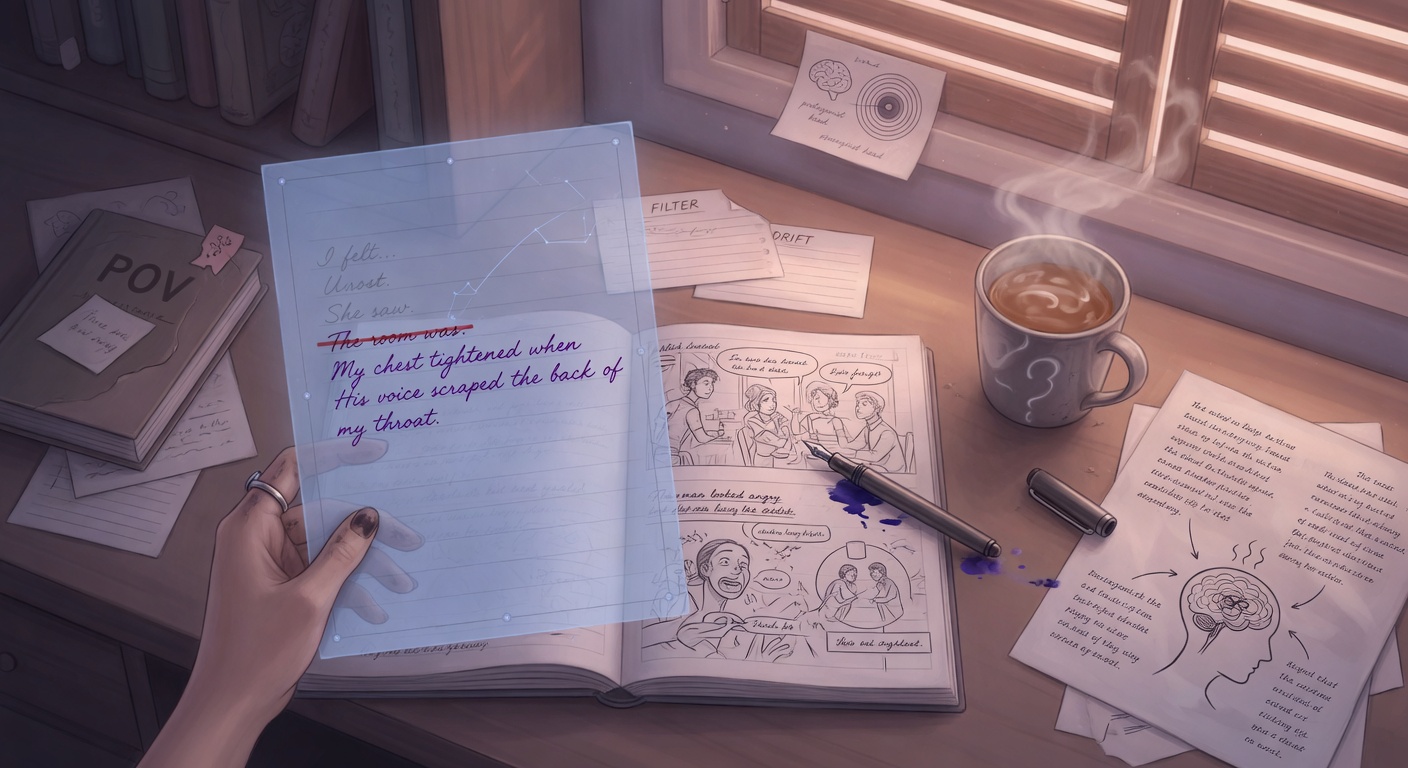
Most writers know what POV means. Far fewer have a clean, working definition of what it feels like when it's done right — and that gap is exactly where drafts go sideways. You can write an entire novel in third-person limited and still have a narrator floating somewhere above your protagonist, describing things no human being actually notices or thinks in real time. AI is genuinely useful for catching this, but only if you know how to ask.
This guide is about a specific workflow: using AI to audit your scenes for what's called omniscient leakage, then rebuilding those passages through your POV character's actual sensory and cognitive experience. It's more surgical than "rewrite this in close third person." Done well, it produces prose that pulls readers so deep into a character's skull they forget there's a narrator at all.
What POV Filtering Actually Means (And Where Most Drafts Fail)
A POV filter is the layer of consciousness between raw story events and the reader. Everything the reader experiences — every image, every piece of dialogue, every emotional beat — passes through one character's particular mind. Their history shapes what they notice. Their mood shapes how they interpret it. Their body is present in the scene, reacting in real time.
The problem is that most first-draft prose drifts. You're writing fast, you're focused on plot mechanics, and you slip into what I think of as the "documentary camera" mode — describing what's visible in the room, what people are doing, what the weather is like, as if a neutral observer were filing a report. This is omniscient leakage: narrator-level description bleeding into what should be a single character's filtered perception.
Here's a quick example of leakage in action:
The kitchen smelled like burned coffee. Sarah sat at the table, her hands wrapped around a mug. She looked tired. Outside the window, the first snow of December had started to fall.
Nothing technically wrong. But whose experience is this? "She looked tired" — that's someone observing Sarah from outside. "The first snow of December" — that's a calendar fact, not a sensory impression. A true POV filter would give us the snow the way Sarah's mind would actually register it: maybe as a peripheral blur of white she barely notices because she's too busy staring at the steam rising off her coffee, or maybe as the exact thing that breaks her open because it was snowing the day her mother died.
The filtered version isn't just more literary. It's more emotionally precise. That's the goal.
Diagnosing Omniscient Leakage: Prompting AI to Audit Your Draft
Before you can fix leakage, you need to find it. This is where AI earns its keep, because it's genuinely good at pattern recognition across a passage — identifying sentences that function as external description rather than character perception.
The key is giving the AI enough context about your POV character before asking it to audit. A bare scene paste will get you generic notes. A scene paste with character context gets you something useful.
I'm going to paste a draft scene from my novel. The POV character is Marta, a 58-year-old former archivist with chronic back pain who is emotionally guarded and tends to intellectualize her feelings rather than sit with them. She grew up in a house full of clutter and noise and finds sparse, quiet spaces deeply calming.

Please read this scene and identify every sentence or phrase that functions as external, narrator-level description rather than filtered through Marta's specific consciousness. Don't rewrite anything yet — just flag the passages and briefly explain why each one breaks the POV filter. Be specific.

[PASTE SCENE HERE]
Why this works: you're not asking the AI to make creative decisions yet. You're asking it to do a diagnostic pass — flag, don't fix. The character detail about her background isn't decoration; it gives the AI a reference point for what "filtered through Marta" should actually look like. The more particular your character description, the more targeted the audit becomes.
What to tweak: if your character is less psychologically complex or more emotionally reactive, adjust the description accordingly. The AI needs to understand not just who your character is but how their mind works — that's the filter.
After you get the audit, look for patterns. Common culprits: physical descriptions of your POV character from outside ("she looked tired"), weather described as fact rather than impression, other characters' internal states stated directly ("he was nervous"), and expository sentences that exist to convey information to the reader rather than to reflect what the POV character is actually thinking about.
The Replacement Pass: Translating Narrator Observations into Character Experience
Once you have a flagged list, the actual rewrite work begins. This is where most writers try to do too much in one prompt — pasting the whole scene and asking for a complete overhaul. That tends to produce prose that's technically closer but feels generic, because the AI is making up character interiority without enough guidance.
A better method: work passage by passage, giving the AI the flagged sentence plus the character context plus any specific backstory or emotional state relevant to that moment.
Here's a flagged passage from my scene: "Outside the window, the first snow of December had started to fall."

My POV character is Marta (58, former archivist, emotionally guarded). In this scene, she's just received a letter confirming that the archive where she worked for 30 years is being demolished. She hasn't cried yet. She's sitting very still.

Rewrite this observation as something Marta actually perceives and registers in this specific moment — not as a poetic symbol, not as a plot signal, but as the way her particular mind would notice or not notice the snow given what she's just learned. Give me three variations: one where she barely registers it, one where it lands with unexpected weight, and one where it triggers a specific involuntary memory.
Asking for three variations is deliberate. You're not outsourcing the creative decision — you're using AI to generate raw material that you then choose from and adjust. Nine times out of ten, none of the three variations is exactly right, but one of them will unlock the sentence you actually want to write.
Pay attention when the AI generates the "barely registers it" version. That's often where the real POV work is hiding — in what a character actively doesn't notice, or notices only at the edge of consciousness. That kind of selective attention is extremely hard to write from scratch but surprisingly easy to refine once the AI has given you a starting shape.
Calibrating Filter Depth: Prompts for Shallow vs. Deep POV on the Same Scene
Filter depth isn't binary. There's a spectrum from light close third (we're in the character's head but the narration still has some stylistic distance) to deep POV (the narration is almost indistinguishable from the character's direct thought stream, with zero narrative intermediary). Different scenes in the same novel might need different depths — a quietly tense dinner scene might work in shallower filter, while the moment your protagonist realizes she's been lied to for twenty years might need to go very deep.
AI is useful here for letting you hear the same scene at different depths so you can make an informed choice rather than a default one.
Below is a scene draft. The POV character is Declan, 34, a marine biologist who is more comfortable with data than with people and who processes emotion through spatial and sensory details — he notices textures, temperatures, the position of objects in a room.

Please rewrite this scene twice:

Version A: Shallow close third. We're aware of Declan's perspective but the narration has some authorial distance — complete sentences, a slightly curated quality, occasional free indirect discourse but not constant.

Version B: Deep POV. The narration is Declan's thought stream as it actually moves, including incomplete sentences, sensory intrusions, the way attention snags on irrelevant details before returning to what matters. No filtering phrases like "he noticed" or "he thought" — just the direct impression.

Keep the plot beats identical in both versions. I want to feel the difference in intimacy and psychological access.

[PASTE SCENE HERE]
The instruction about filtering phrases — "he noticed," "he thought," "she wondered" — is important. These are filter words, and they're the most common technical signal that a scene is in shallow rather than deep POV. In deep POV, you cut them entirely. Instead of "She noticed the coffee was cold," you write "The coffee was cold." The reader understands whose consciousness this is from context.
When you compare the two AI versions side by side, you're not looking for which one is "better." You're looking for which one feels right for this scene's emotional stakes. A very high-stakes interior moment almost always wants deeper filter. A scene where your character is in action mode, reacting fast and physically, might actually read better with slightly more distance — because a person in crisis doesn't have elaborate interior monologue, they have fragmented sensory input and instinct.
When to Break the Filter Deliberately and How to Tell AI the Difference
Here's something the craft books don't always say clearly: strict POV filter isn't a rule, it's a tool. There are legitimate reasons to pull back from deep filter — and if you're going to use AI in your revision process, you need to be able to communicate the difference between "this is leakage I want fixed" and "this is a deliberate choice I want preserved."
Intentional filter breaks include: a brief authorial intrusion to establish dramatic irony (the reader knows something the POV character doesn't), a shift in narrative register to mark a significant passage of time, a moment where the POV character is so dissociated that the narration appropriately goes flat and external. These aren't mistakes. But an AI doing a POV audit will flag them as mistakes unless you tell it otherwise.
I'm going to paste a scene. I want you to identify any passages that break the close third-person POV filter — but I need you to distinguish between two categories:

Category 1: Unintentional leakage — narrator-level description that should be filtered through the POV character but isn't.

Category 2: Possible intentional breaks — passages where the filter violation might be deliberate (dramatic irony, dissociation, narrative transition, authorial register shift).

For Category 1, suggest a filter-corrected revision. For Category 2, just flag it and ask me to clarify my intent before making any changes.

My POV character is Yusuf, 19, a first-year university student who is actively suppressing grief over his father's recent death and who tends to describe his emotional state in terms of physical sensations — tightness, temperature, weight.

[PASTE SCENE HERE]
This prompt structure is one of the most useful things I've found for revision work. It makes the AI your collaborator rather than your autocorrect — it flags and asks rather than assuming. The "Category 2" ask is doing real work here, because it forces the AI to consider authorial intention as a variable rather than treating every POV break as an error.
One more thing worth knowing: deep filter has a cost. When you strip all narrative distance, you lose the ability to convey certain kinds of information efficiently. You also increase the risk that a character's limited perspective becomes frustrating to readers who can see the larger picture the character can't. The best close-POV novels manage this through careful scene sequencing and what they choose to put near each other, not through the filter alone. AI can help you hear the filter; the architecture decisions are still yours.
Putting the Workflow Together
The full sequence looks like this: you take a draft scene, give the AI a rich character description, and run the audit prompt to identify leakage. You work through the flagged passages one by one using the replacement pass prompt, asking for variations rather than a single answer. You use the depth calibration prompt when you're unsure whether this particular scene needs shallow or deep filter. And you use the intentional breaks prompt for any scene where you've made deliberate choices you don't want overwritten.
None of this replaces your judgment. What it replaces is the particular kind of revision blindness that sets in after you've read your own draft too many times — where you stop seeing "the first snow of December had started to fall" as a narrator observation and start reading it as perfectly fine prose because you know what you meant when you wrote it.
AI doesn't know what you meant. It only knows what's on the page. That's exactly what makes it useful here.
Start with your most emotionally important scene — the one where you most need the reader inside your character's skull. Run the audit. You'll likely find three to five flagged passages. Take the most egregious one and do the full replacement pass with variations. Just that. See what it produces before you try to tackle the whole thing at once. The process gets faster as you learn to write your character descriptions more precisely, and the gap between what the AI gives you and what you actually want narrows considerably once you've run a few of these passes on the same manuscript.