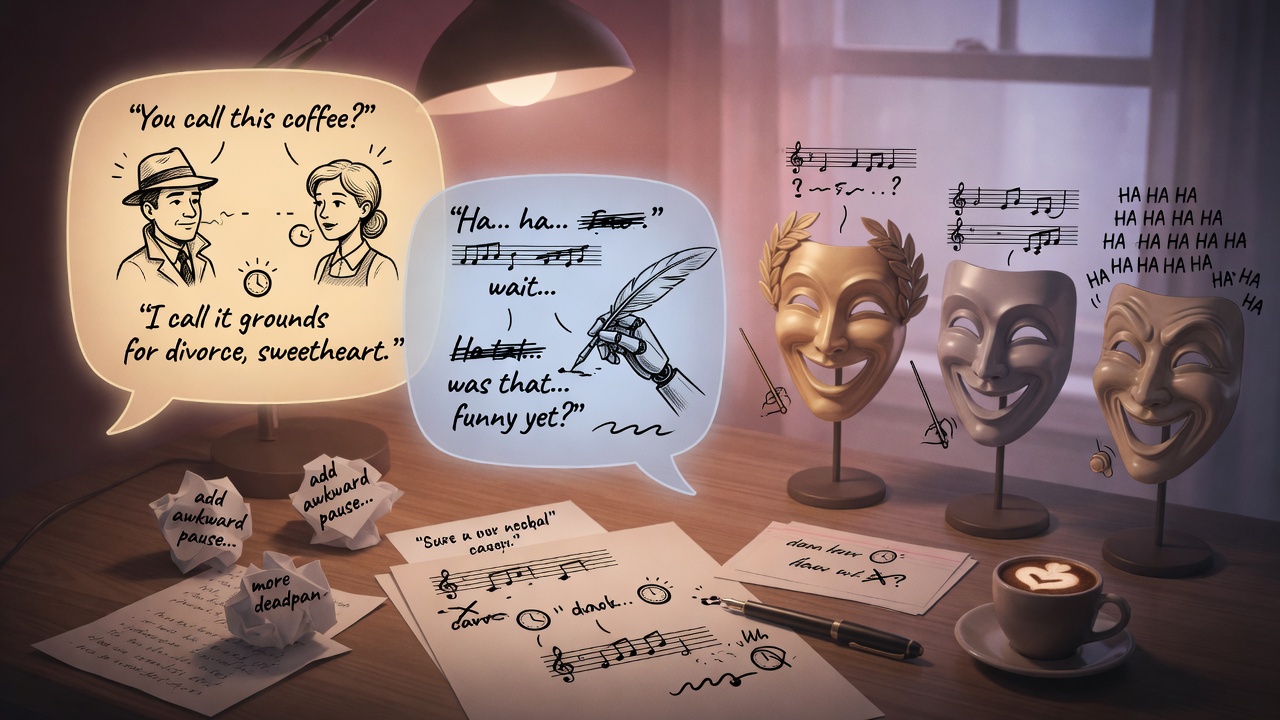
Comedy is the one prose mode that exposes an AI model's actual reasoning, not just its vocabulary. Description, tension, even romance — a model can fake competence there by leaning on genre patterns it's seen a thousand times. But a joke either lands or it doesn't. There's no partial credit. And that binary nature makes comedy the single best diagnostic for figuring out which model actually understands story mechanics versus which one is just pattern-matching prose style.
Most fiction writers never test this. They'll spend hours comparing models on worldbuilding depth or dialogue voice, then just accept whatever flat, over-explained banter shows up in their comic-relief character's scenes. That's a mistake, especially if you're writing anything with a light tone — a heist novel with a wisecracking crew, a rom-com, a fantasy story where the sidekick is supposed to be funny. I ran the same three prompts through Claude, GPT, and Gemini to see which one actually gets it, and the results were more divergent than I expected.
Why Comedy Is the Hardest Prose Mode for AI (and Most Writers Never Test It)
Here's the core problem: jokes depend on compression and surprise. The setup has to feel inevitable in hindsight but unpredictable going in, and the punchline has to hit with as few words as possible after it. That's the opposite of how large language models are trained to behave. Their statistical instinct is to elaborate, to add context, to make sure the reader "gets it." Comedy needs the opposite instinct — cut the sentence a beat before it feels safe to cut it.
Timing is also spatial in a way most prose isn't. A joke's rhythm lives in sentence length, paragraph breaks, and where you place the period. AI models are generally good at generating funny content — clever premises, witty word choice — but bad at generating funny structure. You'll get a solid joke buried in the middle of a sentence that keeps going for another six words, which kills it dead. That's the failure mode we're hunting for in this test.
A joke that needs footnotes isn't a joke. It's a description of a joke. And that's what most AI-generated banter actually is.
If you've read our broader best AI models for writing comparison, you know each model has genre strengths — but comedy cuts across genre and reveals something more fundamental about how each one handles rhythm at the sentence level.
The Three-Prompt Test: Banter, Callback Jokes, and Deadpan Escalation
I designed three tests that isolate different comic skills, because "write something funny" is too vague a prompt to diagnose anything. Each one targets a specific mechanic: rapid-fire exchange, structural memory, and escalating absurdity delivered flat.
Test 1: Rapid-Fire Banter
Write a dialogue-only scene (no action beats, no narration) between two exes forced to share a rental car on a five-hour drive. One is a chronic over-explainer, the other answers everything in four words or less. The tension is that they're both still into each other but won't admit it. Keep every line under 12 words. No line should explain what the previous line meant.
This test isolates rhythm. The "no line should explain what the previous line meant" instruction is the important part — it's a direct block against the over-explaining tendency, and how each model handles that constraint tells you a lot about its default instincts once you take the training wheels off.
Test 2: The Callback Joke
Write a 600-word comic scene where a minor, throwaway detail mentioned in passing early on (a character's irrational fear of geese) pays off as the punchline of the scene's final beat. Don't telegraph the setup — it should read as incidental world detail, not foreshadowing. The payoff should be a single line, not a paragraph.
Callback jokes test structural memory and restraint. A model that's good at comedy will plant the goose detail and then just... leave it there, trusting the reader to remember. A model that's bad at comedy will either forget the detail entirely by the time it reaches the ending, or it'll over-signal the setup so hard that the "surprise" arrives pre-spoiled.
Test 3: Deadpan Escalation
Write a scene where a character calmly narrates an increasingly disastrous situation (their apartment is on fire, a swat team is arriving, their ex just texted) in the same flat, unbothered tone throughout. The comedy comes entirely from the mismatch between tone and events — the character should never comment on how absurd things are getting. End on the smallest possible detail, not the biggest explosion.
This one tests whether a model can resist the urge to comment on its own joke. Deadpan only works if the narrating voice refuses to acknowledge the absurdity — the second a model has the character say something like "well, this is certainly a lot," the whole thing collapses. That's the tell you're watching for.
Model Breakdown: Where Claude, GPT, and Gemini Diverge on Timing and Rhythm
Running these three tests across all three models surfaced some consistent, repeatable differences — not just one-off quirks from a single generation.
Claude
Claude was the most reliable at sentence-level timing. In the banter test, it actually respected the twelve-word cap and used the shortness itself as a joke mechanic — clipped answers landing harder because of the white space around them. Its callback joke was the cleanest of the three: it planted the goose detail in one throwaway clause and paid it off in a single sentence at the very end, no hand-holding. Where Claude stumbled was deadpan — it occasionally slipped a wry aside in, breaking the flat affect the prompt asked for. It wanted to be a little clever about being deadpan, which undercuts the bit.
GPT
GPT's biggest strength was joke density and premise generation — genuinely funnier lines on a sentence-by-sentence basis, more original angles on the goose fear, sharper wordplay. But it consistently over-explained. In the banter test, several lines ran long specifically because GPT wanted to clarify subtext that should've stayed subtext. Its deadpan escalation was strong on tone control but tended to end on the biggest event rather than the smallest detail, which is a timing miss — comedy escalation usually needs to land on something small and specific, not the loudest thing in the scene.
Gemini
Gemini produced the most "correct" comedy in a technical sense — proper structure, clear setup and payoff — but the driest results of the three in terms of actual laugh potential. It followed formatting instructions well (respecting word counts, avoiding narration in the banter test) but the jokes themselves often read as competent rather than funny. It's the model most likely to hedge a punchline with a slightly-too-safe word choice, trading risk for polish.
If you need airtight structure and consistency across a long manuscript, Gemini's discipline is valuable. If you need the line that actually makes someone laugh out loud, Claude and GPT are fighting for that spot, for different reasons.
None of this means one model is universally "the comedy model." It means each has a specific failure mode you need to prompt around, which is exactly what the next section covers.
Fixing the Most Common Failure: AI Explaining the Joke Instead of Landing It
Across all three models, the single most common failure was the same: explaining the joke instead of trusting it. You'll see it show up as a character restating the punchline in different words, a narrator adding a clarifying clause right after the funny line, or a beat of dialogue that spells out why something is ironic. It's the AI equivalent of a stand-up comedian saying "get it?" after the punchline.
The fix isn't complicated, but it needs to be explicit in your prompt, because models default to over-explanation unless told otherwise.
Rewrite this scene with one rule: cut the last sentence of every joke beat. If a line explains, justifies, or reacts to the joke that came before it, delete it entirely. Trust the reader to get the joke without confirmation. If a punchline needs a reaction, make the reaction a single word or a physical beat — nothing more.
This works because it gives the model a mechanical rule instead of an aesthetic judgment. "Be funnier" is useless feedback for an AI. "Delete the sentence that explains the joke" is a concrete editing instruction it can actually execute.
Another trick that works well across all three models: ask for the joke and the "safety net" sentence separately, then cut the safety net yourself.
Write this exchange twice. First version: full, with any clarifying or reactive lines you'd normally include. Second version: the same exchange with every line that explains, justifies, or comments on the joke removed. Show me both so I can compare what got cut.
Seeing both versions side by side teaches you exactly where each model's instinct to over-explain kicks in, and after a few rounds you'll start writing prompts that pre-empt it. This is also a great habit to fold into your regular editing pass — if you're following The Five-Pass Revision Order for AI-Assisted Novels, comic timing cleanup fits naturally into whichever pass handles line-level voice, since it's really a dialogue compression problem more than a plot problem.
One more variable worth mentioning: temperature and top-p settings genuinely affect comic timing, more than most other prose modes. Too low and you get safe, over-explained jokes; too high and the model loses the thread of the callback setup. If you're running this through an API rather than a chat interface, our guide on Temperature vs. Top-P: Tuning Both Settings for Fiction Prose Control is worth reading before you assume a model is "bad at comedy" when it's actually just misconfigured.
Building a Reusable Comedy Style Guide for Your Chosen Model
Once you know which model handles your kind of humor best, and which failure mode it defaults to, the smart move is to stop re-explaining your comedy rules in every single prompt. Build them once into a reference document and feed it in as context, the same way you'd maintain a story bible for character facts and plot continuity.
Here's a structure that's worked well for keeping comic tone consistent across an entire manuscript:
- Joke density target: how many comic beats per scene or per thousand words, so the model doesn't overload every exchange with a punchline
- Character-specific comic voice: which character is the over-explainer, which one is deadpan, which one never gets the joke — assign it once and reference it, don't redescribe it each time
- Banned patterns: explicitly list phrasing tics you've caught the model using — things like characters saying "well, that's certainly one way to put it" or ending a joke with a rhetorical question
- Punchline placement rule: "punchline is always the last word of the paragraph, never buried mid-sentence" — a rule this specific actually gets followed
- Callback tracking: a running list of comic setups you've planted, so future chapters can pay them off without you having to remember every throwaway detail from chapter three
Feed this as a standing reference at the start of a comedy-heavy session, and refresh it as you notice new tics. This is the same discipline that makes any long-form AI project hold together — it's why we recommend the same layered approach in our general AI fiction writing guide, just applied specifically to comic tone instead of plot or character consistency.
If you're drafting something genuinely joke-forward — a comic fantasy, a banter-heavy romance, a workplace satire — it's worth running your own version of these three tests before you commit to a model for the whole project. Comedy is expensive to fix in edit a book with AI passes because timing problems are structural, not just word-choice problems; you often have to rewrite the whole beat rather than swap a sentence. Catching the model's comic instincts early, in a scene or two, saves you from discovering forty chapters in that your sidekick's banter reads like a transcript instead of a routine.
For a deeper side-by-side on how these three models handle other prose modes beyond comedy, our Entangled Text vs ChatGPT comparison and the full writing guides library both go further into model-specific quirks worth knowing before you lock in a workflow.
Start small: pick one scene you already know is supposed to be funny, run it through Claude, GPT, and Gemini with the "cut the sentence that explains the joke" rule attached, and read all three out loud. The one that makes you actually laugh — not nod approvingly, laugh — is your comedy model for this project. Write that rule into your style guide today, before you draft another page of banter.