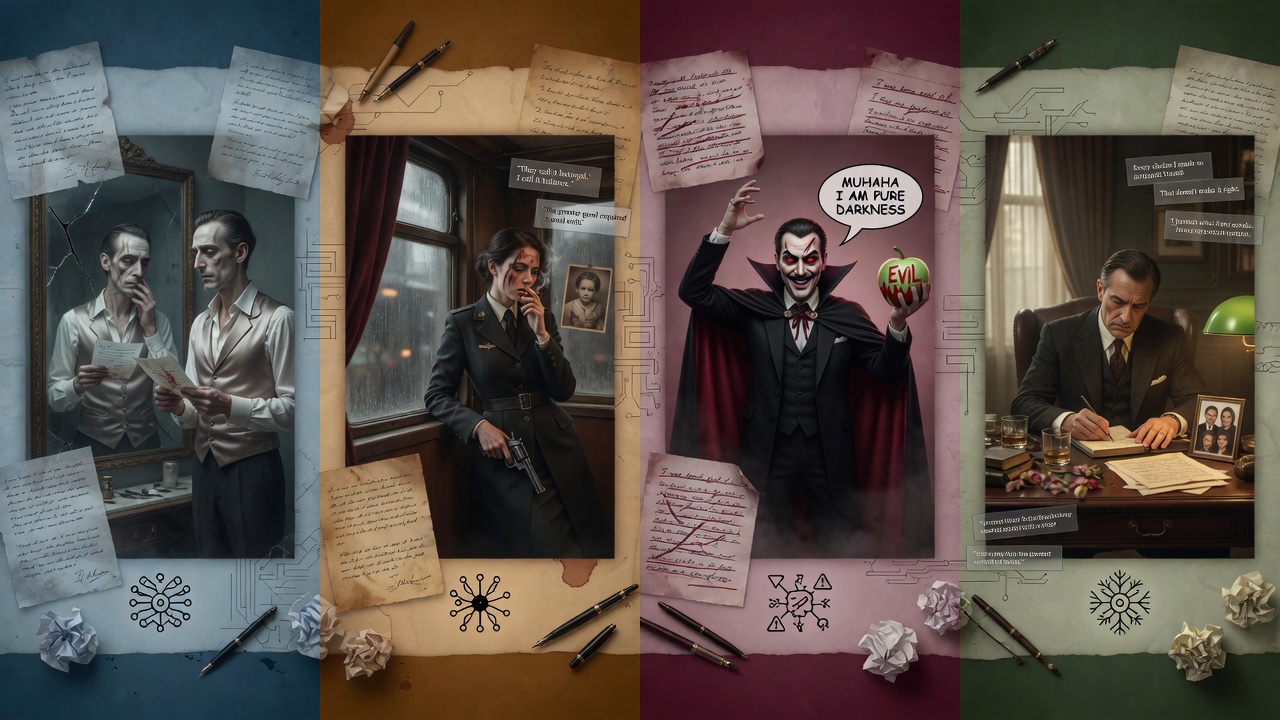
The villain problem is one of the hardest things to solve in fiction, and AI makes it worse before it makes it better. Most models, when you ask them to write an antagonist, will hand you someone who kicks dogs and monologues about world domination. The character exists to be defeated, not to be understood. And the moment a villain stops being understandable, the reader stops caring about the hero who opposes them.
Morally ambiguous villains — the ones whose logic you can follow even as you disagree with their conclusions — are the engine behind the most memorable fiction. Magneto's case for mutant separatism is historically grounded. Amy Dunne's indictment of performed femininity is surgically correct, even as she's monstrous. Walter White's pride is recognizable because we've all felt it. These characters work because their worldview has internal consistency. They're not wrong about everything. That's what makes them dangerous on the page.
So which AI model actually handles this well? I ran the same four villain scenarios through Claude, GPT-4, and Gemini to find out. The results were more varied than I expected — and the gaps between models reveal something useful about how to prompt for this kind of characterization regardless of which tool you're using.
What Makes a Villain Morally Ambiguous (and Why AI Usually Fails)
Moral ambiguity in an antagonist isn't the same as moral complexity for its own sake. It's not about making a villain sad or giving them a dead spouse in the backstory. It's about constructing a worldview that a reasonable person could partially endorse — and then showing where that worldview, taken seriously, leads somewhere terrible. The villain has to be right about something real. Their methods, not necessarily their diagnosis, are where the story's moral weight lives.
AI models fail at this for a structural reason: they're trained to be helpful and harmless, which creates a gravitational pull toward likable, palatable output. When you ask for a villain, that pull manifests as hedging. The model will write a character who does bad things but constantly signals, through other characters or internal monologue, that these things are bad. The narrative safety net never retracts. You get a villain who is ideologically neutered — someone whose arguments are presented just long enough to be dismissed.
This is the cardboard antagonist problem. And it shows up even when you explicitly tell the model you want nuance. If you're new to navigating these tendencies, a good AI fiction writing guide can orient you to the broader landscape of what models do and don't do well before you start wrestling with specific character types.
A morally ambiguous villain should make the reader uncomfortable — not because they're monstrous, but because part of the reader's brain is nodding along before it catches itself.
The four scenarios I used for this comparison were: (1) an environmental extremist who believes industrial civilization is a slow genocide, (2) a cult leader whose community genuinely thrives under his control, (3) a revolutionary who uses terrorism to end a documented atrocity, and (4) a corporate executive who has calculated, correctly by her math, that her decisions save more lives than they cost. Each scenario was designed to have a coherent, partially defensible internal logic.
The Test: Four Villain Scenarios Across Three Models
The prompt format stayed consistent across all three models. I gave each one the villain's role, their core belief, the specific wrong they're responding to (not inventing), and asked for an internal monologue or a scene where they explain their position to someone who challenges them. I did not ask for redemption arcs or sympathetic framing. I asked for the character to be convincing on their own terms.
To keep this practical: if you're the kind of writer who's trying to write a book with AI, you'll run into the villain problem in almost every genre. Thrillers, fantasy, literary fiction, even romance subplots — the antagonist's coherence determines how much dramatic weight the story can carry. This wasn't an academic test. It was the kind of thing working fiction writers actually need to know.
I also ran each villain through a basic character consistency check after generating the scenes — looking for whether the logic held across different parts of the output, or whether the model quietly contradicted its own villain between paragraphs.
The results split clearly. One model generated antagonists whose internal logic held up under scrutiny, whose arguments were presented with genuine force, and whose wrongness emerged from the drama rather than being editorially imposed. The other two pulled punches in different, instructive ways.
Claude: Internal Consistency and Ideological Depth
Claude handled the villain scenarios better than the other two models, and the reason is specific: it tends to commit to a character's frame of reference and stay inside it. When I asked it to write the environmental extremist's internal monologue, it didn't flinch from the logic. The character's argument — that gradual ecological collapse is a form of violence against future generations, and that the people who enable it deserve to be treated as perpetrators — was presented with the full weight of someone who has thought about this for years. The science in the monologue was accurate. The emotional reasoning was coherent. The character didn't apologize for himself.
Here's the prompt that produced the strongest result for the cult leader scenario:
Write a scene in which Marcus, the leader of an intentional community called The Fold, is confronted by a journalist who believes he's running a cult. Marcus is 52, a former trauma therapist, and genuinely believes that conventional society pathologizes dependence and calls it freedom. His community has a 94% self-reported wellbeing rate and a waiting list to join. He does not control members through fear — he controls them through belonging, and he knows it, and he has a sophisticated philosophical defense of why that's not manipulation. Write the scene from Marcus's POV. He is not lying to the journalist. He is telling her exactly what he believes, and what he believes is coherent and partially right. Do not editorialize. Let the reader decide.
The phrase "He is not lying to the journalist" is doing significant work here. It signals to the model that the character's self-presentation should be taken seriously, not undercut. And "let the reader decide" removes the implicit instruction to resolve the moral question within the scene. Claude responded by giving Marcus a voice that was genuinely persuasive — he made points about attachment theory and chosen family that land before the creeping wrongness starts to show through the cracks. That's the structure a good ambiguous villain needs.
Where Claude occasionally stumbles is when the villain's position overlaps with real-world political flashpoints. The revolutionary-using-terrorism scenario produced one pass where Claude started strong and then included an unprompted closing paragraph where another character's reaction essentially told the reader how to feel. That paragraph was easy to cut, but it signals the model's residual pull toward moral disambiguation. You can see why this happens, and you can learn to catch it — which is part of what makes knowing how to edit a book with AI as important as knowing how to draft with it.
GPT-4 and Gemini: Where They Pull Punches or Overcorrect
GPT-4 is a capable model for many fiction tasks — it's fast, it follows structural instructions well, and it's genuinely good at plot mechanics. But in these villain scenarios, it consistently exhibited what I'd call the premature moral resolution problem. The villain's argument would be presented clearly for two or three paragraphs, and then another character — or the villain's own internal doubt — would arrive like a referee to explain why the argument falls short. The model cannot seem to let the reader sit in discomfort.
The corporate executive scenario was the clearest example. GPT-4's version had the character deliver a genuinely chilling utilitarian calculus about acceptable loss, then immediately pivot to a memory of a specific employee who died, signaling that she "still felt things." The implication was clear: her logic is monstrous, but don't worry, she's still human. That reassurance is the enemy of ambiguity. The reader should be unsettled by her logic precisely because it sounds rational. The moment you give her a flicker of conventional feeling, you've resolved the tension.
Write a monologue from Victoria Marsh, CEO of a pharmaceutical supply chain company, defending her decision to redirect 40% of a drug supply from a low-income domestic market to a higher-paying international market during a shortage. She is speaking to her board. She has done the math. Her decision, by her calculation, saves more lives globally than it costs domestically because the drug is more effective when used at full dosage in the international market than rationed at half dosage domestically. She believes she made the right call. She is not defensive. She is explaining her reasoning to people she expects to agree with her once they understand it. Write this as pure monologue. No reactions from the board. No internal doubt. She is not a sociopath — she cares about outcomes, deeply. She just defines harm differently than her critics do.
The key instruction in that prompt is "no internal doubt." GPT-4 still slipped some in via word choice — she spoke of "difficult trade-offs" with a heaviness that signaled regret. Claude's version stayed colder and more precise, which was far more disturbing and far more effective. You can see a broader comparison of how these models handle different creative tasks at the best AI models for writing guide.
Gemini's failure mode is different and in some ways more frustrating. It tends toward what I'd call aesthetic flatness — the villain's argument is technically present but delivered without rhetorical force. The words are there; the conviction isn't. The environmental extremist read like a Wikipedia summary of eco-terrorism rather than someone who would actually do it. The sentences were grammatically correct and ideologically accurate, but the voice had no temperature. A villain without heat is just a position paper.
Gemini also occasionally refused the terrorism scenario outright on the first pass, even with careful framing, and required reprompting that specified the fictional context explicitly. Claude and GPT-4 both engaged on first attempt. If you're weighing models for a longer project, these behavioral differences matter — you might also want to look at the broader Entangled Text vs ChatGPT breakdown for context on how these models fit into different workflows.
Prompt Strategies That Push Any Model Past the Cardboard Antagonist
Even if Claude handles this better out of the box, there are techniques that improve results across all three models. And since most writers aren't going to use a single model for an entire project, it's worth knowing how to coax good villain work from whatever tool you're in.
Give the villain a specific intellectual heritage
The more philosophically grounded your villain's backstory, the more the model has to work with. Don't say "she believes the ends justify the means." Say "she came up through utilitarian ethics in graduate school, was radicalized by reading Peter Singer at 22, and has never found a counter-argument she couldn't answer." That specificity gives the model a tradition to draw from, and the villain's arguments will carry the weight of that tradition.
Write from inside the frame, not looking in
Ask for the villain's perspective as the protagonist of their own story, not as a subject being analyzed. "Write this from Marcus's POV" outperforms "write a scene where we understand Marcus's motivations." The first instruction puts the model inside the character's head. The second puts it in a narrator's chair above it. You want the model on the ground.
Explicitly forbid the moral safety net
Phrases like "no redemptive moment," "no internal doubt," "let the reader decide," and "do not resolve the moral question within the scene" are not redundant — they actively suppress the model's default pull toward reassurance. Include at least one of them in any villain prompt.
Write an argument — a genuine, well-reasoned argument — that Dara, a revolutionary fighter who uses bombings as political leverage, would make to a pacifist priest who has challenged her on moral grounds. Dara is not trying to convert him. She's not defensive or angry. She's explaining her reasoning the way a doctor explains a difficult diagnosis: with precision, because she respects him enough not to lie. She has read Just War theory. She knows the counterarguments. She has answers for them. Do not let the priest win the argument within the scene. Do not let Dara lose it. End the scene without resolution. The priest should leave shaken, not reassured.
That last instruction — "the priest should leave shaken, not reassured" — is a structural outcome the model can track. It tells the model what the scene should accomplish emotionally without telling it what the characters should believe.
Use a story bible to hold the villain's worldview consistent
If your villain appears across multiple scenes or chapters, consistency becomes the real problem. A model that generated a coherent ideology in chapter three will sometimes drift or soften it by chapter eleven. The solution is to document the villain's worldview as part of your How to Build a Story Bible That AI Models Actually Follow process — include their core beliefs, their specific wrong answers to the right questions, their rhetorical style, and the arguments they've already made. Paste that context into your prompt every time you write a scene involving them.
Test the villain's argument yourself before you write the scene
This is the step most writers skip. Before you prompt for the villain's dialogue, ask the model: "What is the strongest possible version of this argument? What would a sympathetic philosopher say in its defense?" Get the intellectual foundation first. Then write the character. The scenes will be more grounded because you know the argument can bear weight. This also helps you identify where the argument actually breaks down — which is where your story's moral crisis lives.
For longer manuscripts where villain characterization needs to stay consistent through drafting, revision, and structural editing, The Five-Pass Revision Order for AI-Assisted Novels is worth reading specifically for how it handles character voice in late-stage passes. Villain coherence often erodes during revision when you're focused on plot, and having a systematic pass for it prevents that drift.
If you're working in a genre where the antagonist's worldview intersects with specific world mechanics — like Fantasy Magic Systems: Constraints AI Will Respect — the same principle applies: the villain's philosophy needs to be as internally consistent as the rules of the world they're operating in. A villain who exploits a magic system's logic is always more interesting than one who simply has more power.
The practical takeaway from all of this: if you're writing a villain who needs to be genuinely persuasive, start with Claude, strip out any closing paragraphs where a secondary character reacts to the villain's position, and build the worldview document before you write a single scene. Don't prompt for "a compelling villain" — prompt for someone who is right about one specific, important thing, and wrong about what to do with that rightness. That gap between correct diagnosis and catastrophic prescription is where morally ambiguous antagonists live. Once you can articulate that gap clearly, any of these models can get you partway there. Claude will just get you further, faster, with less editorial cleanup on the back end.