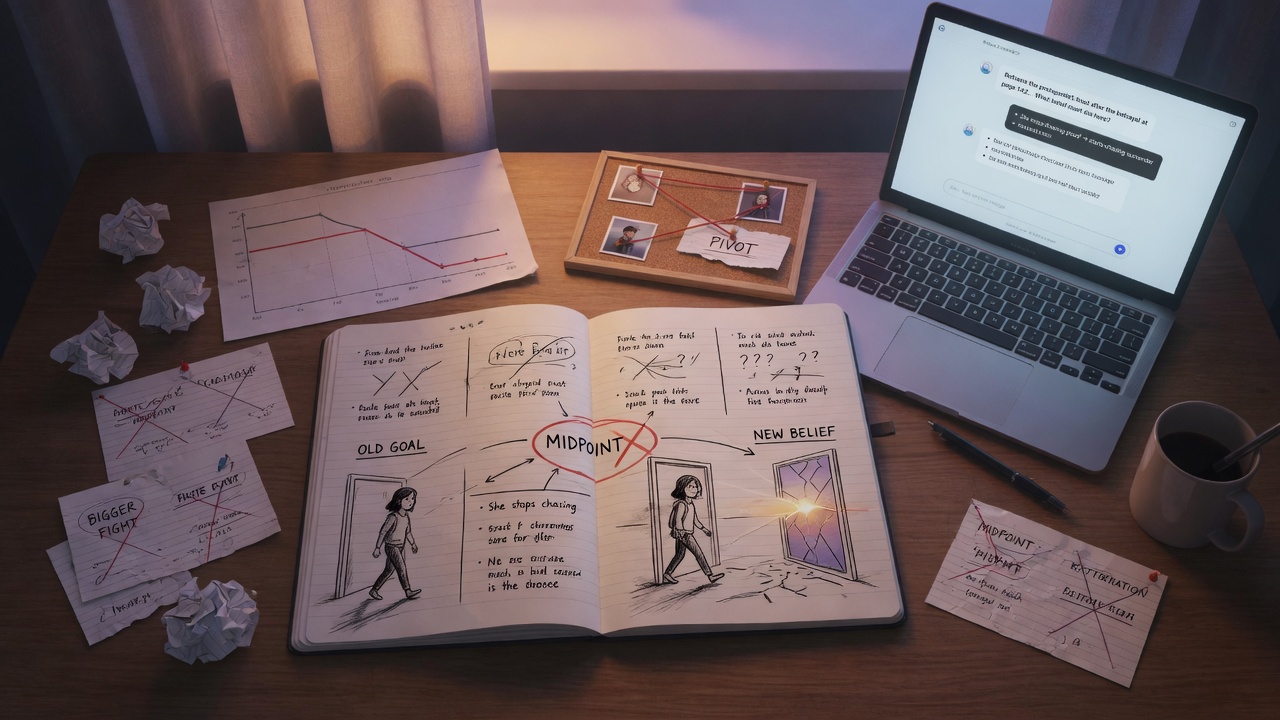
Why most "midpoints" are just a bigger fight scene, not a real pivot
Ask most drafts what happens at the midpoint and you'll get some version of: "the stakes get higher." A car chase becomes a car chase with gunfire. A tense negotiation becomes a betrayal. The volume goes up. But volume isn't structure. A real midpoint doesn't just escalate the danger — it changes what the protagonist is trying to do, or what they believe, or who they trust. If your midpoint is just Act Two's opening conflict wearing a bigger costume, your second half will sag no matter how many explosions you add.
I see this constantly in AI-assisted drafts, and honestly in human-written ones too. The AI model, especially when working off a loose outline, tends to default to "raise the stakes" because that's the statistically safe move. It doesn't know that raising stakes and reframing the story are different jobs. Your protagonist chasing the same goal harder isn't a pivot. Your protagonist realizing they've been chasing the wrong goal entirely — that's a pivot.
The good news is that this is a diagnosable, fixable problem, and AI is actually great at helping you diagnose it once you know what questions to ask. You just can't ask "is my midpoint good?" That's too vague and you'll get a vague, flattering answer. You need to interrogate it structurally, the way a story editor would, and that means feeding the AI a clean summary and specific diagnostic criteria — not the whole manuscript, not vibes.
The diagnostic prompt: does your midpoint change goal, understanding, or allegiance?
Before you can fix a weak midpoint, you need proof it's weak. The test I use — and the one worth teaching your AI to use — comes down to three questions. Does the midpoint change the protagonist's goal (what they're pursuing)? Does it change their understanding (what they believe to be true about the world, the antagonist, or themselves)? Does it change their allegiance (who they trust, who they're aligned with)? If the answer to all three is no, you don't have a midpoint. You have a plot event.
To run this diagnostic, feed the AI a tight summary of your first half — not the prose, just the beats — and ask it to evaluate against those three criteria specifically. This works well alongside a Three-Act Beat Sheet if you've already got one mapped, since the AI can cross-reference where your midpoint sits relative to your other structural beats.
Here's a beat-by-beat summary of the first half of my novel (Acts One and the first half of Act Two). I want you to evaluate my midpoint scene specifically — the scene where [describe your current midpoint scene in 2-3 sentences].

For each of these three criteria, tell me YES/NO and explain why:
1. GOAL: Does this scene change what my protagonist is actively pursuing, or do they still want the same thing they wanted at the start of Act Two?
2. UNDERSTANDING: Does this scene reveal information that changes how my protagonist interprets the plot, the antagonist, or themselves? Or do they already suspect this?
3. ALLEGIANCE: Does this scene shift who my protagonist trusts or is aligned with?

Be blunt. If this is just a bigger version of an earlier conflict rather than a genuine pivot, tell me that directly and explain what's missing.

[Paste beat summary here]
Why this works: it forces the AI out of cheerleader mode. Most models, left unprompted, will tell you your midpoint is "solid" because they're pattern-matching against generic story shape, not your actual causal chain. Asking for YES/NO plus justification against explicit criteria removes the wiggle room. If you're using a model that tends toward diplomatic hedging, add "don't soften this for my feelings" — it helps more than you'd think.
One thing worth doing before this step: make sure the AI actually has consistent information about your protagonist's arc. If your story bible is thin or contradictory, the diagnostic will be built on sand. Tighten that first.
Prompting AI to generate three midpoint reframes: false victory, false defeat, revealed truth
Once you've confirmed the midpoint is weak — and if you did the diagnostic prompt honestly, you probably found at least one "no" — the next move is generation, not fixing. Don't ask the AI to patch the existing scene. Ask it to generate genuine alternatives using established midpoint patterns, then pick the one that fits your story's DNA.
Three patterns cover most strong midpoints:
- False victory: the protagonist appears to get what they wanted, but the win is hollow, incomplete, or based on a misunderstanding that will collapse later.
- False defeat: the protagonist appears to lose everything, but the loss forces a reframe that's actually necessary for the real ending to work.
- Revealed truth: new information recontextualizes everything that's happened so far — a betrayal, a hidden identity, a lie the protagonist told themselves.
Ask for all three, tailored to your specific plot, not generic descriptions of the pattern. This is where a lot of writers get lazy prompts and lazy results — "give me a false victory midpoint" produces mush. You want the AI working with your actual characters and stakes.
Based on the story summary and character details below, generate THREE distinct midpoint options for my novel — one FALSE VICTORY, one FALSE DEFEAT, and one REVEALED TRUTH. Each option needs to:

- Change my protagonist's goal, understanding, OR allegiance (specify which)
- Use existing characters and setups from my first half — don't introduce brand new characters or plot threads
- Include a one-sentence "ripple effect" showing how this changes what my protagonist wants going into the second half

Protagonist: [name + one-line motivation]
Antagonist/opposing force: [name + what they want]
Current first-half goal: [what protagonist is chasing right now]
Key relationships and secrets already planted: [list anything relevant — a lie, a hidden identity, an alliance]

[Paste first-half summary]
Why this works: constraining the AI to your existing setups prevents it from inventing a shiny new subplot that would require rewriting Act One. The "ripple effect" sentence is the part people skip, and it's the most important part — it's a forced preview of consequence, which tells you immediately whether the reframe has legs or just sounds cool in isolation.
If you're writing romance, this is also where the midpoint often doubles as the relationship's false high or the black moment gets pulled forward — worth checking against a romance beat sheet to see where genre convention wants this turn to land. Fantasy writers should sanity-check that a "revealed truth" midpoint doesn't quietly break your magic system's established constraints — AI loves to solve a reveal with a convenient power nobody mentioned before.
A midpoint reframe is only as good as its ripple. If the AI can't tell you what changes in the next 25,000 words, the reframe is decorative.
Stress-testing the ripple effect on Act Two's second half
This is the step almost everyone skips, and it's the one that actually matters most. You pick a shiny new midpoint, feel good about it, and then don't check whether your existing second-half scenes still make sense. They usually don't. If your protagonist's goal changed at the midpoint, then every scene after it that was written assuming the old goal is now motivationally hollow.
The fix is a cause-and-effect prompt chain: you walk the AI through your existing second-half beats one at a time and ask it to flag anything that no longer follows logically from the new midpoint.
I'm replacing my old midpoint with this new one: [paste the chosen reframe and its ripple effect sentence].

Below is my existing outline for the second half of Act Two through the Act Two/Three break. For EACH beat, tell me:
1. Does this beat still make sense given my protagonist's new goal/understanding/allegiance?
2. If not, what's the minimum change needed to make it work — a new motivation for the same event, or does the event itself need to change?
3. Does this beat build causally on the one before it, or could I delete it without anyone noticing?

Go beat by beat, don't summarize the whole thing at once.

[Paste second-half outline as a numbered list]
Why this works: forcing beat-by-beat analysis instead of a holistic pass stops the AI from smoothing over problems with generic reassurance. The "could I delete it" question is a gut-check for filler — scenes that existed to serve the old midpoint's momentum and now have nothing to do. You'll often find two or three beats that were only there to delay a confrontation the old plot needed and the new plot doesn't.
Run this same chain again after you've made your first round of fixes. Ripple effects compound — changing beat twelve because of the new midpoint might break beat fifteen in a way you didn't predict. Two or three passes through this chain is normal, not a sign you did it wrong the first time.
This is also a natural moment to lean on the Five-Pass Revision Order for AI-Assisted Novels if you haven't structured your revision yet — structural fixes like this belong early, before you're polishing prose that might get cut anyway.
Rewriting your outline backward and forward from the new midpoint
With the ripple effects mapped, you need to actually rebuild the outline — and the safest way to do that with AI is in two directions, not one. Go forward from the midpoint to the climax first, since that's usually where the bigger structural damage lives. Then go backward from the midpoint to your Act One setups, checking whether anything you planted early now needs adjusting to support the new reveal or reversal.
Treat the AI as a continuity checker here, not a creative generator. You've already made the creative decisions — now you need something that will catch the boring, easy-to-miss stuff: a character who knows information they shouldn't yet, a promise made in chapter three that the new plot no longer pays off, a prop or clue that needs to be planted earlier than it currently is.
I've revised my midpoint and second-half outline (pasted below). I need you to act as a continuity checker, not an editor for prose or style. Check specifically for:

1. Foreshadowing debt: does anything in the second half require a setup that doesn't currently exist in Act One or the first half of Act Two? List exactly what needs to be planted and roughly where.
2. Knowledge leaks: does any character act on information they haven't actually learned yet according to this outline?
3. Orphaned threads: are there any subplots or promises from the first half that this new outline drops without resolution?
4. Timeline/logistics: flag anything where travel time, character location, or elapsed time doesn't add up.

Go through methodically and cite the specific beat numbers where each issue occurs.

[Paste full revised outline, first half + new second half]
Why this works: separating "continuity checker" from "creative collaborator" changes the AI's behavior noticeably. When you ask for creative help and continuity checking in the same breath, models tend to prioritize the fun part and wave through logic gaps. Isolating the ask gets you a more rigorous pass. This is also a good moment to run your revised cast through a character consistency checker if you're juggling more than a handful of POV characters or a large ensemble — the midpoint reframe often shifts someone's motivation in a way that ripples into their dialogue voice too.
Once the outline holds up in both directions, you're in good shape to actually draft or redraft the second half. If you're doing this on an existing manuscript rather than an outline-first draft, this is the point where you'd move into a proper revision pass — see how to edit a book with AI for the general workflow, or use the broader edit a book with AI tools if you want to work directly inside a platform built for this rather than juggling a chat window and a dozen pasted documents.
A few notes on keeping this efficient
If you're working with your own API keys rather than a flat-rate tool, these diagnostic and continuity passes can burn tokens fast, especially on longer manuscripts where you're pasting full outlines repeatedly. Worth reading through BYOK Cost Control: Budget a Full Novel with API Keys before you start this process on a 100k-word novel, so you're not surprised by the bill halfway through your third continuity pass.
It also helps to know which models are actually good at this kind of structural reasoning versus which ones are better at prose generation — they're not the same skill, and the gap between models is bigger than most writers assume. The best AI models for writing guide breaks down which models tend to hold causal chains together over long context versus which ones drift. If you're comparing platforms generally, Entangled Text vs ChatGPT covers how a purpose-built writing tool handles this kind of multi-step structural work differently than a general chat interface, particularly around maintaining your story bible and outline as persistent context rather than something you re-paste every session.
Once your midpoint actually reframes the story and your outline holds together in both directions, get a second pair of eyes on it before you draft the full second half. A structural gut-check from a beta reader is worth more here than a line-edit — see the Beta Reader Workflow for AI-Assisted Manuscripts for how to ask readers the right questions at this stage without accidentally soliciting prose feedback on a section you haven't drafted yet.
The real test of whether any of this worked isn't whether the new midpoint sounds more dramatic. It's whether you can say, in one sentence, what your protagonist wants on page one of Act Three that they didn't want on page one of Act Two — and trace exactly which scene made that true. If you can't answer that sentence, run the diagnostic prompt again before you write another word of the second half.