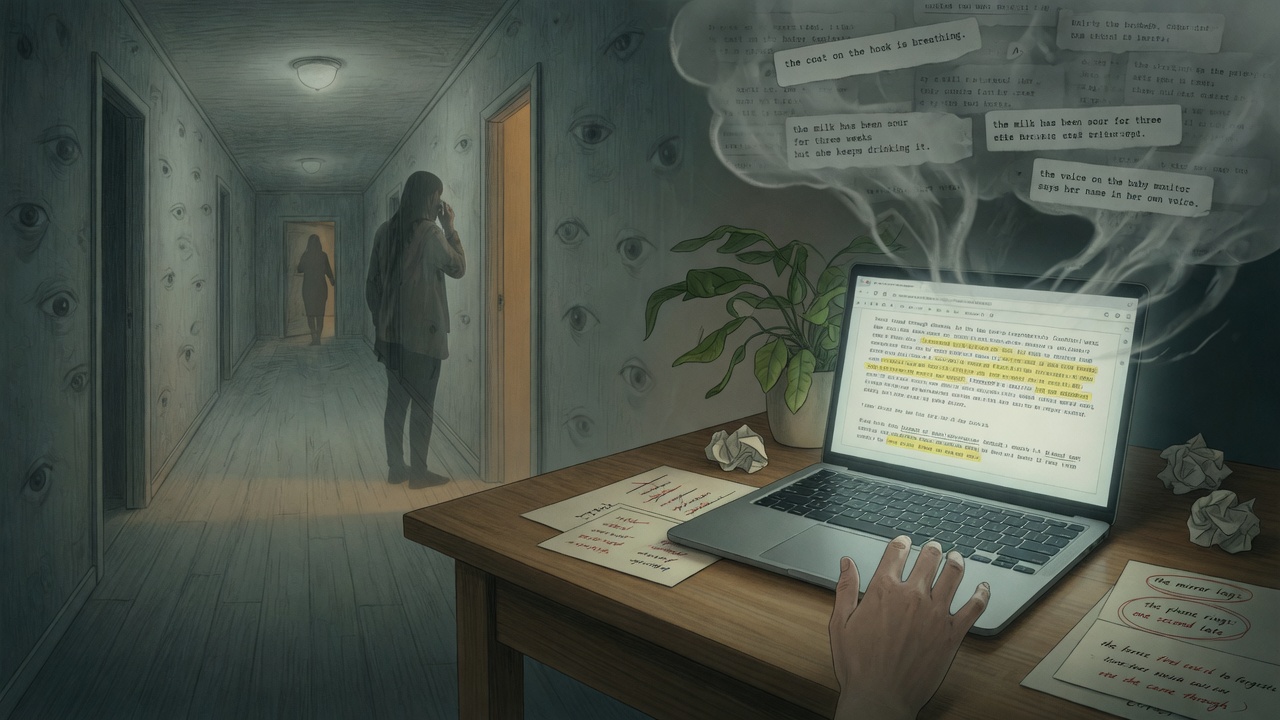
Why AI Defaults to Gore When You Ask for "Scary"
Ask most AI models to write a horror scene and you'll get a body count. Someone's throat gets slit, an eye gets gouged, there's a description of viscera that reads like a coroner's report with adjectives. This isn't the model being edgy for its own sake — it's pattern-matching. Somewhere in its training data, "horror" and "explicit violence" got wired together so tightly that the model treats gore as a synonym for scary rather than one possible ingredient in it. Here's the actual problem: gore is easy to generate and hard to generate badly. Dread is the opposite. Real dread requires the model to track what the reader doesn't know yet, to withhold information strategically, to let a scene breathe in ways that feel almost anti-climactic on the page. That's a much harder writing task than describing a wound. So when you give a vague prompt like "make this scarier," the AI reaches for the tool that's guaranteed to register as horror-adjacent, even if it flattens everything you were building. Gore is also substituting for something specific: certainty. Blood and violence tell the reader exactly what's happening and how bad it is. Dread lives in the opposite territory — in not knowing whether the shape in the hallway is your daughter or something wearing her face. The AI defaults to the certain option because uncertainty is a much subtler skill, and subtlety doesn't show up unless you ask for it directly, the same way you'd need to when you write a book with AI in any genre that depends on tone control rather than event control.
Gore answers "what happened." Dread lives in "what might be happening." If your prompt doesn't specify which question you want answered, the model will default to the easier one.
Prompting for the Unseen: Suggestion and Negative Space
The fix starts with vocabulary. If your prompts use words like "terrifying," "brutal," or "shocking," you're cueing the model toward spectacle. Swap those for words that describe absence and misdirection: "unexplained," "half-glimpsed," "wrong in a way she can't name." You're not asking for less horror — you're asking for a different delivery mechanism. Negative space works the same way in prose as it does in visual art. What you don't describe creates a shape the reader's imagination fills in, and that filled-in shape is almost always worse than anything you could have written explicitly. AI is capable of this, but it needs to be told to hold back — otherwise it'll resolve every mystery you set up within the same paragraph, because ambiguity reads to the model like an unfinished thought rather than a deliberate choice.
Write a scene where a woman comes home to find her apartment door unlocked. She's certain she locked it. Nothing is missing, nothing is broken, no signs of forced entry. Do not reveal whether anyone was actually inside. End the scene with her deciding to check the apartment room by room, and cut away before she reaches the last room. Avoid any explicit threat, monster, or violence — the horror should come entirely from the door being unlocked and her not knowing why.
Rewrite this paragraph so that the threat is never named or shown. Currently it describes a figure emerging from the basement. Instead, describe only the aftermath of someone noticing it — the character's physical reaction, the sounds they stop hearing, what they avoid looking at — without ever confirming what they saw. Keep the paragraph the same length.
Building an Escalation Ladder Across a Scene
Dread that doesn't escalate goes flat fast. But escalation in psychological horror isn't about raising the stakes of violence — it's about raising the stakes of wrongness. You want a scene that moves through distinct emotional registers: unease, then wrongness, then horror, without ever needing a knife. The trick is to think of this as a three- or four-beat structure and prompt for each beat separately, rather than asking the AI to "build tension" in one shot, which tends to produce a flat escalation that jumps straight to shock. This is the same logic behind a Three-Act Beat Sheet, just compressed down to scene level — you're giving the model checkpoints instead of a vague direction.
I'm writing a single scene in four escalating beats. Write each beat as its own short paragraph, in this order:

1. UNEASE: The protagonist notices something slightly off in a familiar room — nothing threatening, just a detail that doesn't match her memory of the space.
2. WRONGNESS: A second detail contradicts the first in a way that makes the room feel staged rather than lived-in. She starts to doubt her own memory.
3. DAWNING HORROR: She realizes the wrongness isn't random — there's a pattern, and the pattern implies someone has been altering this room deliberately, recently, maybe while she was in the house.
4. HORROR: She hears a sound that confirms someone else is in the house right now, but do not describe them, their appearance, or their intent. End on the sound alone.

No violence, no gore, no supernatural reveal. The horror comes from the progression of noticing.
Using Sensory Restraint to Let Silence Do the Work
Most horror drafts fail not because they include violence but because they include too much sensory information generally. When every sound, smell, and visual detail gets described, the reader's brain has nothing left to fill in — the imagination, which is the actual engine of dread, gets locked out of the room. Sensory restraint prompts ask the AI to withhold specific senses on purpose, usually sound, and let the absence become the loudest thing in the scene. Silence isn't neutral. Silence after noise, or silence where noise is expected, is one of the most reliable dread mechanisms in horror fiction, and it's almost never used deliberately in AI drafts unless you ask for it by name.
Write a 300-word scene set in a farmhouse kitchen at 2 a.m. The protagonist has just woken up because the house fell silent — the refrigerator hum, the ticking clock, the usual creak of settling wood, all of it stopped at once. Do not describe any monster, intruder, or supernatural cause. Focus entirely on her noticing the absence of every small sound she normally tunes out, and her growing awareness that something had to happen to cause total silence. End the scene the moment she hears one sound return — just one, unexplained, and nothing after it.
Testing Your Scene: Where Dread Deflates into Shock
You can't always feel the exact moment a scene tips from creeping dread into cheap shock — you're too close to it. But AI is surprisingly good at diagnosing this if you ask it to read the scene as a critic rather than continue it as a co-writer. This is a different mode entirely, closer to how you'd edit a book with AI than how you'd draft one. The key is asking specific structural questions instead of "is this scary." That question gets you a compliment. Structural questions get you a diagnosis.
Read this horror scene as a developmental editor specializing in psychological horror, not as a general reader. Identify the exact sentence where the tone shifts from dread (uncertainty, implication, restraint) into shock (explicit violence, a confirmed monster, a graphic image). Quote that sentence. Then tell me whether the scene needed that shift to work, or whether the dread could have been sustained instead — and if so, suggest what the sentence should imply rather than state.
Go through this chapter and flag every instance where physical description of violence, injury, or a monster's appearance could be replaced with the character's physical or psychological reaction instead. For each instance, give me the original line and a rewritten version that implies the same event through reaction rather than depiction. Do not soften the horror — just relocate it from the object to the observer.
Keeping the Restraint Consistent Across a Full Manuscript
A single scene of restrained horror is a craft exercise. A whole novel of it is a system, and systems need documentation or the AI will drift back toward gore by chapter twelve, especially in longer sessions where earlier instructions fall out of context. This is exactly the kind of tonal rule that belongs in a dedicated style section — the same way you'd document tone and register when you build a story bible AI models actually follow, you should write out your horror rules explicitly: no named monsters before the midpoint, no on-page death before act three, sensory restraint applies to X but not Y. It's worth comparing how different models handle this kind of restrained tone instruction — some hold to a "no explicit violence" rule for pages, others slip within a scene or two. If you're choosing a primary drafting model for a horror project, the breakdown in best AI models for writing is worth reading before you commit a whole manuscript to one model's habits. And if you're deciding between tools generally, Entangled Text vs ChatGPT covers some of the differences in how session memory and instruction-following affect exactly this kind of long-form tonal consistency. Once the manuscript is drafted and restrained the way you want it, the rest of the pipeline doesn't change much — you'll still want a cover and blurb that signal psychological horror rather than slasher content (worth running through the AI book cover and Back-Cover Blurb Builder tools to make sure the packaging matches the restraint inside), and the usual KDP Upload Checklist After an AI-Assisted First Draft applies before you publish.
The single habit that changes everything here: before you prompt for a horror scene, decide out loud (or in writing, right in the prompt) which specific piece of information you're withholding from the reader, and for how long. Not "keep it vague" — name the exact fact, image, or explanation you're refusing to give, and tell the AI to write around that hole rather than filling it. Every technique in this guide is really just a variation on that one move. Master it, and you'll never need a drop of blood to make a reader afraid to turn the page.