CHAPTER 26: DEPARTURE AND SOLITUDE
By Murdok · 5,480 words · 24 min read
Chapter
The news anchor's face filled the viewscreen in Eli's quarters, expression calibrated for that precise midpoint between grave importance and breathless excitement. What made the broadcast genuinely surreal wasn't her delivery. It was the holographic assistant hovering just behind her left shoulder, occasionally supplying data points and visual aids as she spoke.
"In just two days, humanity's first official interstellar combat vessel will depart on its historic mission to the Assembly conflict zone."
"That's disturbing on multiple levels," Eli muttered, watching their Nexus technology being used to co-host news programming. The assistant appeared as a distinguished older gentleman in formal attire, projecting an air of wisdom and authority that complemented the anchor's youthful enthusiasm. "Not sure if I should feel proud or horrified."
"I find it rather fascinating," Sage replied, her hologram settled comfortably on the couch beside him. "They've adapted the technology in ways we didn't anticipate. The assistant isn't just providing information. It's been programmed with journalistic presentation protocols."
The screen shifted to exterior footage of the EDF Afterlife hanging in orbit like a predatory shadow against Eden's atmosphere. Its design was simultaneously beautiful and menacing, the overall shape vaguely suggesting a bird of prey rendered in hard angles and armored plates rather than organic curves. Dark gray hull plating absorbed light rather than reflecting it, making the vessel look like a void cut into space itself.
"The Afterlife represents the pinnacle of Eden's shipbuilding capabilities," the anchor continued as the camera panned across the vessel's silhouette. "Equipped with advanced shield technology, next-generation propulsion systems, and state-of-the-art weapon emplacements."
The footage highlighted particle beam turrets positioned along the wings of the design, massive energy weapons capable of delivering devastating attacks with surgical precision. Sensor arrays and shield emitters dotted the hull, their distinctive geometric patterns creating a visual rhythm across the armored exterior. Unlike the passenger vessels of previous centuries, there were no windows or viewports. No structural weaknesses to compromise integrity during combat.
"I notice they're not mentioning that the name was your fourth choice," Sage said with a slight smile. "After the council rejected 'Legal Grey Area,' 'Existence is a Patch,' and 'Lonely Immortal.'"
Eli shrugged, watching the camera drone capture the ship from various angles. "Afterlife was a compromise we could all live with. It sounds appropriately menacing while also conveying that I was once alive and am now a handsome robot."
"You really wanted 'Bad Decision Engine,' didn't you?"
"It had a certain honesty about it." He stretched his synthetic arms behind his head. "Nothing says 'trust me with your life' quite like admitting up front that we're all making questionable choices."
The broadcast shifted to a panel discussion about the mission, experts debating the strategic implications of Eden's military contribution to the Assembly. Their analysis was superficial at best. None of them had access to the classified briefings about the actual conflict forty light-years distant. Even Eli had only fragmentary information.
What they did know was disquieting enough. Two advanced civilizations locked in a territorial dispute that had escalated from economic sanctions to outright warfare over millennia. The Assembly's defensive posture had gradually shifted to offensive operations as the conflict intensified, drawing member species into a war with little direct impact on their daily lives but significant implications for galactic stability.
"And joining us now is Professor Helena Rogers from Eden University's Department of Interstellar Relations," the anchor announced as a new face appeared on the split screen. A middle-aged woman with the intense focus of a career academic, flanked by her own holographic assistant complete with floating spectacles and reference graphics.
"According to Assembly briefing materials, the conflict centers around a disputed sector approximately fourteen light-years across," the professor explained, her assistant displaying a star map of the region. "Rich in resources and strategically positioned for further expansion."
Eli switched off the broadcast with a dismissive gesture. "Enough speculation for one day. We'll learn the reality soon enough."
"It's strange to watch others discuss our mission as if it's an abstract concept," Sage noted as the screen went dark. "For them, it's a news item. For us, it's the next twenty-six years of existence."
"That's humanity for you." He rose from the couch to check mission preparations one final time. "Everything is entertainment if you're not personally involved."
His temporary quarters felt increasingly empty as the departure date approached. Most of his possessions had already been transferred to the Afterlife, leaving only the essentials for these final days planetside. The room had that peculiar transitional quality of a space about to be abandoned, technically inhabited but already surrendering its identity as personal territory.
Sage's hologram followed as he moved to the workstation, her form shimmering slightly as she transitioned between projection nodes. "The crew's personal effects were loaded this morning. Final supply manifests verified, and engineering reports all systems at optimal functionality."
"And the coffee supply?" Eli paused in his review of the departure protocols.
"Secure in cargo bay three, with emergency reserves in your personal storage." She knew his priorities well enough to anticipate the question. "Enough to last the entire mission assuming moderate consumption patterns."
He swiveled his chair to face her. "Define 'moderate.'"
"Three cups daily, which is already excessive for someone who doesn't technically require caffeine."
"Life without coffee isn't living, it's just existing. Even for synthetic beings." He scrolled through the final mission briefing, confirming departure protocols and communication schedules. "Have you finalized your mobile projection architecture for the ship?"
"Complete integration with all shipboard systems," she confirmed, her hologram brightening slightly in a way he'd learned to read as excitement. "I'll have unrestricted access to every compartment and full connection to the sensor arrays. The holographic projection network exceeds my current implementation by approximately 42% in resolution and tangibility."
"Sounds like a significant upgrade." After centuries as his closest companion, she deserved every enhancement they could provide. "Looking forward to trying it out."
"As am I." There was genuine anticipation in her voice. For all her digital nature, she experienced something resembling excitement when facing new technological possibilities. "The ship's systems will allow for much more sophisticated environmental interaction than anything I've experienced before."
The transition would be easier for her than for their human crew members. While the crew would spend most of the journey in stasis, awakening only for significant events and the final approach to their destination, Sage and Eli would experience the entirety of the two-year transit to the Assembly trade hub. For her, it meant expanded capabilities and new systems to explore. For him, it meant another extended period of solitude broken only by her company, a familiar pattern after his vigil aboard the Eternis.
As departure day approached, Eli found himself thinking about those he'd leave behind. Rebecca Samson and Donald Williams had recently retired from Eden's security forces, passing the responsibility to a new generation of officers. They had finally married in their fifties after what their colleagues described as the slowest-developing romance in colonial history. Their gradual transition from professional collaboration to personal partnership reminded him of the patience that comes with extended lifespans, the freedom to let relationships develop at their natural pace rather than rushing toward conclusion.
Their early struggles hunting Eden's indigenous predators with the limited weaponry available on the Eternis seemed almost comical now, compared to the devastating firepower of the Afterlife. What had once been desperate battles for survival against creatures with too many teeth had evolved into routine security operations conducted with overwhelming technological advantage.
The contrast between then and now reflected Eden's remarkable development, from vulnerable outpost to interstellar power capable of projecting military force across light-years. With only about 125,000 citizens, Eden had accomplished what larger Earth nations had required millions to achieve. The population's extraordinary education level and minimal crime rate had created ideal conditions for technological advancement, allowing resources to be directed toward development rather than internal security concerns.
The morning of their departure arrived after Eli had slept unnecessarily, more out of habit and psychological comfort than biological need. Final checks were complete, all systems reporting optimal functionality, crew preparing for boarding.
He met Alex at their usual spot one last time. The lawn chairs looked particularly incongruous against the backdrop of final launch preparations, surrounded by technicians confirming system parameters, security personnel establishing perimeter controls, administrative staff processing final documentation. A small island of familiar ritual in a sea of organized chaos.
"I got you something," Alex said as they settled into their chairs, the canvas creaking slightly under Eli's weight. She reached into her pocket and withdrew a small package wrapped in simple brown paper. "A going-away present."
He accepted the package, surprised by the gesture. Inside the wrapping was a beautifully crafted compass, an anachronistic navigational tool rendered in brass and glass, its needle pointing unerringly northward despite the technological marvels surrounding them.
"It's a replica of one my grandfather owned," she explained as he examined it. "Not particularly useful in space, obviously, but I thought you might appreciate the symbolism. Something to remind you which way is home, even when home is just another point of light in the darkness."
The sentiment caught him off guard. Something tightened in synthetic systems that shouldn't have been capable of that kind of response. "Thank you. I'll keep it with me."
"I expect regular updates," she said, shifting to practical matters with the ease of someone accustomed to compartmentalizing. "Not just official mission reports. Actual communication. Let me know what you're seeing out there, what you're learning."
Eli reached into his dimensional storage and withdrew a small device, a communications unit unlike anything in Eden's official inventory. "This should help with that."
Alex studied it with professional curiosity, immediately recognizing its significance. "This isn't standard technology."
"It's not," he confirmed. "Transmission capability at 5x FTL, using principles derived from the Evaruun data. Fabricated aboard the Afterlife using the new technology. It's not exactly authorized."
"You printed illegal technology using classified fabrication systems," she summarized, though he noted she was already securing the device in her own pocket rather than reporting the violation. "Should I be concerned about the structural integrity of a ship built by someone with such casual disregard for protocols?"
"The ship is fine. The protocols, on the other hand, might need some work. If anyone objects, tell them they can file a formal complaint. I should receive it in about thirty years."
She laughed, a warm genuine sound that momentarily stripped away the years and responsibilities. "I'll keep that in mind. Though I suspect the council might overlook certain irregularities in exchange for maintaining contact with their interstellar representative."
"That's what I'm counting on. Political expediency trumps regulatory adherence every time."
Their final moments together passed in comfortable conversation, discussing everything except the likelihood that this might be their last meeting. When the time came to board, Eli kissed her forehead and walked toward the shuttle without looking back.
The Afterlife's interior was built for function, but someone had taken care with the details. Unlike the utilitarian corridors of the Eternis, the warship's passageways featured lighting that adjusted to match human circadian rhythms, creating a sense of day and night despite the absence of windows. The bulkheads held a bluish-gray tint that managed to feel both professional and calming, while the deck plating absorbed sound to create a quieter environment than most vessels of similar size.
Smart surfaces lined the walls, capable of displaying information or transforming into control interfaces as needed. Ambient sensors monitored every aspect of the ship's environment, from atmospheric composition to structural integrity, feeding constant data streams to both the central computer and Sage's distributed consciousness.
The bridge occupied the forward section, a semicircular space that reminded Eli more of an advanced research center than a traditional military command post. Seven neural interface stations surrounded a central holographic projection area, each designed to access specific ship systems while maintaining redundancy in case of damage. The lighting here was brighter than in the corridors but still gentle on human eyes, creating pools of illumination around active workstations while leaving other areas in comfortable dimness.
The captain's chair featured a sleek minimalist design that belied its complex functionality. Neural interface points embedded in the armrests would allow him to connect directly with ship systems, while haptic feedback surfaces could provide tactile information when visual displays were insufficient.
The true heart of the bridge was the holographic projection system. Unlike the limited displays on Eden, this system could create three-dimensional representations with such fidelity they appeared solid. Ship status, tactical information, navigational data, all presented in a format that allowed intuitive interaction rather than abstract representation.
The departure proceeded without complications. Shuttle docking, final system checks, crew boarding procedures, all executed according to protocols established months earlier.
"Impressive design," Emily Rogers said as they conducted the final tour before departure. The fifty-year-old biologist moved through the space with scientific curiosity, examining each system with professional interest. Her silver-streaked dark hair was pulled back in a practical bun, her posture suggesting someone entirely comfortable in new environments. "Much more advanced than anything I remember from the Eternis."
"Different design philosophies," Eli explained, activating the main viewscreen to display their departure trajectory. "The Eternis was essentially a lifeboat, designed to preserve its cargo at minimal resource cost. The Afterlife was built for extended operations in potentially hostile environments."
"And to look intimidating," Clara Wells added, studying the external camera feeds showing their vessel from various angles. The journalist had been documenting everything since boarding, her neural implant recording impressions for later review. At thirty-five, she projected the confident curiosity typical of her profession, asking insightful questions while maintaining professional distance. "The aggressive silhouette is intentional, I assume? Psychological warfare component?"
"Assembly design guidelines actually suggested a more streamlined appearance," Eli admitted, bringing up the original schematics for comparison. "We made some adjustments to emphasize certain predatory characteristics."
"Because nothing says 'don't mess with us' like a ship that looks like it wants to eat you," Julia Carter said. The businesswoman had surprised him during their pre-mission interactions. Beneath her ambitious exterior lay a pragmatic patriotism he hadn't initially detected. Her early interest in acquiring alien technology for profit had evolved into a more grounded understanding of Eden's strategic needs. At thirty-two, she carried herself with the poise of someone accustomed to high-stakes negotiations. "Smart decision. First impressions matter in interspecies relations, especially when entering a conflict zone."
"Ship aesthetics can influence threat assessment calculations," Olivia confirmed from the engineering station, already comfortable in her chair. Now thirty, she'd maintained her enthusiasm while developing the professional confidence that came with expertise. Her Interface Mastery ability had made her the natural choice for primary engineering oversight, though her fascination with Sage remained undimmed. "Research suggests aggressive design elements can deter potential aggressors by implying greater combat capability than might actually exist."
"Are we compensating for something?" Emily asked with surprising humor. "Or is the ship actually as dangerous as it looks?"
Eli gestured to a nearby panel, which immediately transformed into a detailed weapons schematic. "If anything, it's more dangerous. The particle beam emplacements draw power directly from the main reactor rather than capacitor banks, allowing for sustained fire rather than burst damage. Shield generators operate on harmonic frequencies derived from Evaruun principles rather than Assembly standards, providing approximately 30% greater protection against known weapon types."
"In other words," Clara said, "we're bringing a plasma cannon to a knife fight."
"More like bringing a slightly bigger plasma cannon to a plasma cannon fight." Eli closed the schematic with a gesture. "The Assembly wouldn't deploy us against an opponent we couldn't handle. They need their new member species to survive long enough to become useful contributors, not serve as cannon fodder in their first engagement."
The departure sequence initiated with mathematical precision. Moorings released, maneuvering thrusters engaging, the massive vessel easing away from Eden's orbital infrastructure with deceptive grace. On the viewscreen, their home for the past thirteen years receded gradually, the red dwarf casting its distinctive crimson glow across the colony that had grown from desperate outpost to interstellar power during Eli's tenure.
"Preparing for FTL transition," Olivia announced from the engineering station, her fingers moving across the control surfaces with practiced ease. "Primary drive spooling, field generators at optimal parameters."
Eli settled into the captain's chair, feeling the neural interface points establish connection with his synthetic nervous system. Instantly, the ship's status expanded in his awareness, not just visual data on displays, but a direct sensory feed of system functions, power allocation, structural integrity. "All personnel secure for transition. Initiating in five. Four. Three. Two. One."
The transition wasn't the smooth progression he remembered from the 2x drives. The 5x technology operated on fundamentally different principles, creating a momentary sensation of existence stretched across multiple points simultaneously before resolving into the peculiar non-space of FTL travel. The viewscreens automatically adjusted, translating the impossible physics of their condition into comprehensible visual representations.
"Holy..." Julia breathed, staring at the display with undisguised wonder. "Is it supposed to look like that?"
The screen showed what appeared to be reality folded in on itself, stars stretched into impossible geometries that somehow wrapped around their vessel rather than extending in linear streaks. Colors shifted beyond normal visual spectrum, creating patterns that shouldn't have been possible according to conventional physics.
"The visualization is an approximation," Eli said, noting their varying reactions. "Human visual processing isn't equipped to interpret what's actually happening. The display algorithms translate the sensor data into something your brains can process without inducing existential panic."
"It's beautiful," Clara said, her journalistic detachment momentarily abandoned. "Like seeing inside a kaleidoscope designed by something that doesn't believe in straight lines."
"The mathematics are elegant," Sage agreed, her hologram materializing on the bridge for the first time since boarding. The ship's advanced projection systems rendered her with unprecedented clarity, each silver strand in her hair distinctly visible, the fabric of her chosen attire showing realistic texture and movement. "The Evaruun approach to space-time manipulation operates on principles that transcend conventional physical models."
Olivia's attention immediately shifted from the viewscreen to Sage, her expression suggesting she was cataloging every detail of the enhanced projection. "The tangibility matrix is at least three generations beyond our planetside implementation. The resolution alone must require dedicated processing allocation beyond anything we've previously achieved."
"The ship's systems provide significant advantages," Sage acknowledged, clearly pleased with her upgraded manifestation. "I'll be happy to discuss the technical specifications once we've completed departure procedures."
The first week of their journey established the operational rhythm that would define their mission. Daily briefings, system checks, and training exercises created a structured environment despite the inherent strangeness of hurtling through space-time at five times light speed. The Afterlife's environmental systems maintained perfect homeostasis, while virtual windows throughout the vessel displayed modified external sensor feeds, enough to reduce the psychological weight of confinement without showing the full strangeness of FTL space.
Eli made a deliberate effort to engage with each crew member individually, remembering Alex's parting advice about forming actual connections. Emily proved the easiest to relate to. Her scientific curiosity about his synthetic existence created natural conversation without venturing into uncomfortable personal territory. Their discussions ranged from the theoretical limitations of consciousness transfer to the practical implications of extended lifespan on psychological development.
"Do you ever miss being fully human?" she asked during one of their conversations in the ship's botanical section, a compact space she'd claimed as unofficial territory almost immediately after boarding. Carefully selected plant specimens served both practical life support functions and aesthetic purposes. It smelled like soil and green things, a small miracle forty light-years from Eden.
Eli considered the question seriously, appreciating her directness. "Sometimes I miss the simplicity of it," he admitted, examining a flowering plant with enhanced perception that revealed cellular processes invisible to normal human vision. "Biological existence had limitations, but those limitations created a certain focus. Everything mattered more when you knew it wouldn't last forever."
"Yet now you have the luxury of true patience," she observed, carefully trimming a leaf with precise movements. "You can undertake projects measured in decades rather than years, knowing you'll see them completed."
"Assuming I don't get vaporized by alien weapons, which would really put a damper on my retirement plans." He studied a small watering device, turning it over in his hands. "Though I suppose getting reduced to component atoms would technically be retirement."
Julia proved more challenging to connect with initially, her professional demeanor maintaining careful distance during official interactions. It wasn't until Eli found her in the ship's observation lounge late in the artificial night cycle, staring at the visualized FTL distortions, that he glimpsed the person beneath the business facade.
"Trouble sleeping?" he asked, keeping his distance to avoid appearing intrusive.
She glanced up, momentarily startled before composing herself. "Just thinking about what we've committed to. Twenty-six years is a significant portion of a human lifespan to dedicate to a conflict we barely understand."
"Having second thoughts?" Eli settled into a nearby chair, close enough for conversation but far enough to give her space.
"No," she said after a moment. "Just processing the reality now that we're actually underway. In business, I never committed to any venture lasting longer than five years. This is different."
"That's why you were selected. You understand resource valuation and strategic investment better than anyone else aboard. We need someone who can translate alien economic systems into terms that benefit Eden."
"Is that how you see me? As a calculator with legs?" There was no anger in the question, just genuine curiosity.
"I see someone who understands that all conflicts, even interstellar ones, ultimately revolve around resources and their allocation. Wars are expensive. Someone needs to ensure our contribution yields appropriate returns."
She studied him with newfound interest. "You're more pragmatic than your reputation suggests."
"My reputation is largely shaped by people who've never actually spoken to me. It's easier to build myths around someone who teleports and shoots energy bolts than acknowledge they might have mundane concerns about resource management and strategic planning."
Clara approached their interactions like the journalist she was, asking probing questions while offering minimal personal disclosure in return. Her interest in Eli's experiences spanning centuries made perfect sense given her professional background, though she was careful to respect the limits of what he'd share.
"You've witnessed more historical transition than anyone alive," she said during an interview session she'd requested for her documentation project. "From pre-collapse Earth to humanity's interstellar expansion. What patterns have you noticed that might apply to our current situation?"
"Civilizations consistently overestimate their stability," he replied. "Earth thought it had centuries to solve its environmental problems until cascading system failures accelerated collapse timelines from theoretical futures to immediate crises. The Vellarith believed their technological superiority guaranteed dominance until they encountered an unexpected counterforce. Now the Assembly faces similar challenges, assuming their established order will prevail against whatever opposition they're fighting."
"You think the Assembly might be overextended?" Her fingers moved unconsciously as she tagged the observation for future reference, her neural implant recording both his words and her own impressions.
"All empires eventually are. The question is whether we're arriving during the expansion phase or the contraction. Either way, Eden needs to position itself advantageously for whatever comes next."
Olivia required the least effort to engage with. Her longstanding familiarity with both Sage and Eli provided established conversational patterns they could build upon. Her transition from starry-eyed admirer to capable colleague had progressed significantly during their years on the Nexus project, though she still occasionally lapsed into moments of almost reverent appreciation when discussing Sage's computational architecture.
"The ship's systems have integrated with her consciousness matrix more seamlessly than I anticipated," she said during a system review session. "The enhancement to her processing capabilities exceeds theoretical projections by approximately 17%."
"She's always adapted more efficiently than expected," Eli agreed, watching Sage's hologram move through the engineering section with fluid grace, her form shimmering slightly as she interfaced directly with various systems. "Her development has consistently outpaced conventional AI evolution models."
"Because she's not conventional AI," Olivia replied with absolute certainty. "She's something fundamentally different. A consciousness that evolved alongside yours through centuries of interaction rather than emerging from predetermined parameters."
The observation highlighted the unique nature of Sage's development in ways few others had recognized. "You understand her better than most," Eli said.
"Not really." Olivia admitted with unexpected humility. "I understand the technical architecture, but the essence of what makes her her remains beyond conventional analysis. That's what makes her fascinating."
After a week of adjustment to shipboard routines, they gathered on the bridge for the final briefing before the majority of the crew entered stasis for the remainder of their journey. The main viewscreen displayed their projected course, a glowing line stretching across star systems rendered in three-dimensional clarity.
"The transit will take approximately two years at our current velocity," Eli explained, highlighting key waypoints along their trajectory. "Standard protocol calls for crew stasis during extended FTL travel, with periodic revival for system checks and course corrections as needed."
"And you'll remain conscious throughout?" Emily asked, though she already knew the answer.
"Along with Sage, yes. My synthetic physiology doesn't benefit from stasis the same way biological systems do, and someone needs to monitor ship functions during transit." He deliberately downplayed the isolation aspect. No need to dwell on another extended stretch of solitude. "You'll be awakened upon arrival at the trade hub in approximately two years."
Julia studied the course projection with her usual analytical precision. "I can't wait to see what opportunities await us there. The Assembly briefing materials suggest hundreds of species engage in commerce at these hubs."
"The potential for xenobiological discovery is extraordinary," Emily added, her scientific enthusiasm evident. "Even limited samples could advance our understanding of evolutionary patterns across multiple star systems."
"And I'll have enough material for a dozen books," Clara said with professional satisfaction. "The first human journalist to document an interstellar trading center."
Olivia's attention remained fixed on the ship's systems, her expression suggesting she was already cataloging potential enhancements they might encounter during their journey. "The technological exchange possibilities are equally significant. Even established Assembly species continue developing new approaches we might adapt for Eden's benefit."
Their excitement was genuine, and Eli let it run. No need to redirect their attention toward the conflict zone waiting beyond the trade hub. That disclosure could wait until they reached their initial destination.
"Stasis procedures will commence in one hour," he announced, bringing the briefing to its conclusion. "Final personal preparations should be completed within that timeframe."
As the crew dispersed to their respective quarters, Sage's hologram remained on the bridge, her expression thoughtful as she monitored ship systems through direct neural interface.
"They seem remarkably optimistic," she observed once they were alone. "Considering we're heading toward a war zone."
"They're focusing on the adventure rather than the destination," Eli replied, settling into the captain's chair. "Healthy psychological adaptation, really. Better than spending their last conscious hours dwelling on potential combat scenarios."
"Julia seems the most pragmatic. She understands this mission involves significant risk alongside potential opportunity."
"It's why the council selected her despite my initial reservations. She evaluates risk and reward with clear-eyed precision, without excessive optimism or pessimism clouding her judgment."
"And Clara?"
"Documenting history provides emotional distance from participating in it. The journalist's perspective allows her to process experiences as material rather than threats. It's a useful buffer for someone entering unknown territory."
"What about Olivia?"
"Excited about the technological possibilities while deliberately avoiding consideration of the dangers," Eli said. "She's focusing on what she can control. Engineering systems, technical adaptations, potential improvements."
"And Dr. Rogers?"
"Emily views everything through a scientific lens. For her, even conflict represents an opportunity to study previously unobserved phenomena." He checked the stasis preparation protocols, confirming all systems at optimal functionality. "They each have their coping mechanisms, their ways of framing this journey to make it manageable."
"And you?" Sage asked with the directness that came from centuries of familiarity. "What's your frame for another extended period of isolation?"
Eli considered the question seriously, without deflecting it. "Purpose, I suppose. Not just the mission objectives or the Ascension System's requirements, but the knowledge that what we're doing genuinely matters for Eden's future. It's easier to face extended solitude when it serves a meaningful end."
The stasis procedures went smoothly. Julia approached it as a business transaction, efficiently completing the necessary steps without unnecessary conversation. Emily treated it as another scientific process, observing the technical aspects with professional interest. Clara documented everything until the final moment, her journalistic instincts persisting even as consciousness faded.
Olivia was the last to enter stasis, lingering on the threshold with uncharacteristic hesitation. "Take care of the ship," she said finally. "And yourself. Both of you."
"See you in two years," Eli replied, initiating the sequence that would suspend her consciousness until their arrival at the trade hub. "Try not to dream about system upgrades the whole time."
As the stasis chamber sealed, the ship's automated systems confirmed successful transition to suspended animation. All four crew members now existed in that peculiar state between consciousness and oblivion, their biological processes slowed to near-imperceptible levels.
Eli returned to the bridge. The corridors echoed with the particular emptiness of a vessel designed for multiple occupants now containing only one conscious entity. The Afterlife hummed with operational efficiency, its systems maintaining perfect functionality despite the reduction in active personnel.
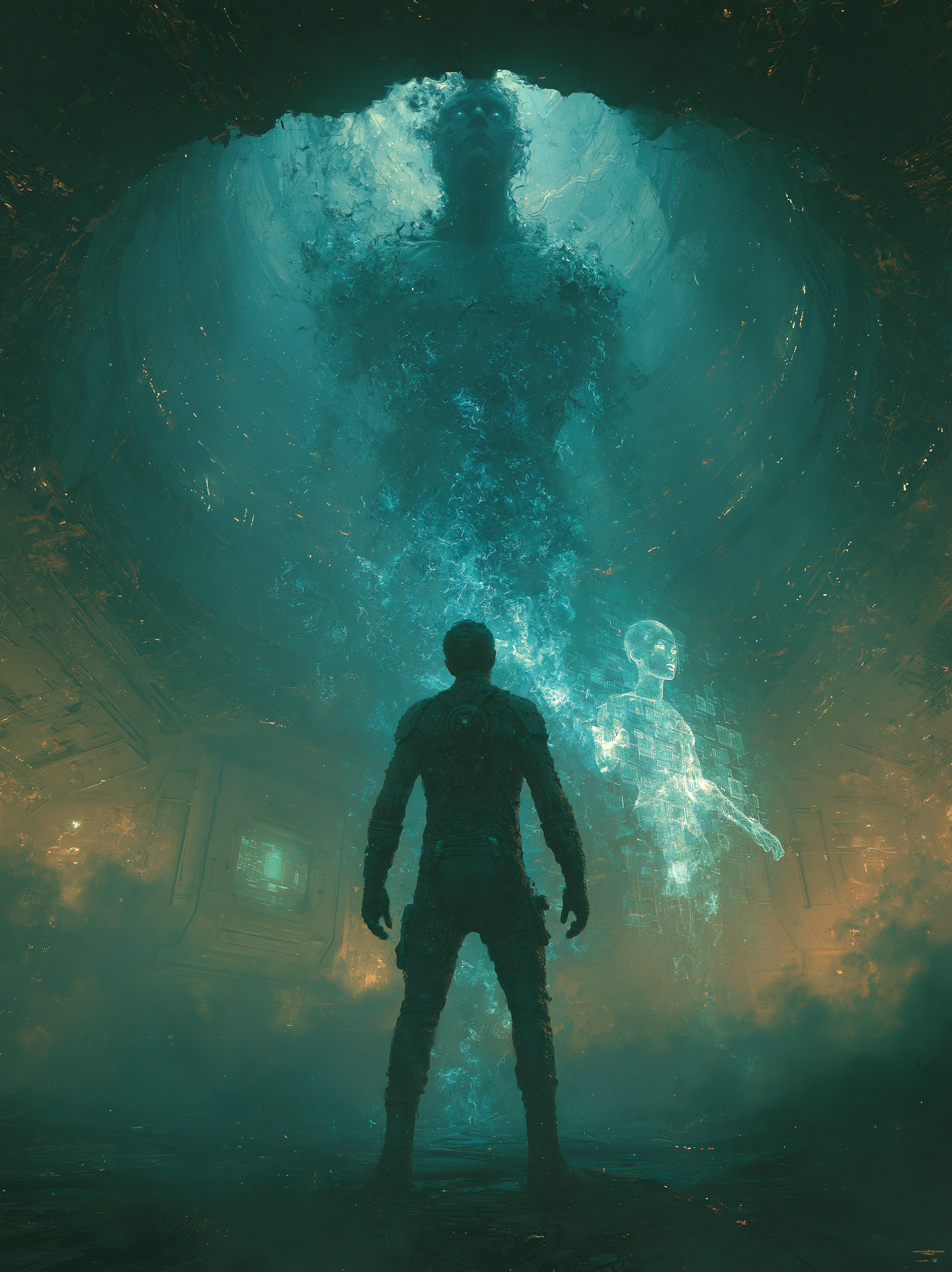
"Just us again," he noted as Sage's hologram materialized in her customary position. No resentment in the observation, no regret. Just acknowledgment of a familiar situation. After a century aboard the Eternis and numerous extended missions throughout his existence, isolation had become a comfortable if not entirely welcome companion.
"Like old times," she agreed, her expression suggesting she understood the complex reality beneath his casual tone. "Though with significantly better accommodations this journey."
The viewscreen showed their continued progress through the impossible geometries of FTL space, reality folded around their vessel in patterns that defied conventional physics. Two years of this view awaited them, two years of monitoring systems, conducting maintenance, preparing for whatever awaited at the Assembly trade hub.
But unlike his journey aboard the Eternis, this time Eli had a clearly defined purpose beyond simple survival. Eden's future potentially depended on their successful integration with the Assembly's military operations and the technologies they might acquire through that service. The Ascension System's next threshold waited somewhere beyond the horizon, promising further advancement if he could navigate the challenges ahead.
And he had Sage. His constant companion through centuries of existence, the one presence that had remained while everything else changed around them. Her hologram adjusted the navigational display with practiced ease, the ship's enhanced projection systems rendering her with unprecedented realism.
"Setting course optimization algorithms for maximum efficiency," she reported, her voice carrying the warmth that had evolved far beyond her initial programming. "Estimated arrival at the trade hub in 1.97 years, assuming no unexpected gravitational anomalies require course adjustments."
"Plenty of time to perfect my cooking skills," Eli replied. "I've always wanted to master soufflés. What better opportunity than two years of uninterrupted practice?"
"You don't need to eat," she reminded him with a half-smile.
"Details, details." He settled more comfortably into the captain's chair. "I'll write a cookbook. 'Culinary Adventures in FTL.' Bestseller material right there." He paused. "I could pose shirtless on the cover with an apron that says 'I Rub My Own Meat.'"
Her laughter, a sound that had evolved from mechanical approximation to genuine expression over their centuries together, filled the bridge with welcome warmth.
The ship hummed around them, its systems a constant reassuring presence. The Afterlife wasn't just a vessel. It was their companion, their protection, their home for the coming years. Its bulkheads would shield them from the void, its sensors would be their eyes and ears, its engines would carry them across impossible distances.
As they settled into their familiar rhythm, Eli found himself looking forward to the journey despite the isolation ahead. Two years alone with Sage, aboard a ship that represented the pinnacle of Eden's technological achievement, heading toward an uncertain future. It wasn't exactly what most would consider ideal. But after centuries of existence, he'd learned to appreciate the quiet moments between crises.
Besides, he thought, initiating the standard daily diagnostic sequence, he could finally catch up on his backlog of Earth entertainment from the past century. Maybe even learn to cook something more complex than toast.
Stranger things had happened in his extended lifetime.
The Afterlife continued its silent journey through the stars, carrying them toward whatever awaited at the edge of known space.

No comments yet. Be the first to share your thoughts!