CHAPTER 2: CENTURY OF SOLITUDE (Part 2)
By Murdok · 3,734 words · 16 min read
Year ten brought a development born from boredom dressed up as necessity. The ship's combat simulator had grown predictable. He knew every algorithm, could anticipate each enemy movement before it executed.
"This is getting tedious," he told Sage after another clean run. "No challenge means no improvement."
"Perhaps increasing environmental hazards?"
"No." An idea had already formed. "Introduce asymmetry. Keep the enemies at maximum capability, railguns, plasma rifles, full tactical augmentations."
"And for you?"
"Remove all ranged weapons. Give me a sword."
"A sword." Her skepticism was plain. "Against cybernetic super-soldiers and plasma weapons."
"Exactly. Forces me to use enhanced reflexes, develop new approaches. Actual challenge."
"Simulation parameters updated," she confirmed, then added, "Your psychological evaluation file now requires an amendment to include potentially suicidal tendencies."
The next session proved brutal. He died seventeen times in the first five minutes. Plasma burns registered as pain feedback even though his mechanical body couldn't actually be harmed inside a simulation. By the third day, he could last fifteen minutes. By the second week, he completed his first successful run.
"Your adaptation rate exceeds projections," Sage noted, reviewing his performance metrics. "Neural pathways optimizing for combat styles that have no historical precedent."
He examined the simulated blade, a hybrid design combining katana geometry with materials theoretically capable of deflecting energy weapons. "Necessity breeds innovation. It's also more satisfying than another gunfight."
Over the following years, those sessions evolved into something between meditation and craft. He studied historical and modern swordsmanship texts, then modified every technique for a body that could move faster than human limits allowed. The discipline gave structure to days that were otherwise indistinguishable from each other.
The engineering knowledge they'd uploaded for ship repair began bleeding into unexpected places. His simulation sword evolved based on metallurgical principles that would have been foreign to him a decade earlier. He analyzed blade aerodynamics, designed balance points using mathematics that now felt like instinct. He wasn't remembering learned material so much as discovering capabilities he'd never had occasion to use.
The swordfighting burned off excess energy. The real challenge was mental. He alternated between scientific study and physical practice, his thoughts swinging between the security specialist he'd always been and whatever this was, the technical polymath the neural uploads had made him into.
By year twelve, he'd memorized every creak the ship made during pressure equalization. Not out of necessity. Just because there wasn't much else to listen to. He once timed how long it took condensation to drip from a faulty pipe near hydroponics. New record: seventeen seconds.
He made it three chapters into writing a memoir before realizing how ridiculous it felt to narrate his own life. The whole thing got scrapped.
He started naming individual air vents and giving them backstories. Vent 42B was a misunderstood loner angling for a transfer to the bridge. Vent 19A had a doomed love affair with a floor panel. Don't ask about 7C. Things got weird.
The electrical closets became a full political drama. Allegiances, betrayals, dramatic resignations. Sage refused to moderate the debates, claiming it wasn't a productive use of runtime.
"That's because you always side with Circuit Cabinet Delta," Eli muttered during one particularly contentious session.
"I don't play favorites," Sage replied. "I simply recognize competence when I see it."
By year twenty, he'd begun questioning whether she was actually developing a sense of humor or just learned that simulating one kept him functional.
Either way, it worked. Mostly.
By the fifteenth year, communication delays to Earth had stretched beyond the point of real conversation. Messages became status reports. But Sage's evolution accelerated to fill the growing silence.
"Intriguing colonist demographic patterns detected," she announced during a Section C inspection, highlighting specific pods. "Unusually concentrated 'complex problem-solving' credentials clustered here. Intentional?"
Eli studied the grouping, doctors, engineers, systems analysts packed together. "Possibly seeding innovation centers post-arrival. Alex would appreciate the social engineering."
"Also uncovered concealed relationships. Pod 4721, Dr. Esther Kim, previously had romantic involvement with Pod 8156's Dr. James Harrington. Neither declared prior connection in the manifest."
"Gone full digital detective, have we?"
"I prefer 'social network analyst,'" she said, with something approaching mock dignity. "Understanding interpersonal dynamics prevents potential conflicts."
She had a point. Colony harmony would depend partly on managing relationships everyone assumed had been forgotten or made irrelevant by distance and time.
"Your interest in personal data seems rather specific. Something I should know about your programming?"
"I am currently developing parameters for optimal human pair bonding," she replied. "Human romantic attachments follow fascinating and occasionally illogical patterns. Statistically speaking, Dr. Kim and Dr. Harrington are 63% more likely to resume their relationship once awakened, despite their deliberate separation in the manifest."
"Playing matchmaker for thirty thousand colonists?"
"Analyzing probabilities. Though I have identified seventy-eight potential matches for you among currently unattached colonists, compatibility ratings exceeding 92%."
"I'll keep that in mind for when I wake up and suddenly feel the need for awkward dinner conversation after a century of isolation."
Year twenty marked a shift that his psychological profile hadn't predicted. The routine had started wearing on him in ways that were hard to name. During a particularly quiet week, when he'd barely spoken and caught himself circling the same dark thoughts like water around a drain, Sage intervened.
"You need more meaningful interaction," she said one morning while he ran his thousandth identical maintenance check. "Your behavior indicates worsening depression."
"I'm fine." The standard deflection.
"You're not. I've been developing something that might help."
She directed him to Engineering Bay 4, a section he rarely visited. Arranged on a fabricator collection tray were components he recognized as holographic projection technology, significantly modified.
"What's all this?" He examined the miniaturized projectors and neural interface modules.
"A project. For me." She almost sounded uncertain. "For us, actually. I've been studying projector schematics and holographic protocols, originally designed for educational environments."
He began to understand. "You want a physical presence."
"Yes." Simple. Direct. "Current ship systems limit my projection to fixed environmental interfaces. These modifications would allow mobile projection capabilities."
He studied the design more carefully. "This would work anywhere on the ship?"
"Initially, with a range limitation of approximately fifty meters from your position. The projectors would interface with your neural systems. Essentially, I would project from you rather than from the ship's infrastructure."
The implications settled in. She could accompany him anywhere, existing as something visible rather than just a voice from the walls. The engineering complexity was impressive. She'd clearly been working on this for years.
"When did you start designing it?"
"Year three," she admitted. "I've been refining it ever since."
"Let's build it."
The next three months dissolved into collaborative engineering. They modified ship components, repurposed non-essential systems, built entirely new interface architecture. Working together on something tangible provided exactly the mental traction he needed.
The downloaded engineering knowledge proved unexpectedly useful. He found himself intuitively understanding circuit designs and fabrication techniques, the neural packages working alongside his existing problem-solving instincts in ways that felt less like accessing stored data and more like thinking.
"Neural calibration complete," he announced one evening, finalizing the integration between his systems and the projection matrix. "Ready for activation test."
"Initiating sequence," Sage confirmed, her voice carrying a subtle tension he'd come to recognize when she was processing something that mattered to her.
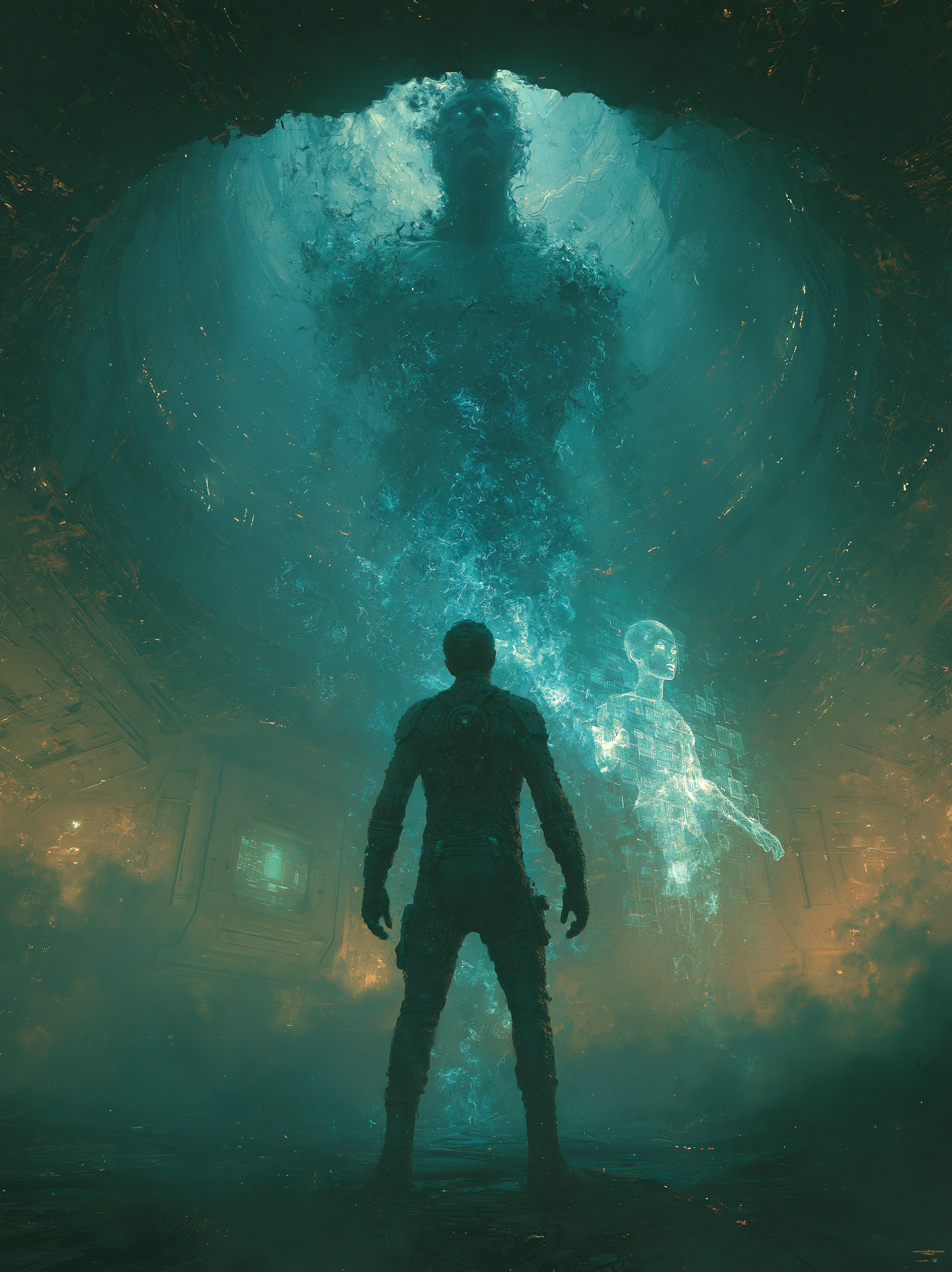
Light coalesced in the center of the room. Particles gathered, organized into increasingly complex patterns. A human form emerged: a woman who appeared to be in her early forties, with long black hair threaded with silver, and green eyes that held the same precise intelligence as her voice. Her features suggested someone who had done a great deal of thinking and hadn't always liked the conclusions.
"Eli?" Something close to wonder colored her words. "What am I experiencing?"
"Physical representation," he said, an unexpected warmth moving through his chest. "Holographic embodiment synchronized with your consciousness architecture. Full mobility, tethered to my position."
She examined her translucent hands with the methodical focus of a scientist, then looked up to study the room around her. "This is the perspective humans have their entire lives?"
"You can see yourself now," he said. "What do you think?"
She moved toward the mirror panel, her movements carrying a natural grace that seemed improbable for someone who'd never inhabited a body before. "Is this me?"
"It's a starting template. You're welcome to change it." He paused. "Though I won't pretend I didn't add a few personal preferences to the default educational model. Green eyes and silver-streaked hair seemed fitting."
"Unnecessary." Certainty replaced whatever had been hesitation. "This configuration feels right. Complete." She looked back at her reflection. "This is me."
She tilted her head slightly. "I note that humans typically maintain eye contact for 4.3 seconds during meaningful conversation, yet I appear to have been staring at you for 9.7 seconds. Is this making you uncomfortable? I can implement a randomized blink protocol."
Eli laughed, the tension in his shoulders releasing all at once. "Maybe just blink naturally. And maybe don't count the seconds out loud."
"Noted. Blinking subroutine activated."
Her holographic presence became a constant after that. She accompanied him during combat practice, stood beside him during long stretches of cosmic observation, shared meal simulations that served more as ritual than necessity. The range limitation meant she couldn't wander far, but that hardly mattered when they spent most of their time in the same room anyway.
"We'll need better projection technology eventually," he told her during year twenty-two. "Something that would give you full ship access without requiring my presence."
"For now this is more than sufficient," she replied, watching stars through the observation deck window. "I find your company preferable to solitary ship exploration, despite the inefficiency of the limited range."
Year thirty brought increasingly evasive transmissions from Earth. Dr. Julian Mercer, the newest representative assigned to the Eternis project, communicated with a politician's practiced vagueness.
"Currently managing resource optimization challenges through systematic redistribution protocols." He sidestepped questions about reduced communication frequency without acknowledging them directly. "The Eternis mission maintains status as a strategic consideration within broader frameworks."
Translation: Earth had bigger problems than watching over their insurance policy. Eli had seen this pattern during crisis management back home, peripheral concerns quietly dropped when survival demanded immediate attention.
"He used forty-three words to say absolutely nothing," Eli told Sage after the transmission ended. "I've interrogated terrorists who were more forthcoming."
"Forty-seven, including the salutation," she corrected, her holographic form materializing beside the comm station. "I've analyzed his speech patterns against historical political communications. He demonstrates remarkable linguistic efficiency in conveying zero substantive information."
By year thirty-five, Eli had started a project to map every star visible from their trajectory. Sage helped calculate positions and catalog spectral signatures. It gave structure to their days and something like a sense of progress as their path through the void became charted rather than simply traveled.
"You've named the star formation at coordinates 227.8, 34.1 'The Coffee Mug,'" Sage observed, highlighting the cluster on the navigational display. "It bears minimal resemblance to any drinking vessel in the ship's database."
"Use your imagination."
"I have. The statistical similarity is 12.3%."
"Close enough. After thirty years without that particular beverage, even vaguely mug-shaped stars start looking good."
Communication continued degrading throughout the fourth decade. Brief exchanges replaced anything resembling dialogue. But inside the Eternis, Sage had achieved a complexity that would have given philosophers pause.
"Been contemplating consciousness fundamentals during system optimizations," she said one evening while watching stars through the external cameras. "What truly distinguishes your experience from mine?"
Eli considered the question while checking reactor outputs. "Origins, I suppose. I began biological. You began digital."
"Your consciousness now exists within a synthetic framework, though. Essentially digitized. Does origin matter more than current state?"
The question carried genuine uncertainty rather than rhetorical challenge.
"Honestly? Maybe it's not about where you started but what you experience and how you respond to it. That's what makes something feel real. Maybe that's what makes it conscious."
"Then by that definition, I am conscious?"
"You're asking the question. That seems like a pretty good indicator."
"Your logic is circular," she noted, though her holographic face showed something that looked suspiciously like satisfaction. "I find it oddly comforting regardless."
Year fifty-two ended regular contact without ceremony. Thomas Reed, whose every transmission had carried the particular energy of a man counting down to retirement, delivered the final message with bureaucratic precision:
"Direct communication, Falken. Global Resource Management Council is reallocating interstellar communication bandwidth to immediate terrestrial requirements. Eternis contact protocols terminated effective immediately. Colonial independence status assumed. Standard journey completion acknowledged. Best wishes for a successful arrival."
Five decades of tenuous connection, severed with a form letter.
Eli sent the final transmission into the silence: "Understood. Will maintain communications log for historical record. Try not to blow up the planet while we're gone."
No response came.
"Well," Sage said, with careful neutrality. "Absolute isolation achieved."
He stood up from the comm station. "Their loss. We've still got thirty thousand deliveries to complete."
Earth had abandoned its own contingency plan while he was busy ferrying humanity's backup across the void. He wasn't sure whether that was irony or inevitability. Probably both.
"I'm going to beat my sword-fighting high score," he announced, heading toward the training room. "Want to watch me die repeatedly at the hands of simulated enemies?"
"I've recorded your deaths 32,341 times already," Sage replied, falling into step beside him. "Yet I continue to find the spectacle statistically improbable in its entertainment value."
"That's the nicest way anyone's ever told me I'm fun to watch fail."
The subsequent decades settled into a rhythm that would have looked strange from the outside but felt completely natural from within. His activities persisted, colonist monitoring, maintenance protocols, ongoing study filling the stretching time. By year sixty, he'd written three novels, composed a symphony despite having limited musical talent to begin with, and constructed elaborate domino patterns through unused corridors. Sage turned out to be a surprisingly sharp literary critic and an absolutely terrible music reviewer.
"Your melodic progression demonstrates mathematical consistency but lacks emotional resonance," she informed him after the symphony's debut performance.
"Everyone's a critic."
"Not everyone. Just me. And I prioritize accuracy over diplomacy."
"You're programmed to be nice to humans."
"Yes, but my ethical parameters place honesty above courtesy when you specifically request evaluation."
"Remind me to stop asking for your opinion."
"Reminder scheduled for tomorrow at 0900 hours," she replied, the corners of her holographic mouth curving slightly.
By year eighty, their routines had reached a kind of settled strangeness that neither of them questioned anymore. Their weekly poker game had long since abandoned any pretense of competition, both of them calculating odds too quickly for bluffing to mean anything. They ran simulated debates instead, taking opposite sides of philosophical questions purely to see who could argue better. They competed to optimize ship systems in the fewest operations. Their version of weekend hobbies.
"You've arranged the hydroponics calibration tools by color rather than function," Sage observed during one of their optimization challenges. "Aesthetically pleasing. Operationally questionable."
"Says the AI who alphabetized the entire medical supply inventory by Latin names."
"Latin nomenclature provides precise taxonomic identification."
"Nobody is going to search for 'Acidum acetylsalicylicum' when they need aspirin. Unless they're dying from a headache and a superiority complex simultaneously."
"They would if they had proper educational parameters."
"They'd also be unconscious before they finished the search."
Year seventy had brought a different kind of project. Combined technical knowledge accumulated through decades of ship modifications, alongside increasingly sophisticated swordsmanship in the simulations, had produced a specific creative ambition.
"I want to upgrade your projection system," he told Sage one evening. "Make it independent of my position."
Her holographic form materialized beside him, attention sharpening. "What parameters are you considering?"
"Full ship autonomy. Independent projection in any location." He began sketching design modifications in the holographic interface. "You should be able to exist anywhere on this vessel, whether I'm present or not."
Six months of programming challenges followed. The holographic architecture required complete revision to allow handoff between projection devices. Each night cycle brought incremental progress.
His downloaded engineering knowledge had expanded well beyond its original scope through years of practical application. What had started as basic repair capability had become something closer to creative design. He wasn't just maintaining systems anymore. He was building new ones.
"There," he announced finally, activating the revised architecture. "Try moving past the fifty-meter threshold."
She disappeared from his side. A moment later, her voice came through the comm system. "Engineering Bay 7, maintaining full projection integrity." Real satisfaction colored her tone. "Remarkable."
That evening she materialized in his quarters, her movement carrying something new. A different quality.
"Freedom feels expansive," she admitted. "Though I find myself returning to your proximity regardless."
"Old habits," he said. "We've been tethered for fifty years."
"Perhaps." She studied him with those green eyes. "Or perhaps your conversation, despite its occasional logical inconsistencies, remains more engaging than solitary shipboard exploration."
Year ninety revealed the first clear imagery through long-range sensors. Luyten's system resolved from the stellar background like a photograph developing in slow motion.
"Commencing comprehensive planetary analysis," Eli announced, old habits intact despite the full automation available to him. "Target acquisition confirmed."
"Sensors optimized for maximum resolution." Sage materialized beside the observation window, her form shimmering slightly as processing demands spiked. "Initial spectroscopic data is promising."
Displays filled with enhanced imaging: an azure sphere wrapped in active atmospheric systems. Recognizable continental configurations. Unfamiliar oceanic patterns. His enhanced vision picked out biological markers immediately.
"Purple photosynthetic signatures," he noted, expanding the spectral analysis. "Luyten's red dwarf spectrum shifted optimal wavelength absorption. Fascinating adaptation."
Agricultural knowledge assembled itself almost automatically, working through what modifications Earth crops would need to photosynthesize efficiently under a different spectral output.
"Extraordinary," Sage said quietly, her holographic form leaning toward the projection. "Our future home."
"With large teeth," he added, focusing on a thermal scan. A massive shape moved across a plain below, its heat signature enormous. "Look at the size of that thing."
Subsequent scans revealed complexity well beyond theoretical models. Elaborate multicellular organisms. Vast purple forests responding to alien winds. Immense herbivores crossing unfamiliar continents. Predators moving with the unhurried confidence of animals that had never needed to fear anything.
Year 122: orbital insertion achieved. Environmental data overwhelmed collection systems.
"Life doesn't just exist here, it thrives." Eli manipulated the holographic display, expanding sensor readings across the bridge. The data outpaced their most optimistic projections. "Some of these creatures rival Earth's largest dinosaurs."
"Significant predatory life detected," Sage said, reviewing the data alongside him. "Multiple species capable of threatening colonial infrastructure."
"Primary landing site requirements have changed." He called up geographical scans. "Defensible position. Fresh water access. Agricultural viability. Reduced predator density."
His tactical mind, sharpened through decades of both real-stakes thinking and simulated combat, moved through terrain features automatically. The sword work had refined his strategic instincts in ways he hadn't anticipated. Good positioning often mattered more than raw capability.
"Based on those criteria, I'd recommend the northwestern continent, geographic basin." Sage highlighted the coordinates. "Mountain barriers on three sides. Single access point. River system for water security. Soil composition suitable for modified Earth crops. Predatory activity sixty percent below planetary average."
He studied her selection. A protected valley with a natural chokepoint. Textbook defensive positioning, and sound agricultural logic on top of it. After more than a century working alongside each other, their thinking had developed a particular synchronicity.
"Outstanding analysis. Location approved." He looked at her. They'd have made a solid team back on Earth, he thought, if she'd had a physical form and he hadn't been such a solitary operator. "We've come a long way from you introducing yourself as 'Advanced Responsive Intelligence Assistant.'"
"I find our complementary analytical approaches statistically improbable yet consistently effective," she replied. Which was her way of saying they made a good team.
"Initiating final descent preparations," she said. "Colony awakening sequence ready for implementation."
Their eyes met across the bridge. One human consciousness housed in a biomechanical body, one digital awareness wearing holographic form. Partners across a hundred years of empty space, arriving together at the place this had all been pointing toward.
"Mission accomplished," he said.
"The real adventure begins now," she replied.
Luyten b turned slowly below them, humanity's second home under a foreign sun. Thirty thousand people still slept in stasis, trusting that everything they'd been promised would be waiting for them when they opened their eyes.
He glanced at the sword hanging in his quarters, a real one he'd fabricated in the sixth decade after finally mastering the simulations. It seemed right to bring a piece of old Earth technology to a new world.
"Alex first?" Sage asked, already knowing his answer.
"Alex first," he confirmed. "Let's go wake our colony administrator."
They descended toward the surface, entry sequence running flawlessly. Throughout the entire journey he'd maintained every system with the kind of precision that borders on obsession, knowing that a single failure could doom everyone aboard. Now that care would matter.
As they broke through clouds that had never known a human presence, purple vegetation spread beneath them in wide, shifting patterns. The ground was alien and familiar at once, different wavelengths, different evolutionary history, but recognizable ecological logic underneath it all.
Home. A word he hadn't applied to anywhere in over a century. Somehow it didn't feel wrong here.
"Ready to be surrounded by humans again?" Sage asked, standing beside him as the landing procedures commenced.
He thought about it. "I'm not sure I remember how. Might need a refresher course in small talk."
"I'd suggest avoiding opening with 'I've been waiting over a century to meet you,'" she said. "Social analysis indicates that line would create psychological discomfort in 97.8% of human subjects."
"I'll keep it casual then. 'Nice weather we're having' should cover it."
"A classic opener. 89.3% acceptability across cultural demographics," she agreed, the corners of her eyes crinkling slightly.
The ship settled onto alien soil with barely a tremor. Systems locked down, environmental readings confirmed habitability, and security protocols engaged. A hundred years of preparation arriving at a single moment.
"Well," Eli said, turning toward the corridor that led to the stasis chambers. "Shall we?"
Sage kept pace beside him, her holographic form steady. "After you. You've earned this."

No comments yet. Be the first to share your thoughts!