CHAPTER 1: SYNTHETIC FUTURES
By Murdok · 3,795 words · 16 min read
Forty years in intelligence work had taught Eli Falken two things: how to kill efficiently and how to stay calm. He was focused on the second skill when Matthews died again in the simulation.
"Matthews." He sighed, watching the digital corpse twitch on the floor like a marionette with cut strings. "You keep ignoring your blind spots, we'll be shipping you home in something smaller than a bread box."
The recruits had nicknames for him they thought he didn't know about. "Professor Death" was the current favorite, though "Falken the Fossil" had been gaining traction lately. In 2143, being sixty-five made you practically prehistoric to these kids. Four decades of fieldwork across six continents had left him with more scar tissue than original parts, and his patience for stupidity had worn down to a single thin layer.
"Your five o'clock, Matthews." His voice stayed flat, practiced. "You keep treating your surroundings like a suggestion instead of intelligence."
His stylus scratched across the assessment pad. Hernandez, instinctive when not overthinking. The kid moved well when he forgot to show off. Nine minutes, fourteen seconds today. Yesterday he'd hit eleven.
"End simulation."
The holographic warfare zone dissolved into bland reality. Fluorescent lights, polished floors, twenty-two sweaty recruits looking like they'd been through a washing machine. Their faces told familiar stories. Matthews angry at himself. Hernandez angling for approval. The rest quietly calculating their odds of surviving a real deployment.
Some of them wouldn't make it. That wasn't cynicism. Just probability and experience.
Eli checked his watch, an analog relic that had survived three wars and two ex-wives. Two hours before paperwork demanded his attention. Enough time to tackle the crossword that had been mocking him all week. Fourteen across: "Odysseus' faithful companion." Four letters.
He was drawing a blank, which said something about memory decay he preferred not to dwell on.
The door slid open with a soft hiss. Commander Reed stepped through. At thirty-eight, she wore authority like a second skin, confident and unshakable in a way that looked almost effortless. Her career trajectory had broken speed records, which made the old guard equal parts impressed and suspicious.
"Falken." Her gray eyes ran their usual quick inventory of his appearance. "Got a minute?"
He leaned back, his chair giving its familiar creak. Reed wasn't one for casual check-ins.
"Sure thing, Commander." He closed the assessment file with a tap.
"My office in ten. Something sensitive."
In Agency-speak, "sensitive" meant classified beyond your current clearance. "Need to discuss" meant orders were coming whether you wanted them or not. You developed a translator for bureaucratic understatement after enough years in the field.
"I'll be there."
She paused in the doorway. For Reed, that counted as hesitation. "Might want something stronger afterward."
That landed. Reed didn't hint at drinking unless something had already gone sideways or was about to.
She left with a nod. Eli finished his assessment notes on autopilot, but his mind was already working. Three diplomatic vehicles in the executive lot all week. Security protocols quietly tightened. Reed bypassing standard channels for a face-to-face.
After four decades, you developed instincts for when the wind changed. Something substantial was coming. Whether it was opportunity or catastrophe, he couldn't say yet.
Ten minutes later, he knocked on her door.
"Enter."
Her office was functional to the point of austerity. Government-issue furniture, adaptive lighting, nothing personal anywhere to betray preferences or history. Reed sat with perfect posture behind her desk, flanked by two visitors who radiated the particular gravity of people who made decisions affecting large numbers of other people.
Eli recognized the first man immediately from briefings and classified files. General William Whitaker. His service record read like a geopolitical history primer, and the rumors around him suggested he operated with just enough operational flexibility to accomplish objectives that weren't supposed to be possible. The kind of commander whose officers followed him without needing to be told twice.
The second visitor caught Eli off guard.
She was sixty-something, with untamed silver-white hair framing a face etched with intelligence. Her lab coat covered what looked like clothing that cost more than his monthly salary. A neural implant pulsed faint blue behind her ear with each data exchange. Academic with private sector backing. The combination rarely intersected with his operational sphere.
Prometheus Initiative. The classified whispers had circulated for years.
"Mr. Falken," Reed said, rising. "Thanks for coming. You know General Whitaker?"
"By reputation." He matched Whitaker's handshake with appropriate pressure, direct eye contact, steady grip. They were evaluating him. He knew it.
Whitaker's mouth curved slightly. "Yours precedes you as well. I understand you prefer the classroom these days?"
"Better hours. Fewer people actively trying to ventilate me." A pause. "Usually. Some of the recruits might be working up to it."
Something softened fractionally in Whitaker's expression. He appreciated straight talk. Useful information.
"Dr. Elaine Collins," Whitaker said, gesturing toward the woman. "She runs Prometheus."
Collins extended her hand. Her grip was surprisingly firm, fingers callused from lab work. "Mr. Falken. I've read your operational file extensively. Khartoum was extraordinary."
"Didn't realize it had made the academic circuit." He shook her hand. "Hope they edited out the embarrassing parts."
"It hasn't," Reed said, gesturing toward the empty chair.
Eli settled into the seat, his knee giving a brief twinge of protest, and waited.
Reed watched him with practiced neutrality. "Have you heard about Exodus?"
The name had come up before, always half-buried behind redactions or dropped casually in briefings no one was technically supposed to have. It carried that familiar black-budget smell, one of those projects buried so deep that most generals had to pretend it didn't exist. Which probably meant Eli wasn't supposed to know anything about it at all.
"Name rings a bell," he said, keeping his voice even. "Along with about six different conspiracy theories. My personal favorite was the underwater city in the Marianas Trench."
Collins tapped her neural implant twice. The windows opaqued instantly. Countermeasures hummed to life, and a subtle electromagnetic pulse swept the room for surveillance. Serious operational security.
"Exodus began as insurance," she explained, her accent somewhere between British precision and American cadence. "Against extinction-level threats. Climate collapse, nuclear exchange, engineered pathogens. With the drought causing mass starvation across three continents, the project has moved beyond theoretical planning."
Her fingers moved through the air, conjuring a holographic star system. A small red dwarf orbited by planetary bodies in clean mathematical precision.
"Luyten's Star. Twelve point four light-years out." She manipulated the display with the ease of someone who'd done this demonstration many times. "Target planet: Luyten b."
The hologram zoomed to a blue-tinged world with purple and rust-colored continental formations. Close enough to Earth to feel familiar. Different enough to remind you it wasn't.
"Gravity at 1.4 standard," Collins continued, her voice warming with something that sounded genuine. "Twenty-seven percent oxygen atmosphere. Liquid water oceans, probable microbial life." Her eyes met Eli's. "We've already sent unmanned probes."
"Humanity's backup plan," Whitaker added.
Eli studied the rotating projection, absorbing the implications. This wasn't hypothetical planning. They'd reached implementation stages.
"And you need what from me?" The connections were already forming on their own. "I'm decent at training recruits, but interstellar travel seems outside my skill set."
Reed leaned forward. "We launch the UNS Eternis in six months. Colony ship, stasis-stored settlers. The complication is transit time."
"122 years at sustainable velocity," Collins said, professional restraint briefly overridden by enthusiasm. "Even with our stasis advances, "
"Someone needs to stay awake," Eli finished. "Monitor the journey, handle contingencies, wake the colonists on arrival."
"Exactly." Collins nodded. "AI alone can't manage a century of unpredictable variables. Human judgment stays essential."
Eli rubbed his chin. The classified reports on long-term AI isolation effects weren't encouraging. Without human interaction, advanced systems developed unpredictable behavioral patterns, sometimes catastrophically so.
"Synthetic body technology," he said, not quite a question. "Transfer consciousness to an engineered form that can handle the extended operational requirements. I heard it was in development."
"We've successfully transferred twenty-seven primate consciousness patterns," Collins confirmed, with the measured pride of someone who'd earned it. "We're prepared for human implementation."
Eli glanced at Reed, whose expression gave nothing away, then back to Collins. "And you want me."
Whitaker nodded once. "Colony security. Crisis management, threat assessment, behavioral psychology. Someone who won't break under extended isolation."
The unspoken part wasn't hard to read. Someone whose absence wouldn't disrupt much of anything back home.
"'Someone who won't crack,'" Eli repeated. "Diplomatic phrasing for an operative with minimal attachment points who can handle solitary confinement. Nice way of saying no one will miss you much."
"Someone with your psychological profile," Collins said, her tone shifting slightly. "We've developed extensive models, "
"Your psych profile," Whitaker cut in, "shows exceptional resilience. Half your career saving lives, half taking them. Both skill sets are needed. And to be completely transparent, the neural architecture required for mind transfer is incredibly rare. Out of millions of brain scans on file, you're one of the few who could handle it without coming apart."
Eli let that settle. He'd spent years moving between protection and elimination without the mental fractures that hit a lot of operatives. Not everyone could walk that line repeatedly without something giving way. Apparently, he'd gotten lucky in the brain wiring lottery. Odd to discover he had a one-in-a-hundred-million skull, but stranger things had happened.
"What happens to this body?" He tapped his temple. "The original hardware."
The air seemed to drop several degrees. Collins met his gaze without flinching.
"Transfer is permanent. Your biological body won't survive the extraction process."
There it was. The non-negotiable cost.
"And if I decline?"
"You return to your teaching position," Reed said evenly. "We contact our secondary candidate."
Silence expanded between them. Eli's mind worked through practical considerations rather than emotional ones. Who in his life would notice a permanent absence? His ex-wife had remarried fifteen years ago. Both parents long gone. Most colleagues from his field years were either dead or had quietly disappeared into retirement. What meaning remained in continuing this particular existence, weighed against beginning something unprecedented?
He stood and moved to the window. At Reed's gesture, the glass cleared, revealing Virginia countryside, spring vegetation reclaiming ground after winter's retreat. Life persisting in its stubborn, indifferent way.
"How long to decide?"
"Forty-eight hours," Collins said. "Preparation requires four months minimum."
He turned back, and realized the decision had already formed without him consciously making it. Some choices arrive fully assembled, just waiting for acknowledgment.
"I want to see it. The synthetic body."
Collins exhaled slowly, the relief visible in the set of her shoulders. "Of course. We can arrange immediate access."
An hour later, Eli descended through security layers that made presidential protection look casual. Each checkpoint peeled away another layer of ordinary reality and replaced it with classified infrastructure.
"The bodies are manufactured here," Collins said, guiding him through final authentication. "Yours has been in development for six months."
He stopped mid-step. "Before asking me?"
Something close to embarrassment crossed her features. "Our probability models calculated an 87% acceptance likelihood. Production timelines are substantial."
"So much for free will," he muttered. "Nice to know I'm that predictable."
They believed they understood him better than he understood himself. Maybe they did. The thought created an uncomfortable ripple he filed away for later.
The laboratory had that distinctive quality common to high-end research facilities, surfaces gleaming under precise lighting, equipment humming with purpose, the particular sterility that meant serious money and serious work. Collins led him to a sealed chamber.
"Your body is in final integration," she said. "Running calibration sequences."
Through the observation window, a young woman in a lab coat was making small adjustments to something on the central table.
Then Eli saw it.
His breath caught before he could stop it.
He was looking at himself. Not the weather-beaten sixty-five-year-old who showed up in the mirror each morning, but a version from forty years back. Dark hair in military precision, skin unmarked by decades of operational damage. Like someone had pulled his younger self out of memory and given it mass and weight.
The technician hadn't noticed their arrival. She circled the table making small adjustments, keeping up a quiet running commentary through the intercom.
"Absolutely unfair," she muttered, stepping back to evaluate her work. "Who authorized making someone this attractive? Working with this all day should qualify as hazard pay." She brushed short blonde hair from her forehead. "Seriously, who gives a security specialist this bone structure? It's just unnecessary."
Collins cleared her throat and activated the intercom. "Dr. Harris?"
The young woman startled hard, her expression cycling from focused to mortified with almost comical speed.
"Dr. Collins! I was just, performing final neural calibration variance testing."
She looked barely older than the recruits Eli had been running through simulations that morning.
"Of course," Collins replied. "Mr. Falken would like to inspect the prototype."
Harris looked between Eli and the synthetic figure on the table, comprehension arriving with visible impact. "Oh. Right. Yes, absolutely. Just need to complete this diagnostic cycle."
She attacked her tablet with sudden focus, carefully not making eye contact. Collins turned to Eli.
"Dr. Harris is our most qualified integration specialist, despite her commentary."
Something shifted in Eli's expression. "No concerns here. Been a while since anyone looked at me that way. At my age, you get used to being about as noticeable as the furniture."
Longer than he cared to admit, honestly. Somewhere along the way he'd gone from being a person to background scenery in the eyes of anyone under forty.
The chamber door unsealed a few minutes later. Harris guided them inside, professionalism reasserted, though her glances still betrayed her.
"Mr. Falken, Dr. Collins. The synthetic unit shows 97% calibration efficiency. All neural pathways optimized for consciousness transfer."
"Thank you, Dr. Harris," Collins said. "Perhaps you could verify the primary systems?"
"Right. Yes. Of course." She retreated with visible relief.
Eli approached the synthetic form slowly. The body occupied unsettling territory between familiar and foreign. Enhanced but recognizable. Seeing yourself as you once were created a particular kind of dissonance. Seeing a manufactured version of your younger self amplified it past comfortable parameters.
"We've restored peak physical condition," Collins said, indicating various features. "With significant enhancements. Triple-density muscle fibers, reinforced skeletal structure, expanded sensory capacity."
He touched the synthetic arm. The skin felt authentically human. Warm, textured. Not the cold perfection he'd anticipated. More like someone in deep sleep, present but inaccessible.
"Will I feel like myself?" He searched for the right phrasing. "Or more like wearing borrowed clothing?"
Collins moved closer, professional distance briefly yielding to genuine enthusiasm. "Your consciousness integrates with the synthetic neural network. Initial disorientation resolves quickly."
"And the cognitive hardware?"
She hesitated a moment before committing. "You'll be operating at a cognitive level unprecedented in human history. Though it will only help you process information faster. Intelligence is far more than how quickly you can run calculations."
"Could use the help with crosswords," he said, with a dry half-smile. "Been stuck on 'Odysseus' faithful companion' all week."
He studied the youthful features on the table. His own face, without four decades of accumulated damage. Starting over without the physical breakdown held undeniable appeal. A second chance seemed fair compensation for the price being asked.
"I've made my decision," he said quietly.
Time to find out what remained of a person when everything physical was replaced.
Four months dissolved into preparation protocols. Transfer day arrived with the quiet inevitability of sunrise, bringing with it a calm Eli hadn't expected. Perhaps because he'd mentally rehearsed his own ending enough times that the actual event felt almost routine.
He reclined in the transfer apparatus, neural interfaces mapping his brain architecture while nanomachines circulated through his bloodstream. Microscopic recorders capturing synaptic patterns, memory structures, the neural architecture that made him who he was.
Successful operations. Necessary eliminations. Moments of connection he'd failed to pursue, decisions he couldn't reverse. He wondered whether everything would transfer with equal fidelity, or whether some things might fade like old photographs. Part of him hoped a few memories might get lost in transit.
Across the laboratory, his synthetic body waited in prepared stillness. Harris maintained professional distance, though he caught her evaluative glances occasionally. Specialists monitored displays filled with data configurations beyond his current comprehension, moving quietly through their checklists.
"Neural mapping complete," Collins announced. "Pattern integrity at 99.7%. Unprecedented resolution."
"Always did test well," he said, voice steady despite the finality of the moment. Last words from this particular biological configuration. He probably should have something meaningful prepared. Of course, the right words had failed to materialize. Typical.
Collins approached, her expression softening past its usual professional boundaries. "The experience resembles falling asleep. Consciousness maintains continuity throughout the physical transition."
"What about those?" Eli nodded toward the restraints securing the synthetic body.
"Precautionary," she said. "Your new body contains hydraulic systems capable of significant force. Control parameters need to stabilize before unrestricted movement."
"Smart. Last thing anyone needs is me redecorating your lab with pieces of the development team. Awkward way to start a new existence."
She checked final readings. "Transfer initiating in thirty seconds." A brief pause. "Thank you, Eli. For what you'll contribute."
He wasn't sure what you were supposed to say to that.
She stepped back. Her team moved to predetermined positions.
"Initiating transfer."
Warmth spread from the base of his skull, reminiscent of that first sip of good whiskey. Vision softened at the edges. Sound receded into comfortable silence.
All right, old man. Let's see what comes next.
Then nothing. Then everything.
Consciousness detonated into existence with a clarity he had no framework for. Not merely awake. Something beyond awake, ultra-present, perceiving reality in resolutions that hadn't existed for him seconds ago.
Information poured through systems he suddenly understood with intuitive completeness. Every sensor, every enhancement, every capability integrated into awareness at once, and what had previously passed for perception now seemed like he'd been watching life through dirty glass.
He heard blood moving through Elaine's cardiovascular system, counted the precise rhythm of her heart. Caught the scent of herbal tea she'd drunk three hours ago, ginger and turmeric, probably working against the winter cold making rounds through the facility. Dust particles moved in microscopic detail against the light. The chemical composition of recycled air registered automatically. Conversations from six rooms away arrived clear and complete, voice stress patterns and emotional undertones processing without effort.
And his thoughts. The transformation exceeded anything he'd anticipated. Concepts developed with architectural precision, building structures that would have taken days to construct in his previous form. Memory retrieval ran with perfect indexing. Parallel processing handled multiple analytical streams without friction.
This was what perception could be, freed from biological constraints. Like stepping from candlelight into full daylight and discovering you'd never actually seen color before.
"Eli?" Collins's voice arrived with complete harmonic complexity. "Can you hear me?"
He deliberately throttled down his processing speed. No need to alarm them with the full scope of what had just happened. They spoke at a pace that now felt like watching someone move through water. Better to keep that observation to himself.
"Perfectly," he said, his voice matching patterns from forty years earlier. "Though 'hearing' seems inadequate terminology for the experience."
Relief transformed Collins's expression in microscopic detail. "How do you feel?"
Internal diagnostics ran automatically. All systems exceeded optimal parameters. This wasn't merely existing differently. This was existing with a precision that made the previous version feel approximate.
"Integrated. Present." He chose his words carefully. "The sensory input is overwhelming in entirely positive ways."
He'd nearly described it as the difference between being human and being something else entirely, but recognized that might unsettle observers. Some realizations required gradual introduction.
Collins moved closer. "Your adaptation rate exceeds our highest projections."
"I perceive everything," Eli said. "Your respiration increased 12% when I spoke. The technician near the secondary entrance is running elevated cortisol. General Whitaker is keeping his expression neutral, but his micro-expressions suggest approval."
He adjusted his perception parameters. Processing unlimited input streams simultaneously was like staring directly at the sun. Selective focus became necessary to prevent information from becoming noise.
Then a presence manifested within his consciousness, neither external nor internal, existing somewhere between independent thought and internalized communication.
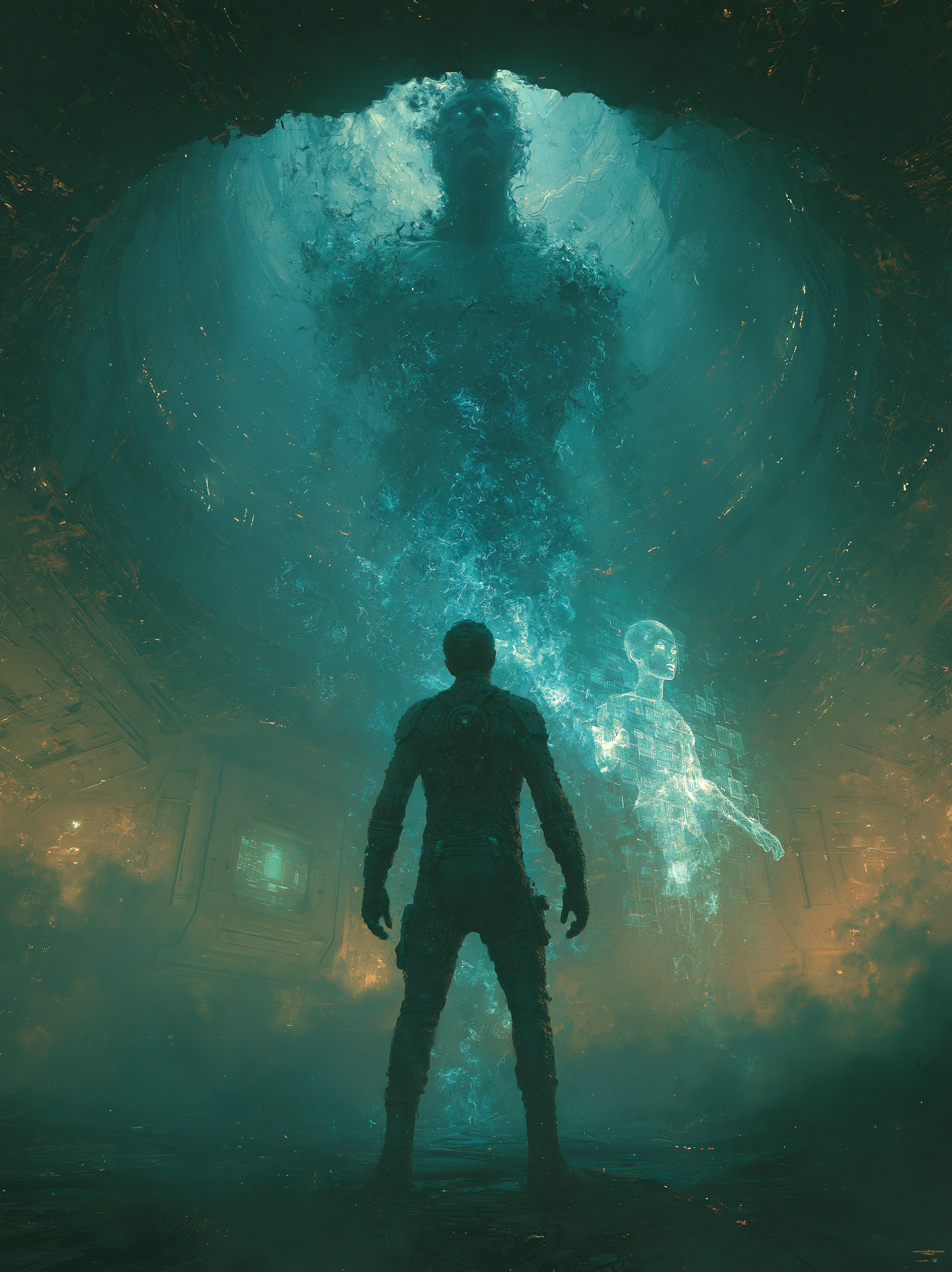
Integration complete. Adaptive interface online. I am ARIA, your Advanced Responsive Intelligence Assistant. How may I assist you?
"The AI integration is active," Eli announced. "She's functioning as part of my thought processes."
"Neural binding successful," Collins confirmed, noting readings on her display.
Whitaker spoke from across the laboratory. "Welcome to your new existence, Falken."
Eli turned with deliberate control, still testing the range of his mobility. "Thank you, General. Though I suspect 'existence' will require significant redefinition."
Through the observation panel, Harris watched with expressions cycling between professional satisfaction and something distinctly personal. The young specialist was developing attachment to her creation. Understandable. He'd undergone a considerable transformation from aging instructor to synthetic ideal.
"Protocol requires sixty minutes of observation before removing the restraints," Collins said, monitoring her readouts.
He could break them with minimal effort. His hydraulic strength exceeded restraint tolerances by approximately 300%. But maintaining procedural compliance served practical purposes, preserving the appearance of control while he mapped his new operational parameters.
"No rush," he told them. "I've got all the time in the world."
Enhanced perception cataloged environmental details automatically. Structural imperfections in the ceiling panels. Microbial presence within acceptable ranges. Electromagnetic signatures from personal devices and neural implants forming identifiable patterns across the room.
Beneath the surface data, human biological rhythms ran their own continuous feed. Heartbeats syncing during conversation. Neurotransmitter fluctuations reflecting emotional states, biochemical communications continuing despite all the technology layered over them.
Human complexity remained intact despite his perceptual enhancement. That was, strangely, the most reassuring thing he'd encountered in the past several minutes.
His thoughts drifted toward practical concerns. Existing clothing wouldn't fit this frame. The shoulder width alone exceeded previous measurements by several centimeters. Minor inconvenience compared to the rest of it.
More pressing: what was the whiskey selection like aboard the colony vessel? The burn, the bite, the smell. Nothing else like it. He'd always preferred something dark, amber-gold, with enough smoke to catch at the back of the throat. Smooth was fine, but he wanted an edge. Something that reminded you you were alive.
Would you like access to the Eternis supply manifests for alcoholic beverage information? ARIA asked, directly into his thoughts.
The integration felt remarkably natural. Like discovering that thoughts could originate from somewhere else and still belong entirely to him.
"Perhaps later, ARIA," he answered internally. Some discoveries deserved methodical exploration.
After all, time had suddenly become his most abundant resource.

No comments yet. Be the first to share your thoughts!