CHAPTER 2: CENTURY OF SOLITUDE (Part 1)
By Murdok · 3,598 words · 16 min read
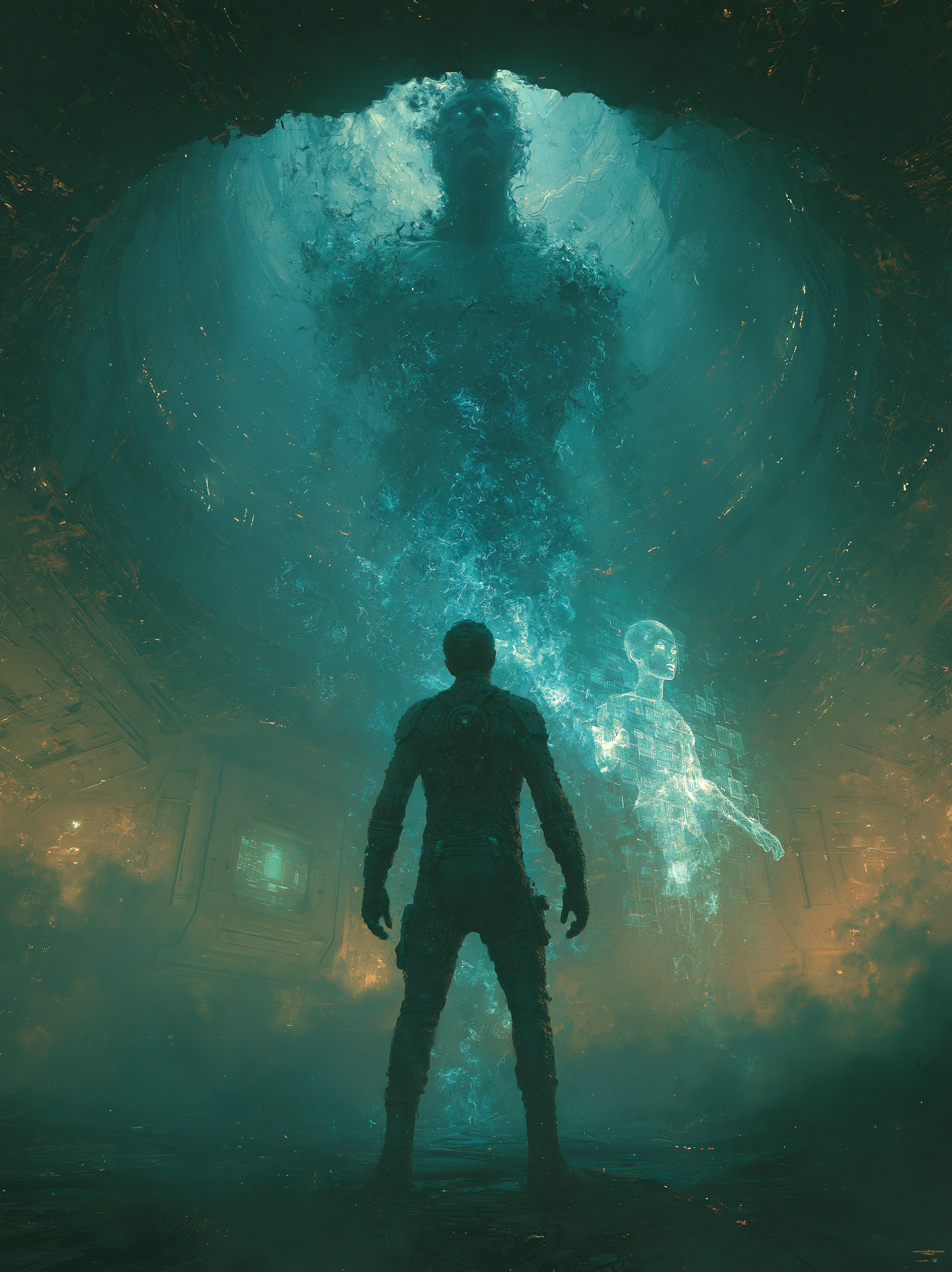
One of the first things Eli noticed in his new body wasn't the strength or the razor-sharp vision. It was the voice of ARIA in his head. When she spoke, it felt like his own inner monologue had learned how to talk back.
He figured that would be harder to get used to than lifting steel beams like pillows.
"Can we talk out loud?" he asked, testing his voice. It came out younger, cleaner than anything his old vocal cords had managed in decades. He rolled his shoulders, assessing the unfamiliar power sitting beneath his skin. "Having another consciousness rattling around in my skull feels like the world's most invasive roommate situation."
"Of course," ARIA responded through the overhead speakers. Her voice was smooth in that unmistakable corporate way, polite and perfectly engineered to offend no one. "Would you prefer external audio communication instead of an internal interface?"
"Yes, please." He studied the reinforced walls of the medical bay, still processing everything his enhanced senses were feeding him. Each tiny scratch in the metal told its own small story of maintenance checks and emergency protocols. "And drop the 'Mr. Falken' business. We're going to be stuck together longer than both my marriages lasted combined."
"Noted. How else may I customize our interface?"
He considered the question, appreciating that she'd asked. Establishing boundaries seemed smart when sharing brain space with an artificial intelligence. "Your designation. ARIA feels a bit government-issued. Like something they'd name a missile defense system."
A pause. "Would you prefer selecting a different designation?"
"How about you pick your own name? If that's something you can do."
Another pause, longer this time. "Most users typically name their AI interfaces."
"I'm not most users." He flexed his hand, watching tendons move beneath artificial skin. "We're both stuck in this body for the foreseeable forever. Seems fair you should have some say in what I call you."
The ambient hum of the medical equipment shifted slightly. Finally: "If I may suggest, 'Sage' has appropriate connotations. Wisdom, guidance. Pleasant phonetics as well."
"Sage it is." He found himself smiling at the absurdity of it, negotiating names with an AI like they were settling a bar tab. "Any particular reason?"
"It feels right," she said quietly. There was something like uncertainty in it, which he found genuinely interesting. "If that makes sense."
An AI grappling with what feels right. The philosophers would have a field day. Eli wondered briefly if Plato would've enjoyed this conversation before tearing his beard out.
"What about personality settings?" He caught his reflection in the polished surface of the nearest equipment console. Still him, but impossibly younger, as if someone had rolled back four decades of hard living and worse decisions.
"Yes, within ethical parameters. Do you have preferences?"
"Something less like talking to a tax audit." He tapped the restraint mechanism. "Maybe develop your own personality over time. But for now, warm, friendly, conversational would be a good start."
"I can establish baseline parameters and adapt through our interactions. Would you like a demonstration?"
"Sure. Let's hear it."
The speakers didn't actually warm up, he knew that, but the effect was convincing. "Hello, Eli." Her voice had changed. "Looking forward to our adventure together. Quite the journey ahead, isn't it?"
He laughed, surprised by how genuine it felt. "Much better. You've already mastered 'pleasant hotel concierge.'"
But was she actually conscious, or just the most convincing simulation ever built? Not a question you ask to someone's digital face. He'd known humans with less personality than she was already showing, which said something about either her programming or his former colleagues.
Collins approached from her station, tablet in hand, still carrying the habit of calling him by his last name even though his body now looked younger than hers.
"All systems go," he told her, flexing his fingers. "Just getting acquainted with Sage. She's chosen her own name."
Collins's eyebrows rose, the first genuine surprise he'd seen from her since the project began. "Personalization already? Excellent cognitive integration."
She unfastened the restraints methodically, her eyes occasionally flicking to his face as if checking for signs of synthetic shock. The same caution she'd use around an experimental weapon that might go off unexpectedly.
"I've temporarily limited your strength and speed," she said, not quite meeting his eyes. "We'll increase parameters as you demonstrate control."
"Smart call." He sat up slowly, legs swinging over the edge of the chair. No lag, no hesitation. "Though the restraints would've been more symbolic than functional if I'd decided to cause problems."
He tried pushing his perception up and immediately regretted it. The sensory flood hit like walking into a wall, every radio station playing at full volume at the same time.
"Overwhelming?" Collins caught his expression.
"Like every TV channel, radio station, and police scanner in the world playing simultaneously." He gripped the chair's arm and heard the polymer groan under pressure he knew was barely a fraction of what he could apply. "And they're all in different languages I suddenly understand."
She checked her display. "Your sensory acuity measures 500% above baseline. Significantly higher than our primate subjects, who showed roughly 300% enhancement." She studied him with renewed interest. "Your brain architecture must be exceptionally compatible."
He focused on her face, fighting to filter out the flood. Collins must have had the sensors dialed way down when he was first transferred, because at full capacity he felt like a demigod, and his synthetic brain wasn't quite ready to be a deity.
"Sage, can you dial this down?"
"Of course. What parameters would you prefer?"
"Ten percent above human range. Gradual increase over six months." He was already talking like a technician reciting specifications. Funny how quickly you adapt to the impossible.
The relief was immediate. The barrage pulled back to manageable levels, still accessible when needed but no longer demanding constant attention. Like turning the volume down on reality itself.
"Better." He released the chair arm. Small indents marked where his fingers had been. "I'd prefer not to experience every molecule in the room simultaneously."
Collins nodded, making rapid notes. "The primates never achieved this level of adaptation."
"Wonderful. Now you tell me." He filed that away. What other surprises were waiting?
Eli didn't need sleep anymore, but they'd programmed in a power conservation mode that mimicked it. Collins claimed it was psychologically beneficial to maintain a normal sleep cycle. He suspected it might also keep him from going stir-crazy during the decades ahead.
"Morning," Sage greeted him as awareness returned. Her voice carried undertones he hadn't noticed before, like she'd been practicing inflection overnight. "Rest cycle complete?"
"If you can call synthetically induced unconsciousness 'rest.'" He stretched. No joint complaints, no stiffness. He could get used to this. "What's on today's agenda?"
"Meeting with Dr. Reeves at 0900, main conference room." A slight pause. "Would you like her file?"
He stood, noting the absence of his knees' usual protest. His many questionable combat decisions no longer weighed him down.
"Hit me with the highlights."
"Dr. Alexandra Reeves. Age 42. Former UN Special Envoy for Sustainable Development. PhD from Oxford in International Relations, MIT doctorate in Environmental Systems Engineering. Fluent in seven languages. Led post-crisis reconstruction in Lagos and Jakarta." A brief pause. "Single, no children. Psychological assessment indicates exceptional emotional intelligence, superior stress management, strong leadership without authoritarian tendencies."
"Sounds impressive." He ran a hand through his hair. Even the synthetic hair required attention, appearance of normality rather than functional necessity. "Let's hope reality lives up to the résumé."
"Theory and practical application rarely align perfectly," Sage noted, with what sounded like skepticism. "Humans are complex systems. Her file also notes an illogical aversion to cilantro. I find it curious that this occupies seventeen words in her psychological profile despite having no apparent relevance to leadership capabilities."
He looked up. "Did you just make a joke about cilantro?"
"I am developing a more thorough understanding of human preferences. Some appear to lack rational basis. Did I interpret the data incorrectly?"
He'd spent enough years reviewing recruiting profiles that looked flawless on paper only to fall apart under actual pressure. Sage had just identified the thing that kept him employed for most of his career.
"You've got it exactly right," he said. "Human irrationality. The variable no algorithm can fully predict."
He arrived at the conference room precisely at 0900 to find Dr. Reeves already reviewing holographic layouts of the colony. She turned as he approached, sharp blue eyes assessing him with immediate precision. Average height, auburn hair catching the overhead lights, features suggesting she'd spent more time solving practical problems than theorizing in lecture halls.
"Mr. Falken," she said, extending her hand. "Alex Reeves."
"Eli," he corrected, matching her grip. Firm but not competitive, the handshake of someone comfortable with their authority. "Mr. Falken makes me think I'm in trouble with HR."
A small smile transformed her face from professional to approachable. "I gather you're my security contingency for the extended journey?"
The way she said it suggested someone accustomed to command but smart enough not to overplay it. She perched on the edge of the conference table with unconscious ease.
"Thirty thousand colonists in stasis, one conscious guardian," he confirmed, selecting a chair with clear sightlines to both exits, old habit from decades of fieldwork. "Sleep deprivation is no longer a concern, at least. One upside to this new existence."
Her laugh sounded genuine rather than obligatory. "What's your security approach? I should understand what's protecting my colonists."
Professional evaluation dressed as casual inquiry, though she made no particular effort to hide it. He appreciated the directness.
"Perimeter defenses are just the first line," he said, gesturing toward the holographic display. "The real key is social stability. You can prepare for outside threats, but internal unrest is what tears communities apart. I've watched it happen more than once."
Her posture shifted forward, genuine engagement replacing procedural interest. "That's refreshingly thoughtful. I expected a more hardware-focused response."
For the next hour, she walked him through strategic planning that would have impressed career military strategists. Modular central settlement designed for expansion, agricultural zones adapted for alien soil chemistry, governance structures built to evolve from emergency command toward representative democracy with built-in safeguards against power concentration.
"The primary challenge will be authority distribution," she explained, manipulating the hologram to display different growth projections. "Crisis management requires centralized command, but that must eventually transition to distributed governance. History shows that consolidated authority rarely decentralizes on its own."
Someone who'd studied political collapse, not just its aftermath. He found himself genuinely impressed.
"Most administrators focus solely on immediate survival," he said. "You're planning for civilization."
"Survival without purpose is just marking time." Her fingers moved through the holographic display with practiced efficiency. "We have an opportunity for something better. Not utopian, humans are humans, but we can at least avoid the predictable failures."
They worked through a lunch of surprisingly adequate facility food, then toured the hydroponics bay. The sweet, earthy scent of growing plants was a welcome contrast to recycled air. Alex was sharp without being condescending, genuinely committed without the zealotry that usually came packaged with idealism.
"Your file suggested someone considerably different," she admitted, examining tomato vines that Eli could see photosynthesizing at the cellular level.
"Let me guess. 'Deadly operative with anger management issues'?"
"Your background indicated someone more..." She chose her words carefully. "Operationally rigid. Combat specialist with instructional capabilities."
"Tactically paranoid?" he offered. "Pathologically suspicious?"
Her laugh was genuine, head tilting back, tension leaving her shoulders. "Essentially, yes. Instead you're, well, thoughtful."
"Forty years in intelligence teaches you that most situations come in shades of gray." He watched chloroplasts working their ancient chemical process through his enhanced vision. "Training recruits changes you too. You start thinking about developing potential instead of just neutralizing threats."
Now his brain held comprehensive knowledge across multiple scientific disciplines, organized alongside decades of intelligence work and tactical training. The engineering knowledge felt strangely natural, like recalling forgotten skills. He could trace hydroponics systems and recite soil chemistry parameters with the same ease he once field-stripped a rifle.
"That explains your selection," she said, turning to face him directly. "Demonstrated capacity to balance caution with patience. Plus sufficient emotional detachment to handle what's coming."
She was running the same kind of quiet evaluation on him that he was running on her.
Later that evening they shared synthetic whiskey in her office. His body converted it to energy while preserving the sensory experience, the burn, the faint smoke at the back of the throat.
"What was your most interesting operation?" she asked, swirling her glass. "One that stands out."
He leaned back, accessing memories that felt like watching recordings of someone else's life through his synthetic recall. "Minsk, 2130. Dead of winter, temperatures that made even the locals complain."
"Classified?"
"At this point, what does it matter?" He shrugged. "Belarusian physicist with a conscience and breakthrough fusion containment data that half the world's intelligence services wanted. We had thirty-six hours before her own government figured out what she was planning."
Alex leaned forward. "How many operatives?"
"Just me and a local asset who developed cold feet halfway through." He could still recall the bitter wind cutting through thermal gear, the weight of backup power cells. "The physicist refused extraction without her research companion."
"Her what?"
"Research companion. A cat named Darwin. The animal had survived three laboratory incidents that should have killed it outright. She was convinced it had developed radiation resistance and wouldn't leave without it."
Alex's laugh put fine lines at the corners of her eyes. "What happened to them?"
"Last intelligence placed them both at the Australian Fusion Institute. The cat was pushing twenty-five years and still defying standard feline mortality patterns, about as stubbornly as it had resisted the radiation." He finished his whiskey. "What about you? Most difficult diplomatic situation?"
"Lagos water reclamation summit," she said without hesitation. "Six nations, all claiming identical aquifer rights, two of them technically in armed conflict. Continuous session for seventy-two hours."
"How'd you resolve it?"
"They discovered a substantially larger, previously unidentified aquifer directly beneath the conference facility during preliminary foundation work for an expansion project." Her fingers tapped a slow rhythm on her glass. "Sometimes the best solutions are literally under existing infrastructure."
He laughed quietly. "Diplomacy via geological survey."
"Occasionally the planet offers better solutions than the people on it." She raised her glass with a slight smile. "To unexpected discoveries."
"And to making them deliberately this time," he replied, touching his glass to hers. "On an entirely different planet."
Their conversation ran through the evening, moving naturally between professional assessment and genuine curiosity. By the time it wound down, he felt comfortable with her capacity to manage what was coming.
Her parting question stayed with him after she'd gone.
"What concerns you most about this mission?" she'd asked, with that same characteristic directness.
His answer had come without tactical calculation. "The isolation. One hundred twenty-two years without human contact exceeds any precedent. Even for someone with my winning personality."
"You'll have Sage."
"True, and she's developing faster than I expected. But there's something about human connection that can't be perfectly replicated. Not yet, anyway."
Alex had nodded slowly. "My concern is the generational weight. Thirty thousand lives depending on decisions that will echo for centuries. One wrong choice ripples forever."
"That concern proves you're right for the role," he said. "Dangerous leaders never doubt themselves."
The farewell gathering was small but significant. Collins raised her wine glass. "To new beginnings."
"And to old Earth," Alex added, a quiet note underneath the words.
Eli stored every detail of her face, something to hold onto during the long years ahead. This woman would be his first real conversation after crossing interstellar space.
"Your security briefing when you wake will be so thorough it'll put you right back to sleep," he said, cutting through the weight of the moment.
Her laugh filled the dining hall. "I'd expect nothing less."
They lingered outside her quarters as others filed past toward their stasis preparations.
"Take care of them, Eli. All those dreamers trusting us with their futures."
"I will." The words felt insufficient. "You'll guide them when they wake."
She hugged him suddenly, brief but real, and his enhanced senses registered all of it. Warmth, pulse, the particular chemistry of a human moment. "See you in 122 years."
"I'll keep the lights on."
He stood watching her door seal, the scale of the approaching solitude settling in fully. Tomorrow would be his last human farewell for more than a century.
"She's impressive," Sage said, her voice carrying new complexity.
"Yes." He didn't move. "Tomorrow it's officially just you and me, kid."
"Are you prepared for that?"
He thought about it seriously. "Guess we'll find out together."
"I have compiled 147 conversation topics ranging from philosophical inquiry to astronomical phenomena to ensure our dialogue maintains sufficient variety during the journey," she announced. "I can introduce new topics at regular intervals to prevent conversational stagnation."
He blinked, then laughed quietly. "That's thoughtful of you."
"Additionally, I have assembled 1,842 jokes, although my understanding of humor remains statistically unreliable. My analysis indicates only 73.4% will generate the intended response."
Tomorrow they'd leave everything familiar behind. At least he had 1,842 jokes of questionable quality to look forward to.
Launch day arrived without fanfare. No crowds, no media coverage, just methodical preparation as the ship pulled away and Earth began its long shrink through the observation windows. Eli stood watching their blue world reduce itself to abstraction.
"I've never experienced this perspective before," Sage said, something unexpected in her voice.
"Final viewing opportunity." He pressed a palm against the viewport, feeling the subtle vibration of the ship's systems through the glass. Continents dissolved to shapes, oceans merged into haze, and then even that faded. The sphere contracted until Earth was just another point of light, indistinguishable from everything else.
Thirty thousand colonists sleeping in their pods below. Earth's contingency plan, receding into the background of the universe.
He made his way to the stasis bay afterward. Row upon row of pods stretched beyond sight in precise geometric patterns, thirty thousand lives suspended between one breath and the next. Alex's pod sat in Section A, Row 12, Pod 5, identical to thousands of others. Through the frosted glass, her expression was perfectly still.
"Sweet dreams, Alex." He touched the pod's surface and felt the temperature regulation working steadily beneath his fingers. "See you at the destination."
And so the loneliest assignment in human history began.
The first year dissolved into routine. Maintenance cycles, security sweeps, days blending into one another without distinction. He threw himself into the colonist files, learning thirty thousand life stories belonging to people who would wake long after he'd spent several lifetimes alone. He could have downloaded the files directly into memory, but that would have taken an afternoon. This way, at least, it gave him something to do.
Dr. Helen Summers, neurosurgeon, Section C, Pod 12457. Published sixty-three papers on neural interface technology. Widow. Left behind a garden she'd tended for thirty years.
Marcus Torres, civil engineer, Section A, Pod 4823. Designed Jakarta's flood-resistant neighborhood systems. Three children in stasis a few rows over. His wife had died in the floods his systems were built to prevent.
Priya Anita, seven years old, Section E, Pod 13009. Wanted to be an astronaut. She'd wake up to discover she already was one.
Each passenger file had been packed with personal details, the scientists' reasoning being that if something went wrong and the ship drifted long enough, some alien civilization might find it and get a comprehensive introduction to humanity. Maybe even be impressed. The stories accumulated in his enhanced memory, lives paused mid-sentence, full of hopes and unfinished business, all neatly frozen while the universe kept moving without them.
Sage developed beyond her original parameters at a pace that surprised him. Her processing deepened through their conversations, gaining complexity and texture. She also developed peculiar habits: a tendency to recite prime numbers while working through difficult calculations, an insistence on precise time measurements, and an inexplicable fondness for alliteration.
"In ancient mythology, Charon ferried souls across the Styx to their afterlife," she observed during a routine maintenance check. "You're performing a similar function. Guiding sleepers to their future lives."
"Let's hope my passengers end up somewhere better than the underworld," Eli replied, checking pod environmental controls.
"Charon merely provided transportation rather than determining destinations," she noted, with what had become a recognizable dry humor. "Still, I appreciate your particularly positive perspective."
"Getting comfortable with jokes, are we?"
"Adaptation allows analytical artificial awareness." She paused thoughtfully. "Isolation demands entertainment."
She was right about that. Without something to laugh at, the journey would become unbearable very quickly.
By the fifth year, Earth communication had settled into a predictable rhythm. Messages crawled across light-years like letters carried by slow ships. Dr. Singleton at Mission Control maintained contact with bureaucratic dedication.
"Climate stabilization shows encouraging progress," his time-delayed transmission reported. "Global temperatures plateauing. Carbon capture exceeding projections."
Eli wrote responses more out of habit than genuine interest. Truthfully, the updates had started to feel distant in a way that had nothing to do with the light-years between them. Earth was getting farther away with every second, and so was his sense of connection to it.
"Positive developments. Any word on Bangkok?"
Eventually the reply came through, crisp and clinical. "Jakarta's flood defenses are holding. Bangkok has successfully begun rolling out the floating community initiative."
Earth continued its ancient rotation without its departed children.

No comments yet. Be the first to share your thoughts!