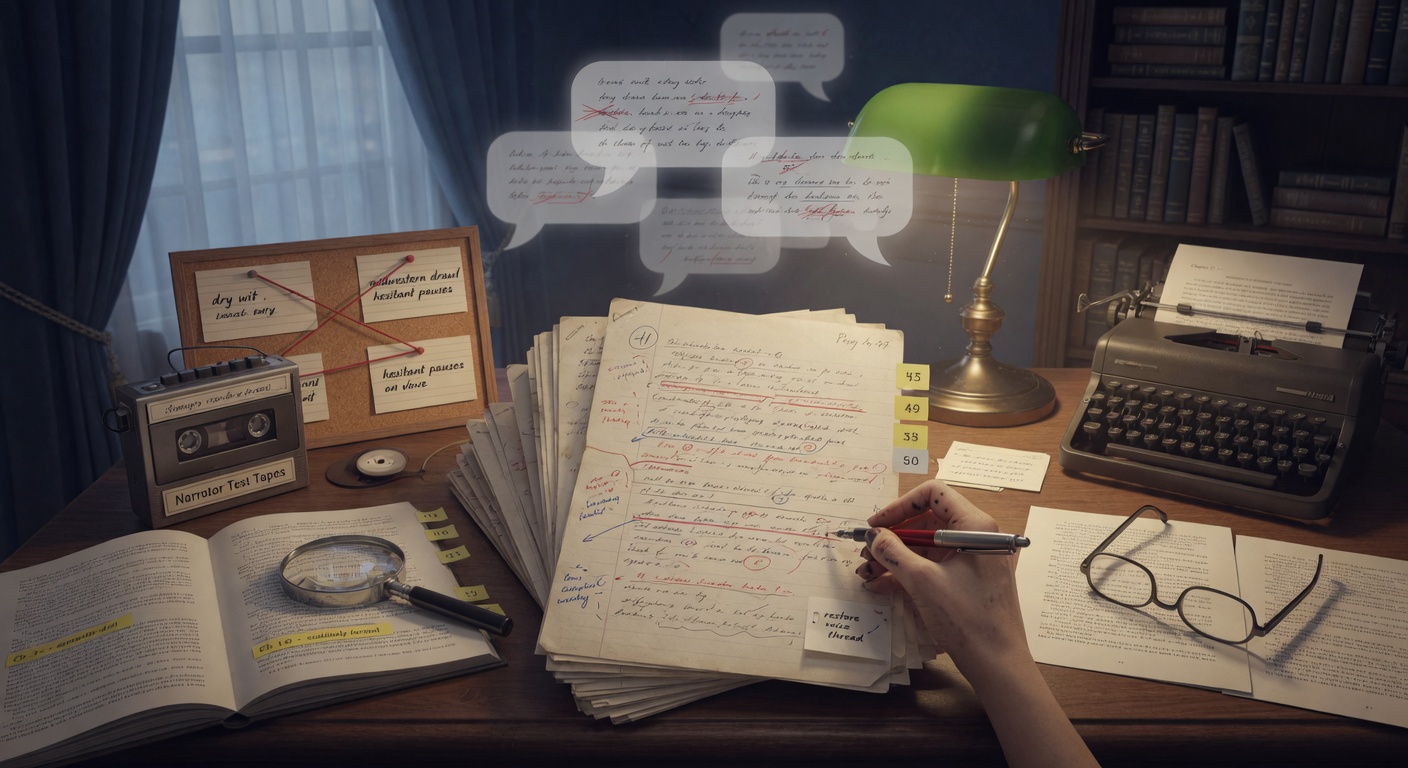
Your novel is drafted. Fifty thousand words, maybe eighty, and you got there with AI assistance — which means you got there faster than you ever have before. That part feels good. The part that doesn't feel as good is when you read chapters one and twelve back to back and notice that your narrator sounds like a different person. Chapter one has that dry, sardonic interiority you spent three sessions getting right. Chapter twelve reads like a motivational podcast.
This is voice drift, and it's the most common structural problem in AI-assisted novels. It's not a flaw in your story's logic or your plot. It's subtler than that, which makes it harder to catch on a normal proofread. By the time you notice it, you're usually already attached to the prose, which makes it harder to fix.
What follows is the method I use — a structured multi-pass edit specifically designed to find voice drift, diagnose where it came from, and repair it before anything goes out to a reader, a critique partner, or a submission inbox.
Why AI-Drafted Novels Develop Voice Drift (And How to Spot It)
AI models don't hold your narrator's voice in memory the way you do. Each session starts with some version of a blank slate. You might have pasted in a style guide, given it sample prose, or carefully established tone in your opening prompt — but three weeks and forty conversations later, those anchors have drifted. The model has been nudged by your mood that day, the urgency of the scene you were writing, the slightly different way you phrased your request.
The result is a narrator who is technically consistent in personality (your detective is still gruff, your protagonist still anxious) but inconsistent in register. The sentence rhythms change. The metaphor style shifts. Interiority that was clipped and observational becomes lush and emotional without any in-story reason for the change. These are the fingerprints of different sessions, different prompts, sometimes different models.
Here's how to spot it before you start the formal edit:
- The random chapter test: Open three chapters at random — not the ones you remember best — and read the first two pages of each out loud. Listen for shifts in rhythm. If one chapter sounds like Raymond Carver and another sounds like Rainbow Rowell, you have drift.
- The interiority check: Find three passages where your narrator reacts internally to something painful or surprising. Read them in sequence. Are the emotional textures consistent? Is the distance from the feeling the same?
- The metaphor audit: Scan for figurative language. A narrator who compares things to machinery in chapter two but to weather patterns in chapter nine has drifted. Both might be lovely. Together, they're fractures.
- The sentence length pattern: AI tends to homogenize sentence length when you're not paying attention. If your voice depends on short, punchy fragments interspersed with longer winding sentences, check whether chapters from late in your draft have smoothed that out into uniform medium-length sentences.
Voice drift isn't about whether the writing is good. It's about whether it sounds like the same person wrote it. Your reader will feel the inconsistency before they can name it.
Building Your Voice Reference Document Before You Edit
Before you run a single prompt, you need a Voice Reference Document. Think of it as a style sheet, but less about grammar rules and more about the felt texture of your narrator's prose. If you don't have this going into the edit, you'll make judgment calls inconsistently and end up replacing one kind of drift with another.
Your Voice Reference Document should cover four things:
1. Anchor Passages
Pull three to five paragraphs from your draft that you consider the purest expression of your narrator's voice. These should be passages where you read it and think, yes, that's exactly right. They don't have to be the most dramatic scenes — sometimes a quiet moment of observation captures voice better than a crisis. Paste them into the document and label them clearly.
2. Voice Descriptors
Write a paragraph describing your narrator's voice in concrete terms. Not "literary" or "distinctive" — those are useless. I mean: clipped sentences, present-tense interiority that keeps emotion at arm's length, humor that arrives through understatement, similes drawn from architecture and geometry rather than nature, distrust of adverbs. That's specific enough to work with.
3. What This Voice Doesn't Do
This is the section most people skip and then regret. Write down the things your narrator would never do stylistically. Would never use exclamation points. Would never describe a feeling directly — always through physical sensation or action. Would never end a chapter on an explicit emotional statement. These negative constraints are sometimes more useful in the edit than the positive ones.
4. Red Flag Phrases
Collect actual phrases or sentence constructions that feel wrong for this voice. You've probably already noticed some during your reading. "She felt a pang of" is wrong for a narrator who doesn't name emotions. "It was as if the world itself had shifted" is wrong for a voice that stays grounded and literal. Write them down. You'll search for them.
Keep this document open in a separate tab for the entire editing process. Every repair decision you make should reference it.
The Three-Pass Voice Audit: Flagging, Diagnosing, and Repairing
Running this as three distinct passes — not simultaneously — is what makes it work. When you try to flag problems and fix them in the same read, you start making repairs before you understand the full pattern. You end up fixing symptoms instead of causes.
Pass One: Flagging
Read through your entire manuscript with one goal: mark anything that feels off-register. Don't fix it yet. Don't even try to articulate why it's wrong. Use a comment, a highlight, a bracket — whatever your tool supports — and move on. Your only job in this pass is to be a detector, not a surgeon.
What you're flagging: sentences that feel too smooth, too formal, too casual, too emotionally direct, too distant, too lush, too bare. If you hesitate for even a second and think hmm, that's a flag. Mark it. You're looking for accumulations. Three flags in one chapter probably means that chapter drifted during a specific session.
Pass Two: Diagnosing
Now go back to your flags with the Voice Reference Document open. For each cluster of flagged passages, you're asking: what specifically changed? Is it sentence rhythm? Emotional distance? Metaphor vocabulary? The way dialogue tags are handled? Write a one-line diagnosis next to each cluster. This chapter: emotional statements are explicit instead of embodied. This chapter: sentences averaging twice the length of anchor passages. This chapter: figurative language is nature-based instead of urban/mechanical.
Diagnoses tell you what kind of repair the passage needs. They also tell you which AI sessions produced the drift — which is useful information if you're planning to write more of the book.
Pass Three: Repairing
Now you fix. Some repairs you'll do yourself, by hand, because the drift is minor or the fix is obvious. Others you'll bring back to the AI with targeted revision prompts. The key discipline here: every repair gets checked against your anchor passages before you accept it. Not against your general sense of what sounds good. Against the document.
Prompts for Asking AI to Find Its Own Inconsistencies
Here's something counterintuitive: AI is actually quite good at identifying voice inconsistencies when you give it the right frame. The problem is most writers ask it to "check for consistency," which is too vague to produce useful results. You need to give it your Voice Reference Document and ask specific, comparative questions.
These are the prompt structures that work best.
I'm going to give you two passages from my novel. Both are written in the first person by the same narrator, Marcus, a middle-aged forensic accountant who observes the world with dry precision and emotional detachment. He doesn't name his feelings — he notices details instead. His sentences tend to run short to medium length, and he uses similes drawn from numbers, architecture, and engineering. He would never describe weather as "moody" or "ominous."

Here is Passage A, which I consider a clean expression of his voice:
[paste anchor passage]

Here is Passage B, from chapter fourteen, which I suspect has drifted:
[paste flagged chapter excerpt]

Please identify every place where Passage B diverges from the voice established in Passage A. Focus specifically on: sentence length patterns, how emotion is handled, figurative language sources, and any phrases that feel too direct or too decorative for this narrator. Don't rewrite anything yet — just flag and explain.
This works because you're giving the AI a concrete anchor and asking for comparison, not evaluation. The specificity about what to look for — sentence length, emotion handling, figurative language sources — prevents it from flagging things that aren't actually problems. After it flags, you decide which flags are real, then ask for targeted rewrites.
Here is a flagged passage from my novel. My narrator's voice has drifted here — specifically, she's naming her emotions directly ("she felt ashamed," "a wave of grief hit her") when her established voice handles emotion through physical sensation and displacement activity instead. The feeling is always present but never labeled.

Here is the drifted passage:
[paste excerpt]

Please rewrite this passage so it preserves every plot beat and piece of information, but removes all direct emotional statements. Replace them with physical detail, movement, or deflection that implies the same feeling without naming it. Keep her sentence rhythm tight — she runs short. Don't add any new figurative language; this character doesn't reach for metaphors.
Notice how constrained this prompt is. You're not asking for "better prose" or even "her voice." You're describing one specific problem and one specific fix, then hedging against the AI's natural tendency to decorate. The "don't add figurative language" instruction is there because AI default-repairs often involve adding imagery, which can create a new kind of drift.
I need a voice consistency audit across three chapter openings from my novel. My narrator is a seventeen-year-old girl in 1987 who speaks in a colloquial, slightly guarded register — she's smart but performing less smart than she is. Her interiority runs long and digressive. She uses pop culture references native to her era. She sometimes addresses the reader directly but then walks it back.

Below are the opening pages of chapters 3, 9, and 16. Please read all three and then give me a report on: where the voice feels consistent, where it feels off, and what specific features have changed between the earliest and latest samples. I'm especially watching for whether her colloquial register has smoothed out into something more literary as the book progresses.

[paste all three excerpts]
This one is for the diagnostic pass. You get a comparative report across multiple chapters, which is faster than running individual comparisons. The final sentence tells the AI what you're already suspicious of — which focuses its analysis. You can take this report and use it to build your repair list.
Human Touch: What Only You Can Fix After the AI Pass
The AI pass will get you most of the way there. It'll catch sentence rhythm problems, obvious emotional register drift, metaphor vocabulary inconsistencies. What it won't catch — what it genuinely cannot catch without significant hand-holding — is the thematic coherence of your narrator's voice over the full arc of the book.
Voice isn't just style. It's also what the narrator notices, what they don't mention, what they find funny, what makes them go quiet. These are choices that connect to your story's meaning, and only you know what that meaning is.
Here's what to look for in your human pass:
The thing your narrator always comes back to
Most strong narrators have a preoccupation — an image, a concept, a fear — that surfaces repeatedly in their observations. Your detective keeps noticing exits. Your protagonist keeps cataloguing who is watching whom. Check whether this preoccupation is consistent throughout, or whether late chapters have lost the thread entirely because you stopped anchoring your prompts to it.
The silences
What your narrator doesn't say is often more important than what they do. AI tends to fill silences — it's solving the problem of producing text, so it produces text. A narrator who should trail off, deflect, or go strangely flat at a certain kind of moment may have been given complete, well-formed sentences in AI-drafted passages. Only you can restore the meaningful absence.
The moments of voice-as-character
Sometimes the way a narrator writes is the character's psychology on the page. The compulsive list-maker. The person who can't finish a sentence about their mother. The over-explainer who becomes oddly terse when something actually matters. These tics are fragile. They get rationalized away by AI that's trying to produce clean, clear prose. Find them in your anchor passages, and look for every place they've been smoothed out.
Late-draft exhaustion
Near the end of a long draft, prompts tend to get shorter and more desperate. You wrote "continue the scene, she finds out about the letter" instead of the careful setup you used in chapter three. The resulting prose is usually more generic, more efficient, less voiced. These late chapters often need the most work — and that work is almost entirely human work, because it requires knowing what the scene should feel like, not just what it needs to convey.
The AI can restore the music of your narrator's sentences. It can't restore the silences, the obsessions, or the places where the voice is doing something structurally strange because the character needs it to be.
Before you send anything to a reader, do this one concrete thing: take your first chapter and your last chapter, strip out character names and plot details, and ask someone who hasn't read your book whether they think the two excerpts were written by the same person in the same mood. Not whether they're both good. Whether they're the same voice. That gap — between what you know about your narrator and what a cold reader actually hears — is exactly what this whole process is designed to close.