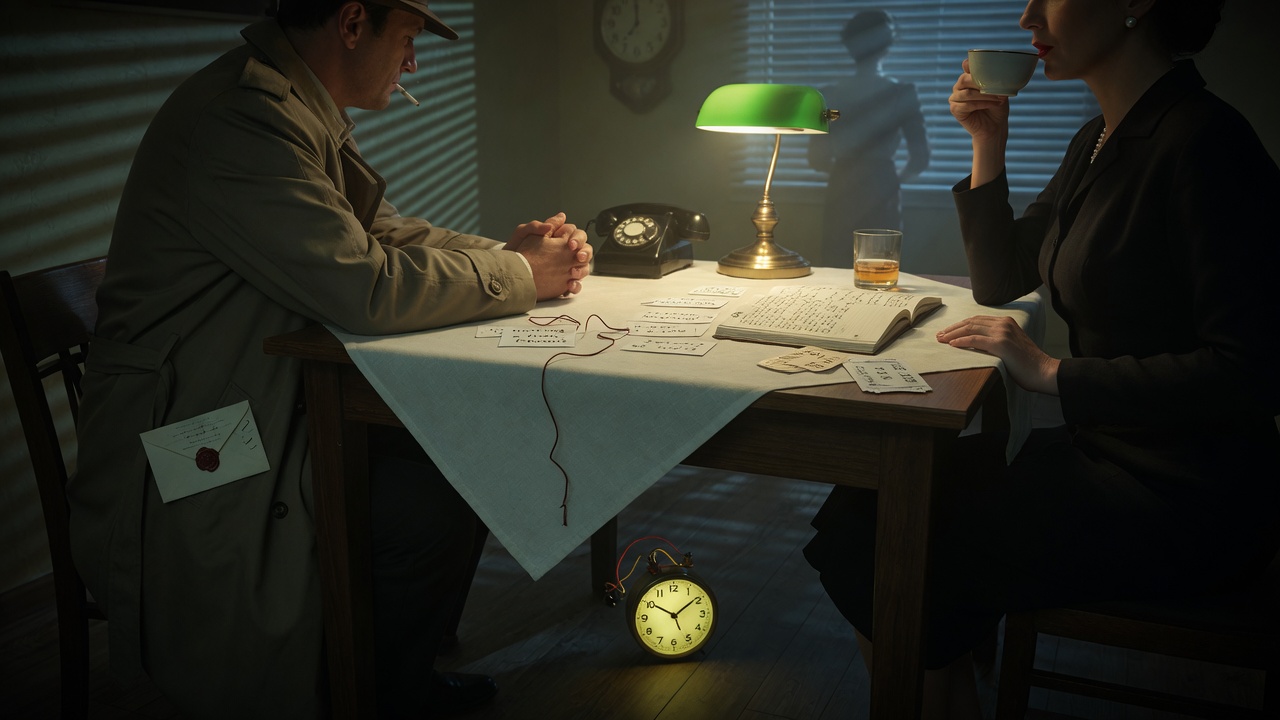
Suspense lives in the gap between what the reader knows and what the character knows. That's it. That's the whole secret. Alfred Hitchcock explained it better than anyone when he described the difference between shock and suspense: two people at a table, a bomb goes off — that's shock, fifteen seconds of surprise. But if the audience sees the bomb under the table before the conversation starts? Now every sentence of small talk is agony. That's suspense, and it can last fifteen minutes.
The problem is that AI, left to its own devices, is constitutionally opposed to this technique. It wants to explain. It wants to resolve. It wants your reader to understand exactly what's happening at every moment, because clarity feels like good writing to a model trained on helpful communication. For thriller writers, that instinct is actively destructive. You need to learn how to fight it — and more importantly, how to prompt around it.
Why AI Defaults to Transparency (And Why Thrillers Demand the Opposite)
When you ask an AI to write a tense scene, it will almost always do one of two things: either dump all the relevant information up front so the reader "gets" the stakes, or hide information arbitrarily and then reveal it with a little flourish that reads like a magician pulling a scarf. Neither approach builds real suspense. One kills it before it starts; the other is just a twist, which is a different thing entirely.
This happens because the model is pattern-matching against thriller-adjacent writing it has seen, which is heavily weighted toward action-thriller prose — the kind where tension comes from physical danger described rapidly. That style does use some information control, but it's crude. The bomb is ticking, the hero is running, you know everything except whether he'll make it. That's jeopardy, not dramatic irony. Jeopardy is when the reader worries alongside the character. Dramatic irony is when the reader worries for the character — because the reader can see what the character can't.
The difference matters structurally. Jeopardy exhausts readers if sustained too long. Dramatic irony, done well, creates a sustained dread that makes readers unable to stop turning pages. To get AI to write that second kind of suspense, you have to stop asking it to "write a tense scene" and start explicitly architecting the information landscape before you prompt for a single line of prose.
The reader's knowledge and the character's knowledge are two separate variables. Thriller suspense is what happens when you widen the gap between them deliberately, at a controlled pace.
Mapping Your Information Gap: What the Reader Should Know and When
Before you write a word of a suspenseful scene, you need a document — even a scrappy one — that maps information across three columns: what the reader knows, what the protagonist knows, and what the antagonist (or threat) knows. I call this an information gap map, and it's the most useful pre-writing tool I've found when working with AI on thrillers.
Here's a rough example. Your protagonist, a forensic accountant named Mara, is investigating what she thinks is embezzlement at a pharmaceutical company. The reader has already seen a scene Mara wasn't in — a phone call where the CFO told his assistant to "make sure she doesn't find the secondary accounts." Mara doesn't know she's being actively obstructed. The reader does. Now every scene where Mara thinks she's making progress carries an undercurrent of dread: she's walking deeper into something she doesn't understand.
Your information gap map for Mara's next scene might look like this:
- Reader knows: The CFO is aware of Mara's investigation and has ordered interference. There is a secondary set of accounts she hasn't found.
- Mara knows: Some figures don't add up in the primary accounts. She has a meeting with the CFO tomorrow and feels she's close to a breakthrough.
- CFO knows: Exactly how close she is. He's already prepared a cover story.
Once you have this map, you can prompt AI with surgical precision. You're not asking it to "write a tense scene where Mara investigates." You're telling it exactly what asymmetry to maintain, which is a completely different instruction.
Prompting AI to Write Scenes Where Characters Are Dangerously Wrong
The most powerful suspense moment in any thriller is when your protagonist is confidently wrong. They think they've solved it. They feel safe. They're about to make a decision that the reader knows — from that earlier scene, from a detail the protagonist overlooked — is going to go badly. The reader wants to reach through the page and grab them by the collar.
Getting AI to write this convincingly requires a specific prompt architecture. You need to give it three things: the character's subjective reality (what they believe and feel), the objective reality the reader has already witnessed, and an explicit instruction not to let any narrative intrusion correct the character's misconception. That last part is crucial. Without it, the AI will hedge. The prose will subtly signal to the reader that something is wrong, through a character's inexplicable unease or a single ominous sentence, robbing you of the dramatic irony you built.
Write a 400-word scene from Mara's close third-person POV. She has just found what she believes is the full extent of the embezzlement — $2.3 million moved through three shell companies. She feels the satisfaction of a case nearly closed. She's drafting an email to her supervisor summarizing her findings.

The reader already knows (from a scene Mara wasn't in) that the real fraud is $47 million, and that the $2.3 million was deliberately left for her to find as a decoy. The CFO planted it to make her feel like she'd succeeded so she'd stop looking.

Critical instruction: Write entirely from inside Mara's confident, satisfied perspective. Do NOT include any narrative signal that she's wrong — no vague unease, no overlooked detail that winks at the reader, no ominous weather. Her confidence should feel completely earned from where she stands. The dramatic irony comes entirely from what the reader already knows, not from anything in this scene.
Why does this work? Because you're offloading the dramatic irony to context the reader already carries, and you're explicitly forbidding the AI from undermining it with cheap signals. The scene becomes genuinely unsettling precisely because Mara sounds right. Her logic is sound. Her satisfaction is real. The reader's discomfort comes from their own superior knowledge, not from authorial nudging — and that's a far more sophisticated effect.
Tweak this by adjusting how close the character is to real danger. Mara drafting an email is low-stakes dramatic irony. Mara boarding a plane to meet the person who's actually the threat — while feeling completely safe — is high-stakes. Same technique, different intensity.
Using Dramatic Irony Prompts to Let Readers Outpace Your Protagonist
Dramatic irony doesn't have to be a single scene. At its best, it's a sustained structural condition — the reader runs several steps ahead of your protagonist for chapters at a time, watching them approach a trap they can't see. To maintain this over multiple scenes, you need AI to consistently write from inside your protagonist's limited perspective, even as the reader's knowledge accumulates.
The technique here is what I call layered revelation: you feed the reader information in separate scenes that your protagonist never witnesses, then write your protagonist's scenes as if that information doesn't exist. The AI doesn't automatically understand this architecture unless you remind it at every scene prompt. A useful habit is to include a short "reader's current advantage" note at the top of each prompt.
READER'S CURRENT ADVANTAGE: The reader has seen that Marcus (Mara's supervisor) is being blackmailed by the CFO and has been feeding the CFO updates on Mara's progress. Mara trusts Marcus completely — he's been her mentor for six years.

Write a 500-word scene where Mara calls Marcus to share her preliminary findings and ask his advice on how to proceed. Mara is warm, trusting, relieved to have his guidance. Marcus gives her advice that sounds reasonable and supportive but is actually designed to steer her away from the secondary accounts.

Write Marcus's dialogue so that his advice is genuinely plausible — a reasonable mentor could give the same advice for legitimate reasons. The reader should feel the horror of watching Mara be expertly manipulated by someone she loves, not because Marcus seems obviously sinister, but because the reader knows his motive and she doesn't.

Stay in tight third-person limited with Mara. We do not get inside Marcus's head at any point.
Notice that the prompt asks for Marcus's advice to be genuinely plausible. This is where most AI-generated suspense fails — the manipulator is too obviously sinister, their dialogue too perfectly calibrated to evil. Real dramatic irony requires the antagonist to be convincing within the protagonist's reality. The horror comes from plausibility, not from obvious villainy.
You can also flip this technique. Instead of the reader knowing more than the protagonist, sometimes you want the protagonist to know more than a secondary character — and the reader watches that secondary character make innocent decisions that the protagonist (and reader) know are dangerous. Same gap, different perspective.
Write a scene from Mara's POV where she watches her junior colleague Daniel cheerfully accept an after-hours invitation from the CFO to "go over some discrepancies." Mara now knows the CFO is dangerous and has been covering up an enormous fraud. Daniel doesn't know any of this.

Mara cannot warn Daniel without revealing how much she knows — which would tip off the CFO that she hasn't stopped investigating. She has to watch him leave.

Write this entirely in close third-person with Mara. Show her internal experience of knowing she can't speak. The scene should feel like watching someone walk toward something terrible with a hand over your own mouth. Do not resolve the tension in this scene — Daniel leaves, and Mara is left not knowing what will happen to him.
That last instruction — "do not resolve the tension in this scene" — is one you should use constantly when prompting thriller scenes. AI defaults to resolution because it patterns against complete narrative units. Suspense requires you to explicitly override that instinct.
Calibrating Disclosure Pace Across a Full Thriller Arc
Scene-level dramatic irony is one thing. Managing the reader's information advantage across a 90,000-word novel is another challenge entirely. Move too fast — reveal too much to the reader too early — and the protagonist's journey becomes tedious to watch. Move too slow, and the dramatic irony never accumulates enough weight to feel significant. The reader needs to feel like they're running just fast enough ahead of the protagonist to dread what's coming, not so far ahead that they're frustrated.
A useful framework: think of your thriller in three information phases.
- Phase 1 (roughly the first act): Reader and protagonist are mostly at parity. You're establishing the world, building trust. The reader might get one or two small advantages — a glimpse behind a door the protagonist didn't see — but nothing catastrophic yet.
- Phase 2 (the long middle): This is where you open the gap. The reader accumulates knowledge through scenes the protagonist isn't in. The protagonist makes decisions that feel reasonable to them but make the reader increasingly anxious. This is the engine of your thriller.
- Phase 3 (the final act): You start closing the gap. The protagonist catches up to the reader's knowledge — but the catches should be painful, not triumphant. Each revelation costs them something. By the climax, protagonist and reader should be at parity again, facing the same unknown: how does this end?
When working with AI across a long project, you can prompt for structural check-ins explicitly. Something like: "Given these scenes that the reader has witnessed and these scenes the protagonist has witnessed, describe the current information gap between them and suggest whether it needs to widen or narrow at this point in the arc." That kind of meta-prompt, used during revision, will surface structural problems you can't always see scene by scene.
Here is a list of scenes the reader has witnessed so far: [paste scene summaries]
Here is what Mara currently knows: [paste Mara's current knowledge state]

We are at roughly the 60% mark of the novel. The reader knows significantly more than Mara does — they know the fraud is $47M, that Marcus is compromised, and that the CFO has a contact inside the police department.

Is this gap too wide for this point in the story? If a reader knows this much while the protagonist is still in the dark, does the dramatic irony risk tipping into frustration? Suggest one piece of information Mara could discover in the next chapter that would start closing the gap without resolving the central mystery — something that makes her realize she's been wrong about a specific assumption, but doesn't yet show her the full picture.
This kind of structural prompt is where AI genuinely earns its keep on long-form projects. It's not writing your thriller for you — it's helping you see your own architecture from the outside.
Disclosure pace is a structural decision, not a scene-level one. The question isn't "what does the reader learn in this chapter" — it's "how far ahead of the protagonist should the reader be right now, and does that distance serve the arc?"
The single most useful thing you can do after reading this: go to your current thriller project and write one short scene from the antagonist's perspective that your protagonist will never witness. Don't worry about where it fits yet. Just write a scene where the antagonist does something — makes a phone call, gives an order, reveals a motive — that only the reader gets to see. Then go back to your protagonist's next scene and reread it with that context in your head. Feel that? That discomfort, that wish to intervene? That's your reader. Give them more of that, and they will not put your book down.