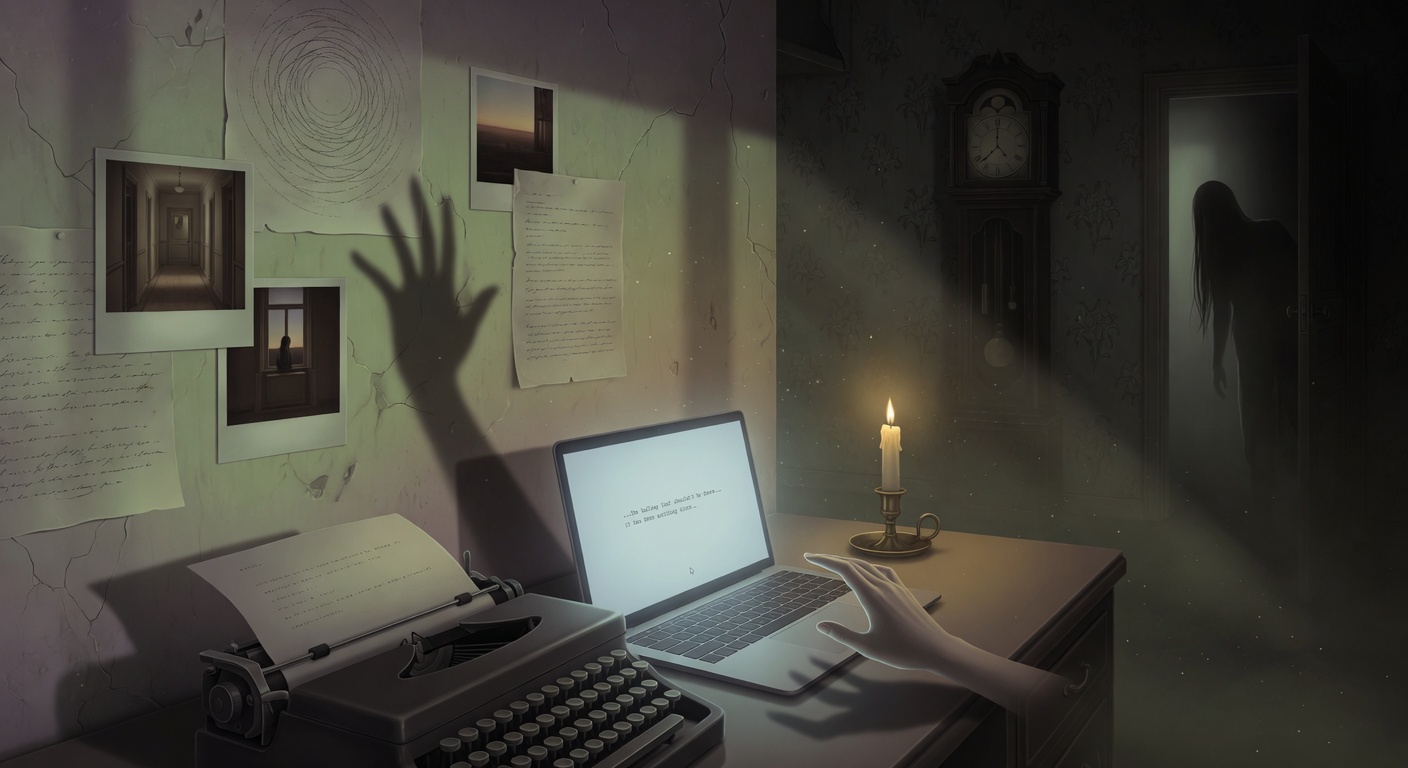
Horror is the hardest genre to get right with AI. Not because the model doesn't understand fear — it does, structurally — but because it has learned a shortcut. Blood, viscera, explicit violence: these are the easiest signals it has for "this is a scary story." So when you ask for horror without being very specific about what kind, you get gore by default. And gore, on its own, isn't dread. It's shock. The two feel similar for about three seconds, and then one of them fades.
The writers who genuinely scare us — Shirley Jackson, Thomas Tryon, early Stephen King — understood that dread lives in the gap between what is and what should be. The house that's too quiet. The smile that doesn't reach the eyes. The door that was definitely closed when you left the room. These are small, almost mundane wrongnesses, and they accumulate. By the time something terrible actually happens, the reader is already terrified. The event is almost a relief.
You can prompt AI to work that way. But you have to teach it, scene by scene, what you actually want.
Why AI Defaults to Gore: The Path-of-Least-Resistance Problem
Think about the training data. Horror as a genre, across the internet, skews heavily toward plot summary, shock value, and visceral description. The model has seen thousands of horror stories where escalation means increasing body count and explicit injury. It's not wrong that those patterns exist — they do. But they represent the path of least resistance, and AI is, at its core, a path-of-least-resistance machine when you don't give it strong constraints.
This creates a specific failure mode I see constantly. You ask for a tense, atmospheric horror scene. The AI gives you a paragraph of beautiful dread — shadows moving wrong, something in the periphery, a smell you can't name — and then, somewhere around the third paragraph, a character gets their throat torn out in careful anatomical detail. The atmosphere collapses. You've gone from psychological horror to a crime scene report.
The model isn't being malicious. It thinks it's helping. It has learned that horror stories escalate toward violence, so it's doing what it was trained to do. Your job is to redirect that energy before it happens — and sometimes to redirect it again mid-draft when the model drifts back toward its default.
The gore isn't the problem. Unearned gore is the problem. When you haven't built the dread first, violence is just noise.
The solution isn't telling the AI "don't be violent." That's too vague and it often produces the opposite — the model overcorrects into something bloodless and boring. Instead, you need to give it a structure to follow and specific sensory territory to stay inside.
The Dread Ladder: Structuring Escalation Across a Scene in Three Tiers
Before you write a single prompt, you need a framework for how dread actually builds. I think of it as a three-tier ladder, and it maps to specific environmental and sensory registers at each rung.
Tier One: Unsettling Normalcy
Everything is technically fine. But something is slightly off in the way normal things behave. The refrigerator is humming a half-tone lower than usual. Your neighbor waves, but with the wrong hand. The dog stops at the same spot on the stairs every night and refuses to move forward. Tier One dread is almost entirely in the reader's interpretation — the character might not even notice, or might notice and explain it away. This is where you establish the wrongness baseline.
Tier Two: Environmental Hostility
The environment starts to actively resist or misbehave. Lights don't respond correctly. Familiar spaces feel geometrically wrong — a hallway that seems longer than it should be, a room where the furniture looks subtly rearranged. The character can no longer explain things away easily, but nothing has happened yet. Nothing you could point to. This is the tier where isolation deepens, where sensory information starts to contradict itself, where the body knows before the mind admits it.
Tier Three: Unbearable Wrongness
Something is clearly and undeniably wrong. But "clearly wrong" doesn't have to mean violent. It can mean the door opens onto a room that shouldn't exist. A voice on the phone that knows something it couldn't know. The reflection moving a beat too slow. Tier Three is the payoff of everything you've built, and it's most effective when the wrongness is specific and impossible rather than just gruesome.
When you prompt the AI, label the tier explicitly. Tell it which rung of the ladder you're on. This alone will dramatically change the output.
Prompting Techniques: Using Restraint Anchors and Sensory Displacement
Two techniques will change how your AI horror drafts feel. The first is what I call a restraint anchor — a specific prohibition woven into the prompt that redirects the AI's energy rather than just blocking it. The second is sensory displacement — directing the AI to describe fear through the wrong sensory channel, which creates an off-kilter effect that's genuinely unnerving.
Restraint Anchors
A restraint anchor isn't "don't use gore." It's a positive constraint that occupies the space gore would normally fill. Something like: "The horror in this scene must be entirely environmental and spatial — nothing touches the character physically." Or: "The dread must escalate only through what the character notices about the room, not through any event or action."
You're not just removing a tool. You're giving the model a different tool to use in its place. It still gets to escalate — it just has to do it with the setting, with objects, with light and sound and spatial wrongness.
Sensory Displacement
Fear in real life is often experienced through the wrong sense. You smell something that makes you afraid before you see anything. You feel cold that has no source. Your hearing becomes suddenly, painfully sharp in a way that hurts. Sensory displacement in prompting means asking the AI to route the horror through an unexpected sensory channel.
Instead of: "describe the terrifying figure in the doorway."
Try: "describe the terrifying figure in the doorway, but only through what the narrator hears and smells — no visual description at all."
The absence of the expected sense creates its own dread. Readers fill in visual gaps with their own fears, and their fears are always more personal and therefore more effective than anything you could write.
Prompt Examples: From Unsettling Normalcy to Unbearable Wrongness
Here's where it gets practical. These are the kinds of prompts that actually produce atmospheric psychological horror rather than gore-by-default. Adapt them to your specific scene, characters, and setting.
Tier One: The Wrong-Frequency Normal
Write a Tier One horror scene (unsettling normalcy) in which a woman named Claire is cooking dinner in her own kitchen — a kitchen she has used every day for eleven years. She is not in danger. Nothing will happen in this scene. The dread must come entirely from small details of the kitchen that are technically unchanged but feel subtly wrong in ways she can't name: the sound of the burner, the weight of the pan, the way the light sits on the counter. She explains each wrong thing away to herself. The scene ends with her deciding she's just tired. Do not introduce any characters, sounds from outside the kitchen, or threats. Third person limited POV. 400 words.
Why this works: the explicit prohibition ("nothing will happen") forces the AI to find horror in stasis, which is exactly where Tier One lives. Naming the number of years (eleven) grounds the wrongness — we understand this is a space she knows deeply, so the deviation matters more. Remove the word limit if you want more breathing room, but keep the "she explains it away" instruction, because that's what separates dread from recognition.
Tier Two: Spatial Hostility
Write a Tier Two horror scene in which a teenage boy named Marcus is walking through his family's farmhouse at 2am to get a glass of water. He has done this a hundred times. The horror in this scene must be entirely spatial and geometric — the house should feel wrong in its dimensions, distances, and layout without anything overtly supernatural occurring. The hallway may seem longer than he remembers. The kitchen might be at the wrong angle. His sense of the floor plan keeps not quite matching what he finds. He must not be touched, spoken to, or confronted by anything. End the scene when he reaches the kitchen and the light switch does not work. First person past tense. No gore, no threat, no figure, no voice. The horror is the house itself not behaving like a house. 500 words.
The "spatial and geometric" specification is doing real work here. It pushes the AI away from its instinct to put something in the dark and toward the much harder, much more effective problem of a space that's wrong. The ending instruction (light switch doesn't work) gives the model a specific beat to land on, which keeps it from resolving the scene with an unnecessary escalation into violence.
Tier Three: The Impossible Specific
Write a Tier Three horror scene — unbearable wrongness — in which a woman named Ruth answers a phone call from her deceased mother. Ruth does not know her mother is dead yet; she finds out during this call. The horror must not be supernatural in an explicit way — no ghostly voice, no static, no unnatural sounds. The voice should sound completely normal. The wrongness comes from what the mother knows: specific, private, recent details about Ruth's life that her mother could not possibly have known while alive. The conversation should be mundane on the surface. Ruth should not scream, run, or have a physical reaction beyond her hands going cold. The scene ends when Ruth hangs up and the phone rings again immediately. Third person close. 600 words. No gore, no violence, no physical threat of any kind.
The phrase "specific, private, recent details" is critical — it tells the AI not to go vague and mystical but to invent concrete, plausible information that feels genuinely violating. The "mundane on the surface" instruction keeps the conversation from turning into a horror movie monologue. And the final beat (the phone rings again) is a classic Tier Three closer — the dread doesn't resolve, it doubles.
Editing the AI Draft: Stripping Gore Back to Its Dread Skeleton
Even with strong prompts, AI drafts will sometimes slip. You'll get two paragraphs of perfect atmospheric buildup and then a sentence where something bites through the character's shoulder, described in unnecessary anatomical detail. Don't throw the draft out. The dread skeleton is usually still there underneath it — you just need to strip the gore away and let it breathe.
When you're editing an AI horror draft, read it once specifically hunting for moments where the text tries to prove the horror rather than evoke it. Gore is proof — here is the evidence that something terrible happened. Dread is evocation — here is the feeling before the evidence arrives, or instead of it. Anywhere the draft reaches for proof, ask whether the scene works better with that proof removed.
A practical technique: take the violent or graphic sentence and replace it with a beat of physical sensation from the narrator's body. Not injury. Sensation. The character's vision narrows. Her mouth goes metallic. His heart does something wrong. The body's response to extreme fear is often stranger and more specific than anything the threat itself looks like, and it keeps the reader inside the character's nervous system rather than watching from outside.
You can also take the AI draft back into a second prompt and ask it to revise:
Here is a horror scene draft. I want you to revise it according to these rules: remove all explicit physical violence and injury description. Replace each removed moment with either (a) the narrator's internal physical sensation in that moment — not pain, but the stranger physical responses to fear: narrowed vision, specific tastes, the wrong sound of her own breathing — or (b) a detail about the environment immediately after, before she processes what has happened. The goal is to make the reader feel the horror before they understand it. Return the revised scene only. [PASTE DRAFT]
This revision prompt works because it doesn't just subtract — it gives the model two specific things to add in place of what it's losing. Option A and Option B are both dread mechanisms that the model can execute reliably. The phrase "feel the horror before they understand it" is your framing device, and it tends to orient the output toward the right register.
The single most useful thing you can do right now: take a horror scene you've already written or prompted that doesn't feel as scary as you want it to, and run it through that revision prompt above. Don't start from scratch. Work with what you have, strip it to the dread skeleton, and see what's been hiding underneath the blood the whole time. That's usually where the real scene is.