Why Dialogue Voice Collapses in AI-Assisted Drafts (and What's Actually Missing)
Here's what happens to almost every writer who starts using AI for fiction drafts: the plot moves, the scenes have shape, but somewhere around chapter three, all the characters start sounding like the same person. A Appalachian grandmother and a nineteen-year-old skater kid from Phoenix are using the same sentence structures, the same hedging language, the same rhythm. It's not that the AI wrote badly — it's that it defaulted to a kind of averaged, neutral voice that nobody actually speaks with.
The problem isn't the AI's fault, exactly. It's a prompting problem. Most writers describe their characters in terms of personality and backstory — "she's sarcastic and grew up poor" or "he's a veteran with trust issues" — and then ask the AI to write dialogue. Those are character notes. They're not voice instructions. Personality can be shown through word choice, yes, but the AI needs you to be much more specific about how that personality sounds at the sentence level before it can replicate it consistently.
What's actually missing is a systematic way to capture and communicate a character's spoken voice — not just their attitude, but the specific textures of their speech. The filler words they lean on. Whether they finish their sentences or let them trail. How long their clauses run. Whether they ask questions or make declarations. This is the difference between a character you can hear and a character you can only read about.
A character's voice isn't their personality. It's the acoustic fingerprint of how their personality moves through language — and AI can reproduce it with remarkable precision once you give it the right specifications.
Idiolect vs. Dialect: Defining the Two Layers of a Character's Speech
Dialect is the regional, cultural, or social variety of language a character speaks. It's the Brooklyn vowels, the Appalachian "holler," the Nigerian English cadence, the military clipping of unnecessary words. Dialect is shaped by where someone grew up, what communities shaped them, what they read and heard. It operates at the level of phonology, vocabulary, and sometimes grammar.
Idiolect is the individual layer — the specific speech habits that belong only to this person. Even two people who grew up on the same block don't speak identically. One of them repeats "I mean" before clarifying a point. The other never uses contractions when she's angry. One guy calls everyone "friend" — not as a warmth signal but as a distancing tactic. One woman answers questions with questions whenever she's nervous. These are idiolect features, and they're what make a character unmistakable even without a dialogue tag.
Most AI dialogue defaults to neither. It gives you generic Standard American English with maybe a sprinkling of slang if you asked for it. To break out of that, you need to work both layers deliberately — and separately. Get the dialect right first (the broad regional and cultural coloring), then layer in the idiolect (the personal tics and quirks). Trying to do both at once usually means you get an inconsistent muddle of neither.
One thing worth noting: dialect representation in fiction is genuinely fraught territory. Heavy phonetic spelling — "wuz" instead of "was," dropped g's spelled out — tends to read as mockery now and can alienate readers. The better approach is to capture dialect through syntax, vocabulary, and rhythm rather than spelling. "I don't know nothing about that" carries dialect through grammar. You don't need "Ah doan know nothin' 'bout that" to communicate it.
Building a Voice Profile: The Five-Axis Prompt Framework
Think of this as a spec sheet you build once per character and then feed into every prompt involving their dialogue. You're defining five dimensions of their speech, and each one gives the AI something concrete to work with.
Axis 1: Sentence Architecture
How does this character construct sentences? Short and declarative — subject, verb, done? Or do they spiral outward, adding qualifications and dependent clauses, looping back to catch something they forgot? A character who speaks in fragments often has an urgent, kinetic energy. One who speaks in long, carefully subordinated sentences is usually controlling the conversation, thinking out loud, or stalling. Tell the AI explicitly: "He speaks in short declarative sentences, rarely more than eight words. He never uses subordinate clauses when nervous."
Axis 2: Vocabulary Register
Where does this character sit on the formality spectrum, and what's their lexical range? A retired academic might use technical terms from her field casually, not to show off but because that's just how she thinks. A teenager who reads obsessively might have a huge vocabulary but deploy it awkwardly, in the wrong social situations. Someone who left school at fifteen might be extremely articulate but work with a narrower word set, compensating with precision and metaphor. Specify this: what domain-specific vocabulary do they reach for? What words would they never use?
Axis 3: Verbal Tics and Filler Patterns
This is pure idiolect. Every real person has verbal tics — words or phrases that surface under certain conditions. The key is making them conditional, not constant. If a character says "you know what I mean" after every single sentence, it reads as authorial hammering. But if they say it specifically when they've just said something emotionally vulnerable and are looking for confirmation — that's a character telling you something. Think about what your character does when nervous, when lying, when excited, when trying to end a conversation they don't want to be in.
Axis 4: Conversational Behavior
Does your character answer the question asked, or a different one? Do they interrupt? Talk over silences or tolerate them? Ask clarifying questions or assume they understood? Some characters deflect with humor every time a conversation gets uncomfortable. Some people turn everything into a story — they can't answer "how are you" without a three-minute anecdote. These behavioral patterns show up in dialogue structure as much as in word choice.
Axis 5: Regional and Cultural Flavor
Don't rely on stereotypes — go specific. Not "Southern" but "grew up in the Mississippi Delta, moved to Chicago at twenty-two, still uses 'fixing to' for future actions and 'might could' for uncertain possibilities, but her vowels have flattened slightly." The more specific the cultural context, the more the AI can draw on real linguistic patterns rather than TV-accent clichés.
Prompt Examples: From Flat Speech to Recognizable Voice
Here's where theory meets the actual work. These are prompts you can copy, tweak for your character, and use directly.
The first example builds a voice profile from scratch when you know the character but haven't defined their speech yet:
I'm writing a character named Darnell, 58, a retired longshoreman from Baltimore who now fixes small appliances out of his garage. He has a ninth-grade education but is extremely observant and precise. He speaks in short to medium sentences. He uses occupational metaphors constantly — everything is described in terms of mechanical systems, load-bearing, failure points. He never hedges: he states opinions as facts. When he disagrees with someone, he doesn't argue — he asks one flat question and then goes quiet. He uses "that's a thing" to acknowledge something he finds interesting but won't elaborate on. He calls men he respects "brother" and men he doesn't "friend."

Write a scene where Darnell is telling his neighbor that her son borrowed money from the wrong people. Write only Darnell's dialogue lines — no narration. Show his speech patterns across at least six exchanges.
Why this works: it specifies sentence length, vocabulary domain, a specific tic ("that's a thing"), and a behavioral pattern (the flat question + silence move). The AI has five axes covered. The instruction to write only dialogue lines forces it to make the voice carry without narration as a crutch.
The second example is for stress-testing an existing voice against a new emotional register:
Here is a voice profile for my character Mira, 34, a Trinidadian-British forensic accountant living in London. Her speech patterns: she speaks formally even in casual settings, avoids contractions when serious, uses "in fact" and "which is to say" as bridging phrases when correcting herself. She has a habit of stating the logical structure of an argument aloud ("there are two possibilities here"). When flustered, her sentences get longer and more tangled — she loses the thread. She almost never swears, but when she does it's jarring and precise, one word, no elaboration.

Mira has just discovered that her mentor has been embezzling from a charity they both work for. Write her confronting him — she starts controlled and formal, then becomes increasingly flustered as he deflects. Show her speech degrading under pressure while keeping her core patterns intact.
This prompt is doing something more sophisticated — it's asking the AI to show a character's voice breaking down in a specific way. Telling the AI "her sentences get longer and more tangled when flustered" means the degradation is characterful rather than just generic upset. Tweak the emotion and the trigger to fit your own scene.
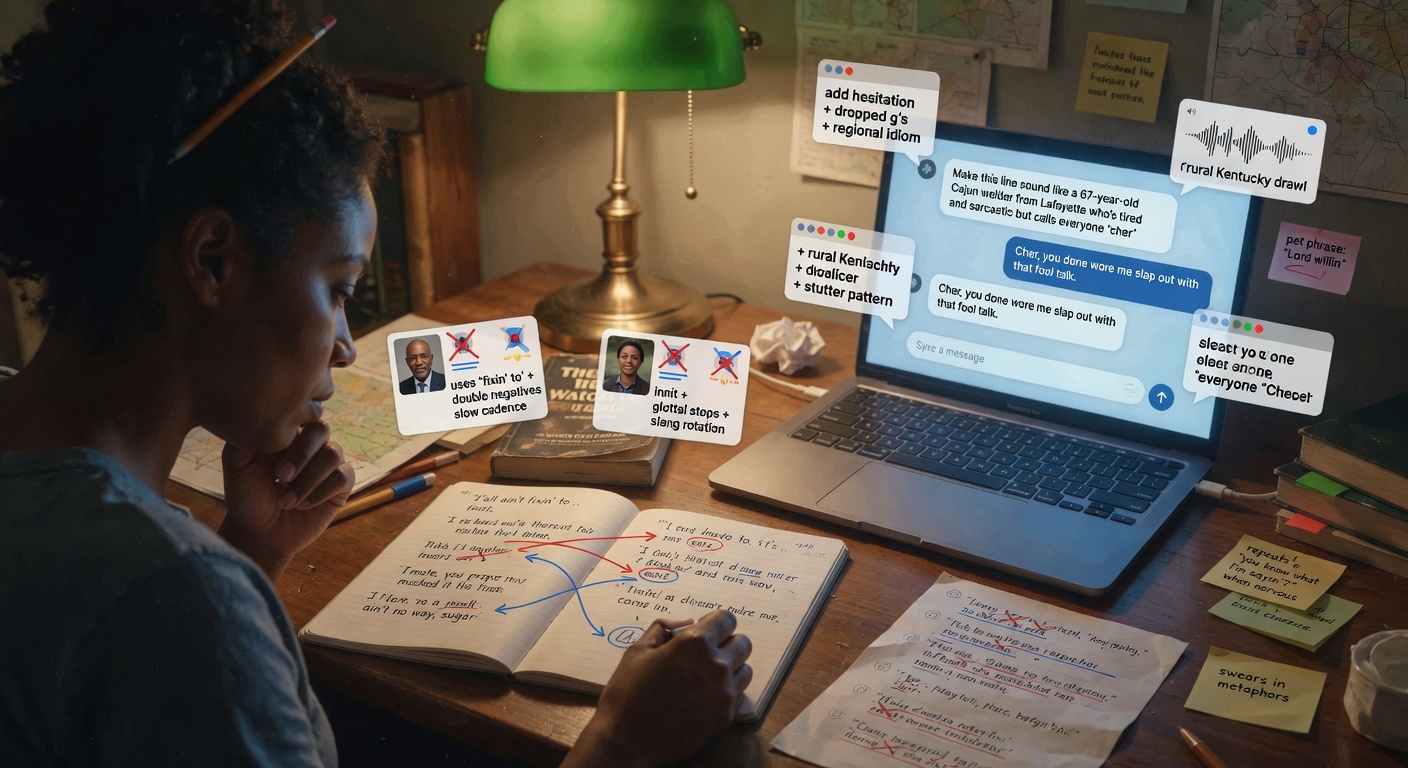
I need to establish a dialect baseline for a character named Clem, a 70-year-old white woman from rural eastern Kentucky who has never lived outside a 30-mile radius. She uses "might could" and "used to could" for past abilities. She says "directly" to mean "in a little while." She calls soft drinks "pop." She addresses people as "hon" regardless of gender or age — it's not affectionate, it's just filler. Her sentences are rhythmically slow — she doesn't rush.

Do NOT use phonetic spelling to represent her accent. Convey her dialect entirely through vocabulary, syntax, and rhythm. Write a three-minute monologue where she explains to a social worker why she doesn't need help with her property. She's polite on the surface and immovable underneath.
The explicit instruction against phonetic spelling is doing real work here. Without it, AI will often drift toward eye-dialect ("jest" for "just"), which undercuts the character's dignity. The scenario — polite surface, unmovable underneath — gives the voice something specific to do.
Locking the Voice In: Using AI to Stress-Test Consistency Across Scenes
Getting one good scene out of AI with a distinct character voice isn't the hard part. The hard part is keeping that voice consistent when the character appears in chapter twelve under completely different circumstances. This is where most AI-assisted drafts start to fray.
The solution is to build what I think of as a voice anchor document — a short reference file (200-300 words) that captures the character's five axes in plain language, plus three or four example lines of their dialogue that nail the voice. You paste this into every prompt that involves that character. Every single one. It sounds tedious but it takes thirty seconds and it's the difference between a voice that holds and one that evaporates.
Here's how to use AI to build that anchor document in the first place:
I've written several scenes featuring my character Tomás, a 45-year-old Mexican-American immigration lawyer from San Antonio. Below are six dialogue excerpts from different scenes. Read them carefully and then write a 250-word voice profile that captures his consistent speech patterns — his sentence architecture, vocabulary tendencies, any verbal tics or behavioral patterns you notice, and the overall rhythmic quality of his speech. Write it as a reference document I can use when prompting AI to write future scenes with him.

[Paste your six dialogue excerpts here]
This is genuinely useful because AI is good at pattern recognition across samples. It will often surface things you didn't consciously put there — and then naming them explicitly makes them reproducible.
Beyond the anchor document, run consistency stress-tests. After you've drafted several scenes, ask the AI to read two or three dialogue passages and flag anywhere the character's voice seems off — sentences that don't match the rhythm, word choices that feel out of register, tics that appear where they shouldn't or are missing where they should surface. Frame it as an editorial pass:
"Here is a voice profile for Tomás [paste anchor doc]. Here are three scenes featuring his dialogue [paste scenes]. Identify any lines that feel inconsistent with his established voice patterns and explain specifically what's wrong with each one."
You'll get false positives — sometimes the AI flags deliberate variations that are actually good. But you'll also catch genuine drift that you'd have missed in a normal read-through, because you're too close to the material to hear it objectively anymore.
One last thing worth doing: write a "voice stress scene" for each major character early in your drafting process. Pick a situation that pushes the character to their emotional limits — grief, rage, panic, humiliation — and use it specifically to map how their voice changes under pressure. Does it get quieter or louder? Do sentences shorten or lengthen? Do the tics increase or disappear? Do they start talking more formally or abandon formality entirely? Once you know this, add it to the anchor document. A character's voice under pressure is often more revealing than their voice at rest, and having it documented means AI can write your climactic scenes with the same fidelity as your quieter ones.
The single most useful thing you can do right now: take one character from whatever you're working on and spend twenty minutes writing their five-axis voice profile. Don't draft any scenes with them yet. Just answer the five axes in specific, concrete language — actual example sentences they would and wouldn't say, specific tic conditions, specific vocabulary domains. Then paste that profile into your next AI dialogue prompt and watch the difference. The voice won't be perfect on the first pass, but it'll be in the right territory, and you'll have something concrete to iterate from rather than starting from scratch every time that character opens their mouth.