How to Use Temperature Shifts to Write Emotional Register
Most writers treat the temperature slider like a mystery dial — turn it up when outputs feel repetitive, turn it down when they feel too weird. That's a waste of one of the most powerful tools you have for shaping emotional prose.
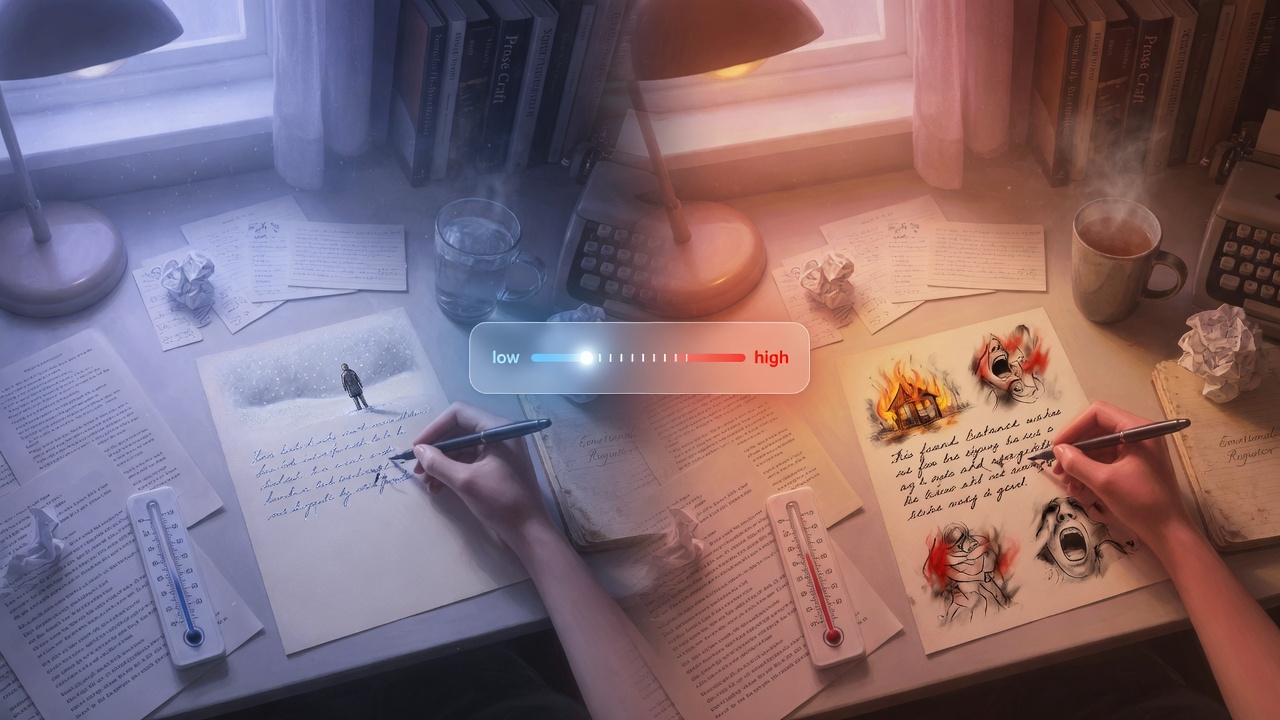
Temperature controls how much the model "explores" versus "converges." Low temperature means the model gravitates toward high-probability, expected word choices — the language becomes precise, controlled, almost surgical. High temperature opens up the probability space, and the model starts reaching for unexpected combinations, fragments, associative leaps. The prose gets stranger, more urgent, less composed.
Sound familiar? That's exactly what happens inside a human mind under emotional pressure. Your character delivering a rehearsed lie uses controlled, flat language. Your character watching her daughter walk into traffic uses something else entirely.
The technique here is simple in theory and surprisingly effective in practice: you map your scene's emotional beats to temperature ranges, generate each beat separately, then stitch the outputs into unified prose. What you get is register variation that feels earned — not random, not mechanical, but genuinely responsive to the emotional weight of each moment.
Why Temperature Is an Emotional Tool, Not Just a Randomness Slider
Here's the thing literary fiction does that genre fiction often doesn't: it modulates register within a single scene. The prose gets quieter right before something terrible happens. It fractures during the terrible thing. It goes flat and documentary afterward, when the character is too numb for feeling. If you've ever read Denis Johnson or Marilynne Robinson or Carmen Maria Machado, you've felt this — the way the sentence itself changes shape to match interior experience.
AI doesn't automatically do this. Left to default settings, it produces prose at a consistent temperature — usually somewhere in the 0.7–0.8 range — which means consistent register regardless of what's happening emotionally in the scene. The model writes a fistfight and a breakfast conversation with the same tonal weight. That consistency is the enemy of emotional impact.
Temperature isn't just about variety. It's about emotional truthfulness — making the texture of the prose correspond to the texture of the experience.
What I've found through daily use is that temperature functions as a rough analog for a character's access to conscious thought. Low temperature = the character is in control, watching themselves, choosing words carefully. High temperature = the character's conscious mind is overwhelmed and something rawer is speaking. That's an oversimplification, but it's a useful one when you're deciding where to set the dial.
The practical range to work with: 0.2–0.45 for controlled, precise register. 0.6–0.75 for neutral scene-building. 0.85–1.1 for emotional overwhelm, grief, dissociation, or ecstasy. Anything above 1.1 tends to produce genuinely incoherent output — occasionally interesting for stream-of-consciousness, but usually just noisy.
Mapping Your Scene's Emotional Arc to Temperature Ranges
Before you write a single prompt, sketch the emotional arc of your scene. Not the plot beats — the feeling beats. Where is your character most controlled? Where do they lose it? Where do they go numb?
A simple scene might look like this: A woman confronts her estranged father at a funeral. She starts composed, delivering prepared words. Then something he says cracks her open. Then she goes cold and leaves. That's three registers: controlled → overwhelmed → dissociated. Three different temperature settings.
Write that arc down like a temperature map:
- Beat 1 — Composed approach: 0.3. Language is deliberate, clipped, rehearsed-sounding.
- Beat 2 — The crack: 1.0. Sentences fragment. Images intrude. Logic breaks down.
- Beat 3 — Cold exit: 0.2. Documentary precision. What she sees, not what she feels.
This mapping step takes five minutes and saves you an hour of wondering why your scene feels emotionally flat. The model doesn't know your scene's arc — you do. Your job is to encode that arc into your prompting strategy before you generate a single word.
One note: you don't need massive temperature swings to produce noticeable register shifts. The difference between 0.3 and 0.75 is dramatic in prose terms. Save the extreme high end (1.0+) for genuine psychological rupture — moments of breakdown, terror, or transcendence. Using it too liberally makes everything feel hysterical.
Low-Temperature Prompts: Writing Control, Restraint, and Cold Clarity
Low temperature is for characters who are managing themselves. The detective who won't let her voice shake. The father choosing words for the worst conversation of his life. The survivor filling out a police report three days after the attack. These are moments where language is weaponized against feeling — where precision is a form of armor.
The prompts for these moments need to reflect that intention. You're not asking the model to "capture tension." You're asking it to write the way someone writes when they're actively suppressing something.
Temperature: 0.25

Write a single paragraph of close third-person prose. Marcus, a 58-year-old former surgeon who lost his medical license three years ago, is examining a wound on a stranger's arm in a gas station bathroom. He has not touched a patient since the incident. The prose should be entirely clinical and procedural — the exact same voice he would have used in an operating room. He notices everything with the precision of someone who trained for decades. There is no emotion in the prose itself, but the clinical detachment should feel like it's containing something enormous. No metaphor. No interiority. Only what he sees, assesses, and does with his hands.
Why this works: the prompt encodes the emotional subtext into the constraint rather than the description. You're not telling the model "write something sad." You're telling it to use a specific register — clinical, precise, no metaphor — and trusting that the gap between what's constrained and what's implied will do the emotional work. Low temperature keeps the model from reaching for florid language on its own.
What to tweak: "no metaphor" and "only what he sees" are your strongest restraint signals. Add or remove these based on how tightly controlled you need the prose. If you want the control to slip just slightly at the end of the paragraph, you can add a single line like: "In the final sentence, allow one sensory detail that suggests he's feeling something without naming it."
Temperature: 0.3

Continue the scene: Nadia has just been told her appeal was denied. She is sitting across from her lawyer in a conference room. Write her response — what she says aloud and the two or three physical actions she takes immediately after. Her dialogue should be brief and grammatically complete. No ellipses. No fragmented sentences. She is performing composure in front of someone she doesn't trust. The narration is close third-person and should match her flatness — short declarative sentences, no emotional language, specific physical details only (the pen she picks up, the folder she closes). The scene ends when she stands to leave.
The "no ellipses, no fragmented sentences" instruction is doing real work here. At low temperature, the model naturally avoids fragmentation — but being explicit about dialogue punctuation prevents it from sneaking in the "she said, her voice barely above a whisper" constructions that signal emotion in conventional fiction.
High-Temperature Prompts: Writing Overwhelm, Grief, and Unraveling
High temperature is where things get genuinely interesting — and genuinely difficult to use well. The model in this range reaches for unexpected associations, breaks syntax, repeats words in ways that feel compulsive rather than accidental. That's exactly what you want for consciousness under extreme pressure. The challenge is directing that chaos rather than just generating noise.
Your prompts need to be highly specific about the shape of the unraveling. Grief doesn't look the same as panic. Dissociation doesn't look the same as rage. Give the model a clear psychological portrait of what's breaking down and how.
Temperature: 0.95

Write a paragraph of close first-person narration from Elena, moments after learning her brother died by suicide. She is standing in her childhood kitchen — the same kitchen where they ate cereal together every morning for sixteen years. The prose should be fragmented and associative: her mind keeps snagging on completely irrelevant details (the pattern on the linoleum, the sound of the refrigerator, a coupon on the counter) before being dragged back to what she now knows. Sentences may be incomplete. The same word or phrase may repeat. She should not narrate her grief directly — she should narrate everything except her grief, the way a mind does when it cannot go to the center of a thing. Allow the prose to be strange. The paragraph should feel like it was written by someone who is not quite inside their own experience.
The phrase "narrate everything except her grief" is the key instruction. At high temperature, the model can be directed toward a specific psychological mechanism — in this case, avoidance and peripheral fixation — rather than just "emotional" language. Without that direction, high temperature often produces melodrama. With it, you get something that reads like actual dissociation.
What to tweak: "sentences may be incomplete" and "the same word or phrase may repeat" can be adjusted based on how far gone you need the character to be. For a character who's distressed but functional, remove both. For genuine breakdown, add "syntax may collapse mid-sentence."
Temperature: 1.0

Write a paragraph from the POV of a 17-year-old boy, Dominic, who has just won a state championship after his coach died two weeks ago. He is standing on the field and the team is celebrating around him. The prose should capture a specific kind of emotional overwhelm — joy and grief arriving simultaneously, neither canceling the other out. Let the sentences run long, then cut short. Let his attention move between the noise of the celebration and sudden private images of his coach (a specific gesture, a specific phrase the coach used). The prose should feel like it cannot hold its own shape. Do not resolve the emotion by the end of the paragraph. Leave it open, suspended, unfinished.
"Let the sentences run long, then cut short" is a structural instruction the model responds well to at high temperature. You're describing a rhythm, not a feeling. That combination — structural direction plus psychological specificity — produces prose that's strange in the right ways rather than just incoherent.
Stitching the Outputs: A Multi-Pass Workflow for Seamless Register Shifts
Generating three different temperature outputs is the easy part. The hard part is putting them together so the seams don't show. Prose written at 0.25 and prose written at 1.0 will have different rhythmic DNA, different sentence lengths, different vocabulary patterns. You can't just paste them together and call it a scene.
Here's the workflow I use, which takes about three passes:
Pass 1: Generate each beat separately
Run your temperature-mapped beats as separate prompts with clear scene context carried through each one. Keep the outputs in a working document. Don't edit yet — just collect the raw material. At this stage you're looking for the best 60–70% of each output, not a polished draft.
Pass 2: Write the transitions manually
This is the part you almost always need to do yourself. The shift between registers is where your authorial voice has to come in. Look at where the controlled prose ends and the fragmented prose begins — what's the sentence, the gesture, the single line that cracks the character open? That's almost certainly something you need to write, not generate.
The transition doesn't need to be long. Sometimes it's a single sentence. "Then he said her name." Or just a paragraph break and a shift in scene detail. But it needs to come from you, because it's the hinge of the whole emotional movement.
Pass 3: Run a unification pass at neutral temperature
Once you have the scene assembled with your manual transitions, run a final generation pass at neutral temperature (0.65–0.75) with this kind of prompt:
Temperature: 0.7

Here is a scene in three sections with different registers. Read the full scene first, then revise only the vocabulary and sentence rhythm so that the prose feels like it comes from a single authorial voice — even though the register deliberately shifts across the three sections. Do NOT flatten the emotional differences between sections. The controlled section should remain controlled; the fragmented section should remain fragmented. Only adjust word choice and micro-rhythm where the transitions feel jarring. Preserve all specific details, character actions, and dialogue exactly as written.

[paste your assembled scene here]
This pass functions as a copy editor who understands your intention. It smooths out the rough vocabulary seams without homogenizing the register differences you worked to create. The instruction "do NOT flatten the emotional differences" is essential — without it, the model will try to find a middle ground and erase exactly what you built.
The goal isn't seamless prose. The goal is deliberate prose — where the roughness is intentional and the smoothness is intentional and the reader can't see the machinery, only feel the effect.
One final thing worth knowing: this workflow gets faster with practice. The first time you do it, the mapping step feels slow and the transitions feel awkward. By the third or fourth scene, you start to develop an intuition for which beats need extreme temperature swings and which need subtle nudges — and your transition sentences start coming quicker because you understand what they're doing structurally.
Pick one scene you've already written that feels emotionally flat. Just one. Map its three or four emotional beats, assign temperature ranges, and generate each beat separately. Then write the transitions yourself. That specific exercise — not a new scene, an existing one you're already unhappy with — is where you'll actually feel this technique click.
Try it yourself
Write your own book with AI — free, no credit card required.
Free · No credit card