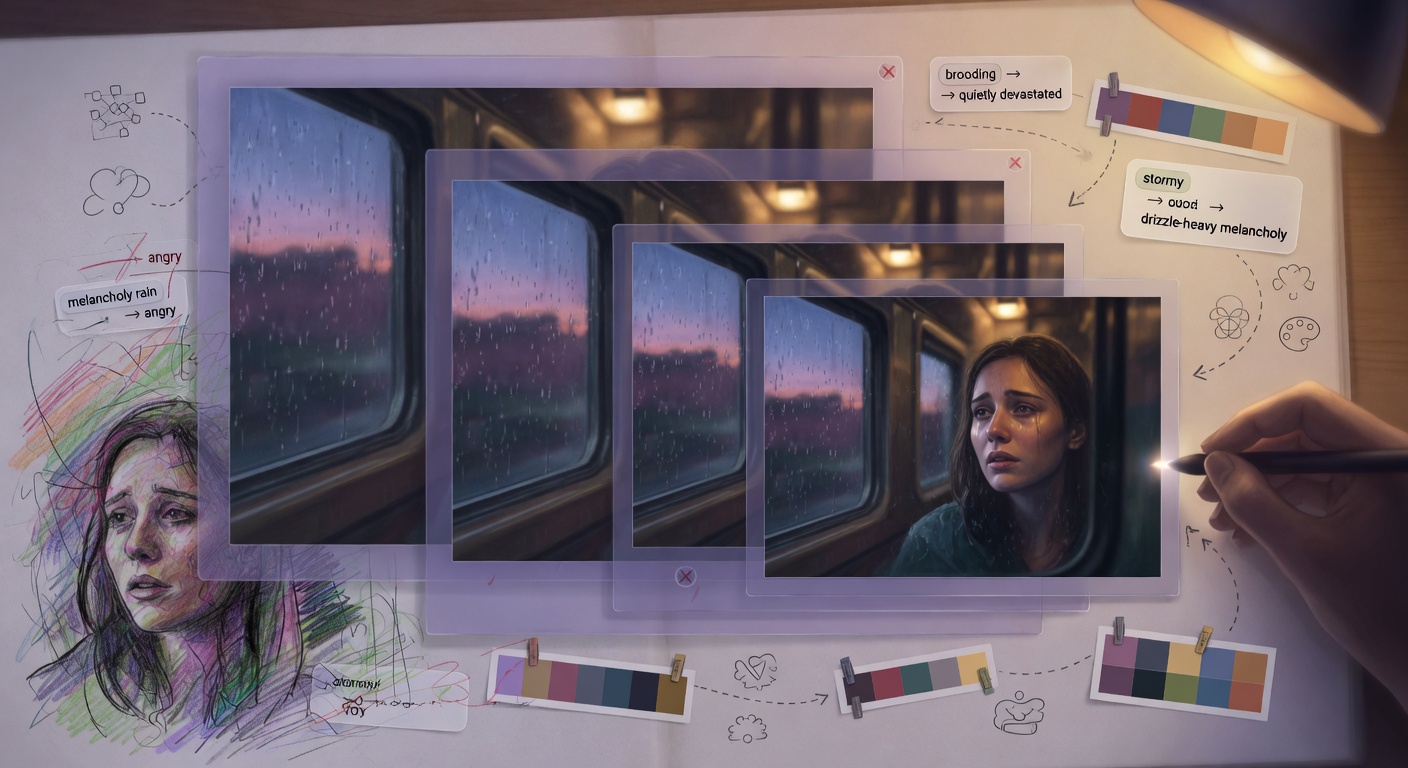
Getting tone right is the hardest part of writing fiction. Not plot, not structure — tone. It's the difference between a grief scene that makes a reader set the book down and breathe, and one that feels like a Wikipedia summary of sadness. When you add AI to the process, that difficulty compounds, because AI models have a default register: competent, smooth, slightly emotionally elevated. Left to their own devices, they write scenes that feel like they were workshopped into submission.
Most writers try to fix this with a single, increasingly complicated prompt. They pile on adjectives. "Make it melancholic but not maudlin, tense but not melodramatic, intimate but not saccharine." The model nods and produces something that technically satisfies every descriptor and emotionally satisfies none of them. This isn't a failure of the model — it's a failure of the approach. Tone isn't a list of qualities. It's a specific pressure on every word choice, every sentence rhythm, every detail selected or ignored. You can't get there in one shot.
What you can do is narrow your way there, pass by pass, using each output to teach the model what you don't want as much as what you do.
Why One-Shot Tone Prompts Almost Always Miss the Mark
Here's what happens when you write a long tone descriptor into a single prompt: the model averages it. It reads "melancholic but not maudlin" and produces something in the middle of that range — which is neither the thing you wanted nor the thing you rejected. The model has no way to know where on that spectrum your instinct lives, because you haven't shown it yet.
There's also the problem of register collision. Tone isn't just emotional color — it's a cluster of interlocking choices: vocabulary level, sentence length, metaphor density, how close the narration sits to the character's consciousness, how much whitespace the prose creates. When you describe all of these in abstract terms in a single prompt, the model makes its own defaults on each axis. Some of those defaults will feel right. Others will completely undercut the emotion you're after.
A scene with perfect emotional content can still land flat if the sentence rhythm is wrong. Clipped, short sentences create urgency. Long, subordinate-clause-heavy sentences create interiority. Mix them without intention and you get noise.
The other thing worth understanding is that AI models have been trained on enormous amounts of text, including a staggering quantity of competently mediocre fiction — writing that is correct without being alive. When you don't constrain the model, it regresses toward that mean. Iterative narrowing works precisely because it doesn't let the model rest there. Each pass pushes it further from the safe center and closer to something specific.
The Iterative Narrowing Framework: Four Passes to Precision
The framework is simple in structure and demanding in execution. You run four passes on the same scene, and each pass uses the previous output as both a floor and a set of constraints to reject or deepen. You're not rewriting from scratch each time — you're using each draft as evidence about what the right version looks like.
Think of it like developing a photograph in a darkroom. The first image that emerges is recognizable but flat. Each chemical bath brings up more contrast, more shadow detail, more of the thing that was latent in the original image all along. You're not adding something new — you're revealing what was always there.
The four passes break down like this:
- Pass 1: Broad emotional anchoring — establish the general territory
- Pass 2: Contrast and rejection — use the Pass 1 output to define what you don't want
- Pass 3: Lexical constraints — lock in specific word-level controls
- Pass 4: Register locking — fine-tune sentence rhythm and narratorial distance
By the end of Pass 4, you're not guessing at tone anymore. You have a model output that demonstrates your target register, and you have a documented set of constraints you can carry forward into the rest of the manuscript.
Pass 1–2: Anchoring Tone with Contrast Pairs and Rejection Prompts
Pass 1 is deliberately coarse. You're not trying to nail the scene — you're trying to establish which emotional neighborhood you're in. Use a broad descriptor, your scene context, and one or two comparative references. The output will be imperfect. That's the point.
Write a scene where Elena clears out her late mother's kitchen the morning after the funeral. Her sister has already left. The tone should feel quietly devastating — not weeping, not numb, but the specific kind of grief where ordinary objects become unbearable. Aim for the register of Marilynne Robinson's Housekeeping — plain, attentive, slightly dissociated. Third person limited, close to Elena's perspective. Around 350 words.
That prompt gives the model territory (quiet devastation, not performative grief), a specific literary anchor (Robinson's dissociated plainness), and a structural constraint (close third, 350 words). You will get something in the right zip code. Read it carefully, not for what's good, but for what's off. Is it too lyrical? Too on-the-nose with the emotions? Does it keep telling you Elena is sad instead of showing you what she's seeing?
Pass 2 is where the real work begins. Take the specific failures of Pass 1 and turn them into explicit rejections. This is the contrast pair technique — you're naming the wrong version so the model can steer away from it.
Rewrite the Elena kitchen scene with these constraints: Do NOT use the words grief, loss, miss, or remember. Do NOT have Elena cry or consciously think about her mother's death. The scene should earn its emotion entirely through physical detail — what she picks up, how long she holds it, what she puts in the box and what she can't. Avoid any sentence that explains what Elena is feeling. If a sentence summarizes her emotional state, cut it. Keep the Robinson register: short declarative sentences, plain nouns, very few adjectives.
Notice what this prompt does differently. It bans specific vocabulary. It removes the model's easiest emotional shortcut (having the character cry or ruminate). It gives a structural rule — emotion through physical detail only. And it repeats the stylistic reference with specifics attached (short declaratives, plain nouns). The model now has much less room to default to mediocrity, because the mediocre moves are explicitly off the table.
After Pass 2, you should have something that feels close but still slightly mechanical in places. Save this draft. You're going to use specific sentences from it in Pass 3.
Pass 3–4: Locking Register with Lexical Constraints and Model Switching
By Pass 3, you're operating at the sentence level. Pull out two or three sentences from the Pass 2 draft that almost work — lines where you can feel the right instinct but the execution is still slightly off. Use them as anchor examples and ask the model to match their logic across the whole scene.
Here is a draft of the Elena kitchen scene. I want you to revise it to match the register of these two sentences, which I think are working:

"She put the colander in the box. It was her mother's colander."
"The window above the sink needed cleaning."

What makes these work: they state facts without commentary. They let the reader do the emotional work. They don't reach. Revise the rest of the scene so every sentence has this same quality — declarative, factual, trusting the reader. Cut any sentence that explains, interprets, or elevates. If a sentence has a simile or metaphor, consider whether it's earning its place or showing off.

[paste the Pass 2 draft here]
This works because you're giving the model a demonstrated example of your target register, not just a description of it. "Declarative and trusting the reader" means something different to a model than seeing two actual sentences that embody it. You're training the model's output toward a specific stylistic signature.
Pass 4 is about sentence rhythm and narratorial distance — the two things that most reliably break tone even when everything else is right. This is also where model switching can be genuinely useful. Different models have different default rhythms. If you've been working in one model and the prose still feels slightly wrong in its cadence, try running Pass 4 through a different one with the same constraints. Sometimes Claude writes in longer, more interior sentences; sometimes GPT-4 defaults to a brisker pace. Neither is better — it depends on your scene.
Final pass on the Elena kitchen scene. I want to adjust two things:

1. Sentence rhythm: The scene should alternate between very short sentences (4-8 words) and medium sentences (12-18 words). No sentence longer than 20 words. If a sentence runs long, split it.

2. Narratorial distance: We should be close to Elena's perception but NOT inside her interpretations. She notices things. She doesn't decide what they mean. If the narration explains why something matters, cut the explanation.

Read this draft aloud in your head before revising. If a sentence has a rhythm that feels rushed or over-deliberate, adjust it.

[paste Pass 3 draft here]
The "read it aloud in your head" instruction is not decoration. Models respond to it. It shifts the model's processing toward something more evaluative about sound and rhythm, and the output often reflects that in measurable ways — fewer awkward stress patterns, fewer sentences that trip over themselves.
After Pass 4, you have your scene. More importantly, you have something else: a documented set of constraints that produced this specific tone. That's the raw material for your Tone Reference Sheet.
Building a Tone Reference Sheet You Can Reuse Across Your Manuscript
A Tone Reference Sheet is a short document — one page, maybe two — that captures everything you learned during the iterative narrowing process for a given scene type. You build it once per major emotional register in your book, and then you use it as a header on every future prompt for scenes in that register.
Here's what to include:
- The emotional territory: A two-sentence description of what the scene type is going for — not adjectives, but a description of the reader experience. ("The reader should feel the weight of ordinary objects. Not sadness, but the specific texture of absence.")
- The rejection list: Words, phrases, and moves that are banned in this register. The Elena scene's rejection list included: grief, loss, miss, remember, crying, and any sentence that summarizes emotional state.
- Demonstrated examples: Two or three sentences from your Pass 3/4 output that you consider working examples of the target register. These go directly into future prompts as "match this logic" references.
- Structural rules: Sentence length range, metaphor policy (allowed/banned/restricted to one per scene), POV distance, and any other formal constraints that proved important.
- Literary reference: The comparative author or title, with the specific quality you're borrowing. Not "Hemingway" but "Hemingway's iceberg — what's left out does the emotional work."
When you sit down to write the next grief scene, three chapters later, you don't start from scratch. You paste your Tone Reference Sheet at the top of the prompt, add your new scene specifics, and you're already operating at Pass 2 or 3 level precision. The narrowing work you did the first time carries forward.
This matters more than it might seem. One of the most common failures in AI-assisted manuscripts is tonal inconsistency — scenes that feel like they were written by different people, because they kind of were (you prompted differently each time). The Tone Reference Sheet solves this. It's the document that makes your AI-assisted prose feel like it comes from a single authorial voice.
The goal is not to make the AI write your book. The goal is to make the AI write your book — as in, in a register that is recognizably, specifically yours.
A few practical notes on maintaining the sheet: update it when a pass produces something that surprises you in a good way. If you discover in chapter eight that removing all similes from your grief scenes makes them stronger, add that to the rejection list. The sheet is a living document, not a one-time artifact.
Also: keep a separate sheet for each major register in your manuscript. A thriller might need sheets for "cold procedural tension," "sudden violence," and "quiet dread." A literary novel might need "grief," "desire," and "childhood memory." A fantasy might need "wonder," "political menace," and "magical wrongness." The investment in each sheet pays dividends every time you use it.
The most practical thing you can do right now is take a scene you've already written — one where the tone feels slightly off — and run it through just Passes 1 and 2 of this framework. Don't aim for perfect. Aim to identify one specific failure in the Pass 1 output and write a rejection prompt that addresses exactly that failure. That one exercise will teach you more about how tone actually works, in practice, than any amount of reading about it.